


Pontevedra. Shrine of Our Lady of the Pilgrim Mother (Virgen de la Peregrina)
About this heritage
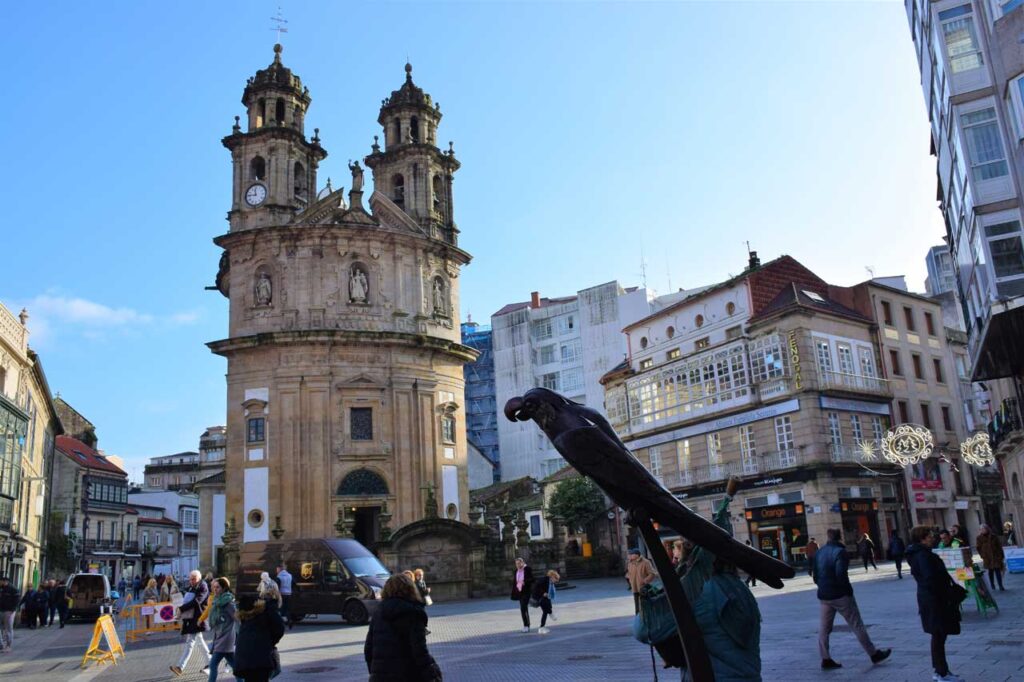
The Shrine of Our Lady of the Pilgrim Mother (Virgen de la Peregrina), built between 1778 and 1782, has become one of the most significant and emblematic buildings in the city of Pontevedra. The Portuguese architect Antonio Souto directed its construction with the collaboration of Bernardo José Mier.
One of the most distinctive characteristics of the sanctuary is its circular feature cause by its scallop-shaped plant, which is the symbol of the pilgrims, who make the Way to Saint James (Camino de Santiago). Besides that, two twin towers along with a bell one crowned the main facade. On the inside, its nave emulates the shape of a cross. Divided into two bodies, the lower and the upper, in the latter are the main door and a pair of enormous pilasters near the windows. More decorated than the lower one, its upper body with three arched niches for the figures of the Pilgrim Mother, Saint Roch, and Saint James.
The interior of the sanctuary is luminous and covered by a dome. There is also a font, made of a mollusk shell, for the holy water, which Méndez Núñez (1824-1869) brought from the Pacific. French pilgrims doing the Way to Saint James brought an image, which today preside the altar. Behind this, stands out the neoclassical altarpiece of the image of the Pilgrim Mother, created by Melchor Del Prado and Juan Pernas Gambino.
To learn more
The Shrine of Our Lady of the Pilgrim Mother is in the historic center of the city of Pontevedra, specifically in the Pilgrim Mother Square. As its name indicates, this sanctuary praises the Virgin of the Pilgrim, who is the patron saint of the Pontevedra province and of the Portuguese Way of Saint James. The tradition tells how this virgin pointed the way to the city of Santiago de Compostela to those pilgrims who arrived by sea and disembarked in Baiona.
Declared a historic-artistic monument in 1982 and a Site of Cultural Interest (BIC) in 2011, this temple is of a late baroque style of neoclassical forms. Erected in 1789 by Melchor Del Prado and Juan Pernas Gambino, its main altarpiece is of neoclassical style.
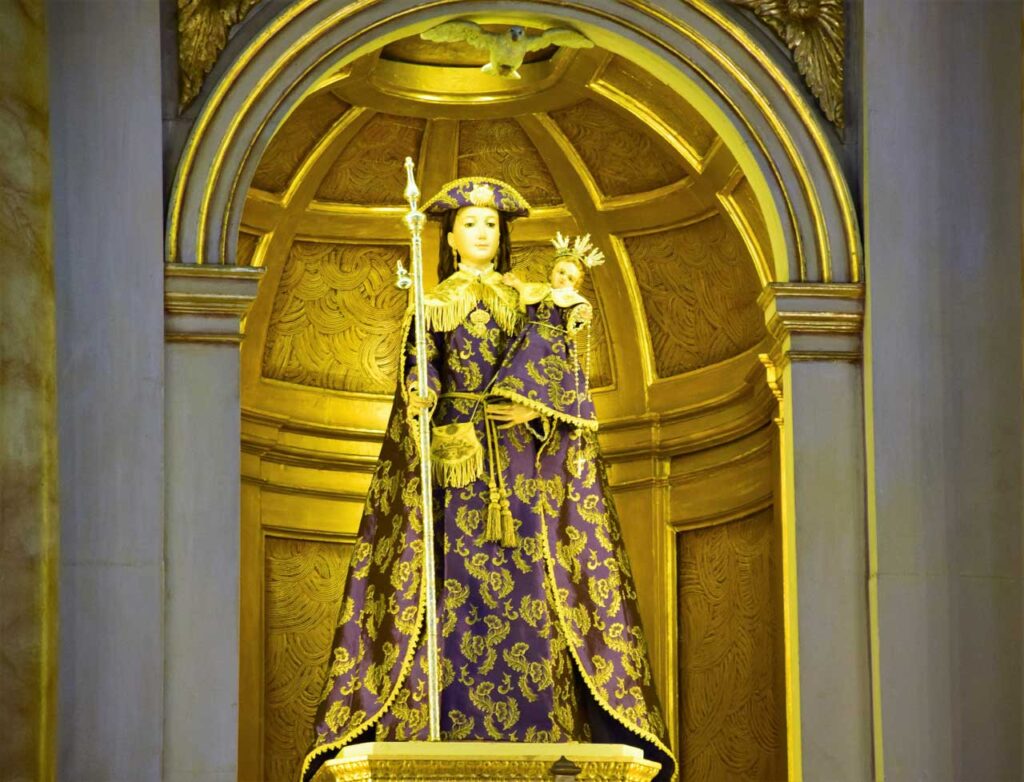
The Pilgrim Mother is the patron saint of the city; thus, this holds festivities in her honor. The celebration for the day of this virgin is on the second Sunday of August, during which her image leaves the temple in a procession. This is the only time of the year when the image of the Virgin gets out of the sanctuary, and for this event, they cover her in a gold and ivory dress embroidered by the Poor Clare nuns of Lugo. This image dates from the 19th century and is the work of the Catalan sculptor Luis Vermell. These festivities last seven days, during which there are concerts, shows, and an exceptional fireworks display
To know it better
Transformed throughout the years, the old quarter of Pontevedra has become one of the best-preserved old-towns in Galicia. This area has a stunning, well-maintained architecture that acquires value with the weight of its history.
At Pontevedras' historical center in the Pilgrim Mother's Square is the Shrine with the same name, built from 1778. This temple, whose architecture combines baroque and neoclassical styles, has a floor plan inspired by the shape of a scallop, symbol of the pilgrimage par excellence. Its main facade is the work of Antón Souto; its doorway holds the image of the Pilgrim Mother, patron saint of the Pontevedra province, dating back to the 19th century and declared a historic-artistic monument in 1982.
Located in the northwest of the Iberian Peninsula, Pontevedra is an administrative, monumental, tourist, and service city. A town of art and history, which has a monument's area that, after Santiago de Compostela, is the most significant in Galicia
Gallery
Location
- Town
- Pontevedra
- Municipality
- Pontevedra
- Province
- Pontevedra
- Country
- Spain
The asset
- Type
- Church
- Eco-destination
- Ría de Pontevedra
- Environment
- urban
- Relevance
- Internacional
How to get there
- Access
- By land
- Distance
- 0.700km
The visit
- Visitable
- Yes
- Accessible
- Sí
- Parking
- Sí
- Signposted
- Yes
Coordinates
- Latitud
- 42.43082500
- Longitud
- -8.64361300