


Sálvora Island. Seabed
About this heritage
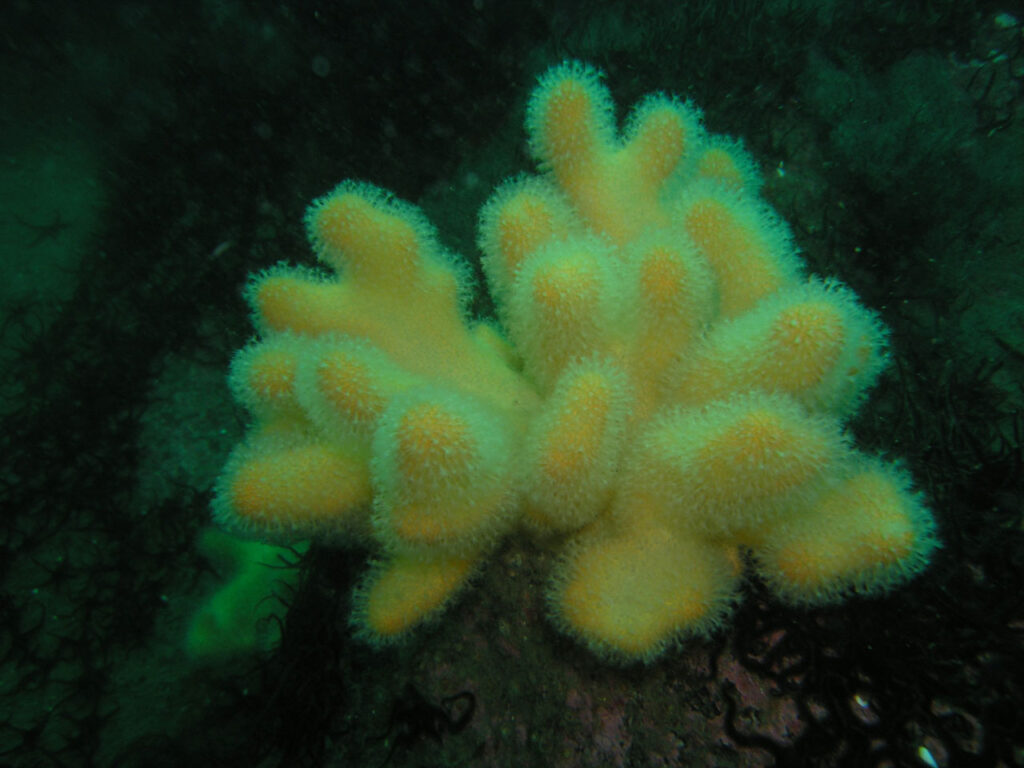
Sálvora belongs to the Terrestrial Maritime National Park of the Galicia’s Atlantic Islands (PNMTIAG) for its exceptional conservation values. The seabed surrounding it have high biodiversity and illustrate the Atlantic ecosystems. Within the National Park, the seabed represent 86% compared to 14% that constitutes the terrestrial part.
In Spain, there are 15 National Parks, and the two Terrestrial Maritime ones, currently existing, are the Atlantic Islands of Galicia and the Mediterranean Cabrera Archipelago.
There are different types of seabed depending on its substrates, such as rocky, sandy, and maërl seabed, this latter formed by calcareous algae - "Lithotammion corallioides" and "Lithotammion calcareum" or shell seabed formed by remnants of mollusk shells mostly bivalve and gastropods.
A specific type of seabed is the one formed by the Zostera Zostera Marina, which is a species of seagrass (eelgrass) of the family Zosteraceae of fibrous roots, stems with multiple branches, and narrow leaves. They are not specifically green algae but submarine phanerogams, belonging to the flowering plants.
It is typical of soft substrates (slits or shell) where it develops seagrass – underwater meadows – that are of great ecological interest.
In Sálvora, there is seagrass of Zostera near the Almacén beach, and in the entire National Park, it is the one with the highest values of coverage and density due to, for example, leaves width.
The seagrass of Zostera Marina harbor a huge biodiversity.
To learn more
There are different types of seabed according to its substrates, such as sand beds, Maerl beds (unattached coralline red algae), or gravel beds formed by remnants of shells, especially from bivalve mollusks and gastropods.
Crags (Rocky grounds) are areas highly populated by organisms capable of surviving the impact of the waves and the turbulence of water, which erodes and shapes the coast. It is saturated in oxygen with a lot of organic matter. These organisms have adapted developing protective features, such as the shells of periwinkles (small edible sea snails) or mussels, whose purpose is to prevent being crushed by the sea; and anchoring features to cling to the substrate, as in the case of algae or mussels whose purpose is not to be dragged by the currents.
Another type of seabed is composed of sand as a substrate.
Sandbeds originate in areas where the water loses strength and deposits the sandy sediments, which have been previously carried and eroded.
Maërl is a word of Breton origin referring to a type of seabed; hence, Maërl beds. They are formed by calcareous algae of arbuscules shape, which are nearly free and strongly calcified. The species that make them up are Lithotammion corallioides and Lithotammion calcareum.
Their shape and vertical accumulation offer an intricate network of shelters allowing seabed to shelter a great diversity of animals.
Therefore, in these seabed, there are populations of bivalves such as Banded carpet shell (Venerupis rhomboides), Rayed artemis (Dosinia exoleta), Queen scallop (Aequipecten opercularis) or St. James shell or Escallop (Pecten maximus).
In addition, one can find gastropods such as the Great Top Shell (Gibbula magus), the Hermit crabs of the species Paguroidea Anapagarus hyndmany, or the Long-clawed Porcelain crab (Pisidia longicornis). For its variety and abundance, also, stands out the polychaetes (worms) and small crustaceans such as amphipods and isopods; and among fish stand out the lances (Ammodytes tobianus) and the amphioxus (Branchiostoma lanceolatum).
At the European level, the Maërl beds are considered a coastal habitat of high ecological value for its high diversity of fauna and marine algae, as well as because they are areas of high productivity.
Gravel beds are formed by remnants of shells, especially from bivalve mollusks and gastropods. These remains form a layer several centimeters thick in which where most of the animals that live here are buried.
This substrate hides a varied fauna of bivalves such as:
Scallops (Pecten maximus): Variegated scallop (Chlamys varia), Banded carpet shell (Cerastoderma edule), Cockle (Cerastoderma edule), Atlantic jackknife clam (Ensis spp.), and Rayed artemis (Dosinia exoleta).
Cephalopods: Cuttlefish (Sepia officinalis) and Octopus (Octopus vulgaris).
Hermit crabs (Eupagurus spp.) and a variety of Polychaete worms, Echinoderms, and Sponges.
Ofiuras and Holothurians as well as Flatfish, rays (Raja spp.), and the Lesser weever (Echiichthys vipera).
To know it better
The island of Sálvora was a haven for pirates and buccaneers until the 19th century. Nowadays, it has a spectacular landscape, with beaches and dunes surrounded by marine flora and fauna. Different species stand out in addition to brown, green, and red algae. In the island's water and rocks, we can find, among others, crustaceans, cephalopods, echinoderms, mollusks, fish, pout, octopuses, sea urchins and starfish, sponges, spider crabs or mussels.
Ribeira is a county in the province of A Coruña that has one of the most important fishing ports in Galicia. It belongs to the region of North Arousa and is divided into the following areas: Aguiño, Artes, Carreira, Castiñeiras, Corrubedo, Oleiros, Olveira, Palmeira, and Ribeira.
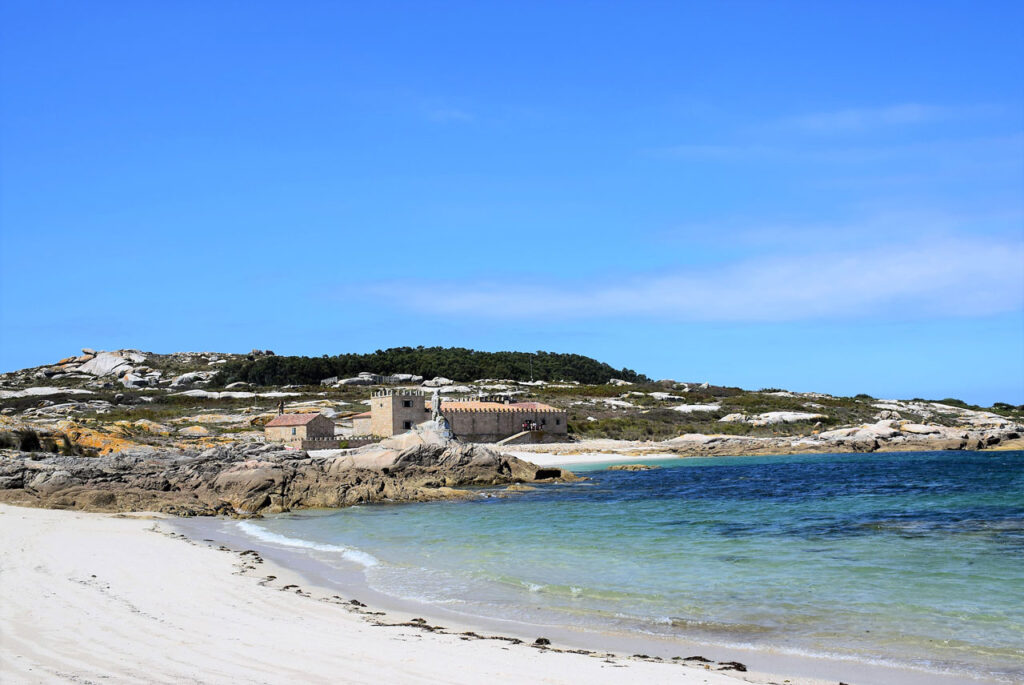
Facing the mouth of the Arousa estuary, right in the town hall of Ribeira, we find the Island of Sálvora. It is included in the National Park of the Atlantic Islands and is the only one that belongs to the province of A Coruña.
Gallery
Location
- Town
- Ribeira
- Municipality
- Ribeira
- Province
- A Coruña
- Country
- Spain
The asset
- Type
- Island
- Eco-destination
- Ría de Arousa
- Environment
- Natural
- Relevance
- International
How to get there
- Access
- By sea By land
- Distance
- 0 km
The visit
- Visitable
- Yes
- Interpretation
- Information panels and signage: The National Park has a welcome information panel in Sálvora at the end of the port. It contains a specific map of the archipelago, with points of interest and authorized itineraries, as well as a general map with the situa
- Accessible
- No
- Parking
- No
Coordinates
- Latitud
- 42.47431900
- Longitud
- -9.01269000