
Sanxenxo. La Dama de Silgar and Atlante´s sculptures
About this heritage
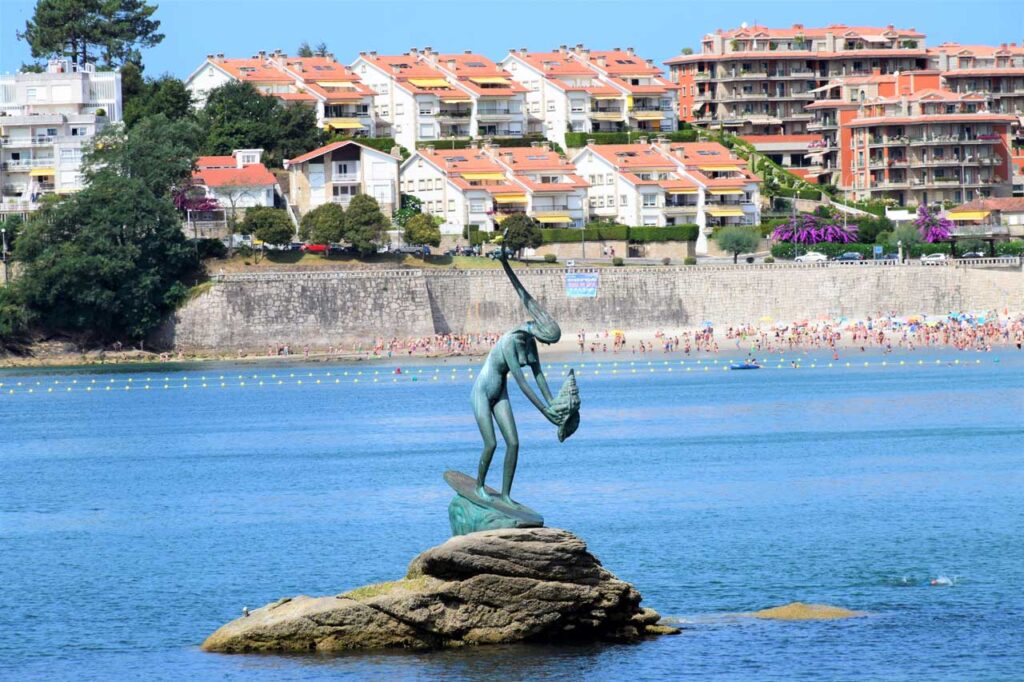
“La Dama de Silgar” (Silgar´s Lady) is an sculpture located in front of Silgar´s beach and at the beginning of the maritime walk. It is very popular in Sanxenxo, it´s an statue located in the middle of the sea which shows a naked woman with her weight on the surf board, it stands out the movement because it looks like the woman is offering a shell t someone that is looking form below or that she might be returning it to its original place. In the other hand, her hair is moving up in a gracile way giving more movement sensation, it also has horns in a ”V” style representing the initial letter of its sculptor’s surname. It is inspired in the Celtic mythology and it symbolizes the sea´s beauty.
The sculptor of this work is the Galician Alfonso Vilar Lamelas and it was donated in 1995 by its author as a gesture of affection to the village.
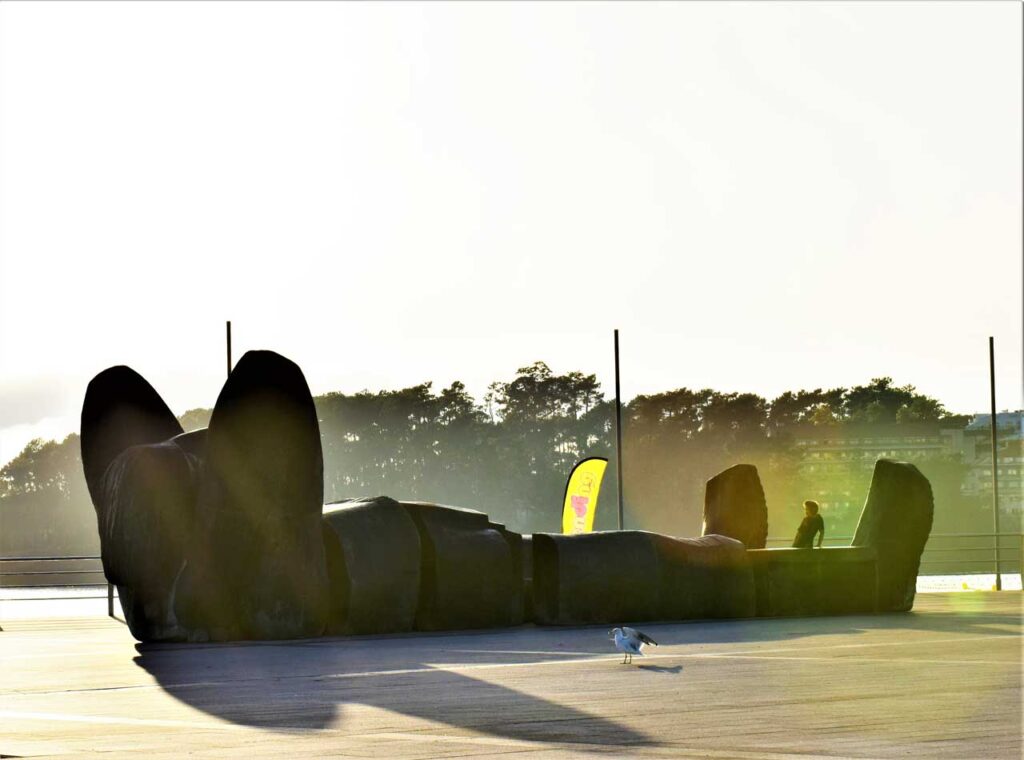
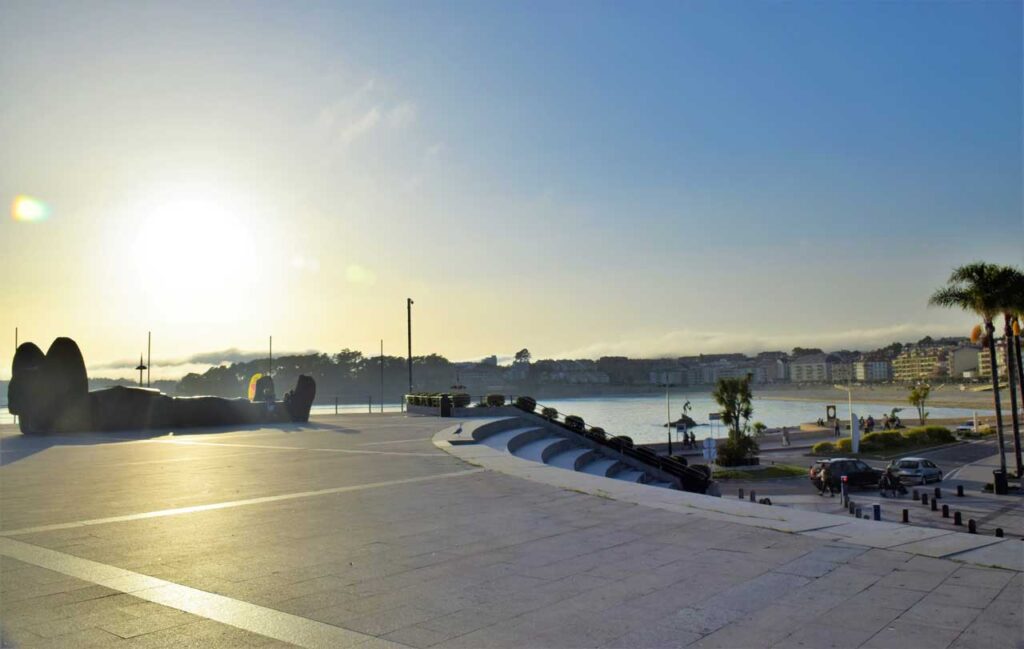
In the middle of Sanxenxo, in the Sea square, you can find another sculpture called “Atlante”. Is an anthropomorphic figure which stays laid, looking to the sky with his hands placidly intertwined on the back of his neck. It weighs about 20.000 kilos, it is 14 meters long and 4 meters wide.
The author of this great dimensions work is Francisco Leiro, its figure is more current that the Silgar´s Lady, but it looks older. It represents a sailor observing the immensity of the sky, in his torso it has a kind of small steps that serve visitors to climb until his abdomen, which is smooth and it allows people to take pictures and observe the sculpture from other angles.
To learn more
The coast of Sanxenxo and Portonovo stand out for their beaches, here we can find the Silgar beach which is a beautiful sandy area, surrounded by a great walk in the main centre of Sanxenxo, Baltar beach in a half Shell formation is also situated in the urban area. It is also of fine white sand, windy and with calm waters, it is an ideal beach to bath and practice water sports as jet sky and windsurfing.
Another beach is Caneliñas, which is located in an urban environment in the vicinity of Portonovo town, limited, on its left side by the Portonovo Viewpoint and on the right side by the Punta de Canelas, very tree-covered. It is a beach of fine white sand with a rocky stretch.
The beaches of Canelas and Pasariñas are located in an semi-urban environment, the Montalvo beach is situated in a rural area with fine white sand which forms soft dunes with scattered vegetation that delimit the beach of the nearby pine forest.
Between the beaches of Montalvo and Pragueira is the beach of Bascuas. Other rural beaches are in Major, characterized by its dunes complex that limits to its left with Punta Faxila and to its right with another rocky formation which separates Pragueira beach.
Without forgetting A Lanzada, one of the most emblematic galician beaches, in addition to being one of the longest with 2.5km, having a large dune complex and being located in a natural area, within the Natura Network 2000, it is part of the Umia-O Grove Intertidal Complex.
To know it better
Sanxenxo is a Galician municipality located in Pontevedra´s province. It is situated in the Val do Salnés region, on the coast of the Atlantic Ocean, in the estuary of Pontevedra and in the estuary of Arousa.
The name of this fishing village comes from San Ginés, who is the patron saint of the town. In 1842, the village was called Sanjenjo, in 1877 Sangenjo and finally in 1983 its name changed to Sanxenxo, which is how the village is currently called.
Sanxenxo has a beautiful beach and comfortable walk where we can find the sculpture of Silgar´s Lady. This work was made in April 1995 by Alfonso Vilar Lamenes and its located in the middle of the sea, on the “Corbeiro” stone.
Silgar´s Lady shows a naked woman on a surf board. The gesture evokes the offering of a large shell to someone who contemplates it from below, or simply the intention of returning it back to the ocean.
In the other hand, in the Sea square, the work of Francisco Leiro can also be found, known as the “Atlante” sculpture. This bronze sculpture weighs around 20.000 kilos and it´s 14 meters long. It represents a god that, according to Greek mythology, lived in the depth of the Atlantic.
Gallery
Location
- Locality
- Sanxenxo
- Municipality
- Sanxenxo
- Province
- Pontevedra
- Country
- Spain
The asset
- Type
- Monument
- Eco-destination
- Ría de Pontevedra
- Environment
- Urban
- Relevance
- International
How to get there
- Access
- By sea By land
The visit
- Accessible
- No
- Parking
- No
Coordinates
- Latitud
- 42.39847700
- Longitud
- -8.80667900