


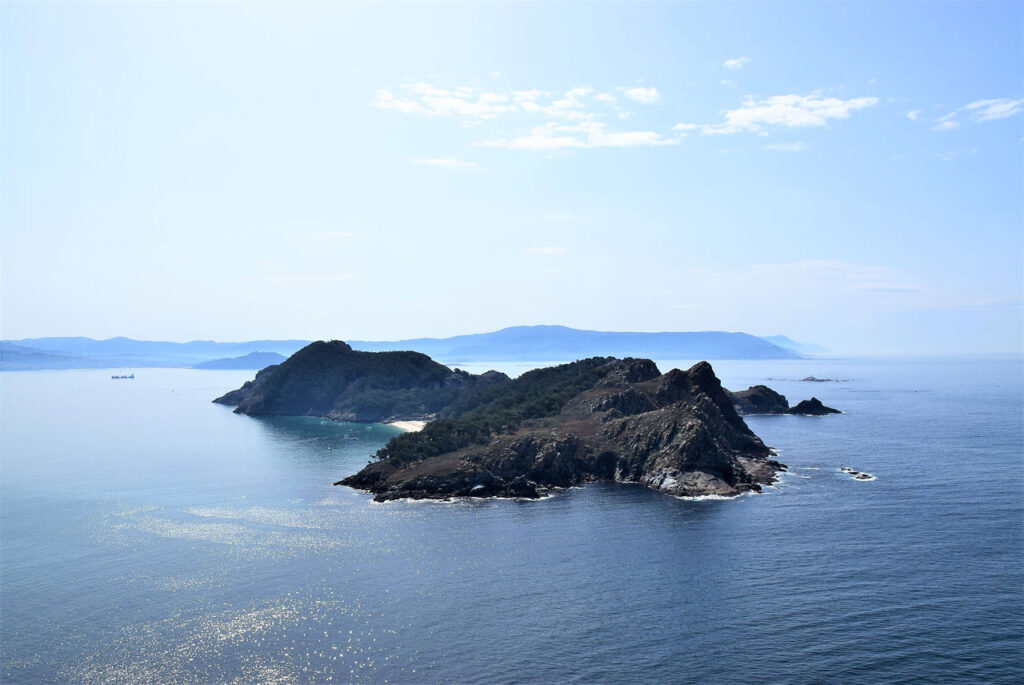
South of Cies Islands. Shipwreck Santo Cristo of Maracaibo (Holy Christ of Maracaibo)
About this heritage
The Santo Cristo of Maracaibo (the Holy Christ of Maracaibo) is a galleon belonging to the West Indies Fleet lost after the Battle of Rande in 1702 in the Vigo estuary. This galleon was taken by the English and loaded with the gold found in other previously captured galleons, but it sank when the English returned. Concerning this galleon's shipwreck, experts find it complicated to distinguish the facts from the legend. So much so, that many amateur divers and treasure hunters have made expeditions to locate it without succeeding. History attributes to the galleon 900 tons of gold as its content, and the exact location where it sunk is unknown, but what history indicates is that when the ship left Cíes Islands, it crashed and sank.
During the '50s, the legend revived thanks to the American diver John Potter, who with the rest of his team dived the south of Cíes Island; they focused on its vicinity, but did not investigate further. Subsequently, the Department of Naval Archaeology of the V Centenary dismantled the belief that the Santo Cristo of Maracaibo sank close to the coast since they examined all the logbooks of the English ships - accompanied the Maracaibo - finding evidence on board of the Monmouth, which led them to the conclusion that the shipwreck had happened in deep open waters far from the coast.
To learn more
The galleon belonging to the West Fleet of the Indies called the Santo Cristo of Maracaibo (Holy Christ of Maracaibo) was lost after the battle of Rande in 1702. The interest in discovering the ship's location lies in its valuable cargo, which had been loaded with 900 tons of gold, and believed to have sunk southwards of Cíes islands. The treasure legend has remained alive for several years, and countless expeditions have been conducted without success.
Between 1991 and 1993, Jean-Ives Blot and his team carried out one of these expeditions, which was sponsored by the Fifth Centenary State Society. On the part of the state, it was one of the largest investments made in the search for the galleons lost after the battle of Rande. Jean-Ives Blot and his team conducted a cinematic study of the area to learn the dynamics of currents and tides while other specialists investigated the journals on board the other more than 50 ships that witnessed the Santo Cristo de Maracaibo sinking on November 5, 1702. The discovery was made thanks to an underwater robot; which found a piece of wood at a depth of 560 meters. It was determined that it belonged to the same period as that of the Maracaibo; however, the government did not find it conclusive, so the legend continues.
To know it better
Cíes Islands, in the province of Pontevedra, have nine beaches of fine white sand and crystal-clear waters. Triangular in shape, Saint Martin (San Martiño) Island is one of the widest of the Cíes. Today, we can see remains of our Galician history as Saint Martin (San Martiño) hermitage or the pieces of the "Muíño do Limpiño" and reach the highest point of the South Island, Mount Pereira.
On October 15, 1702, the incidents that occurred in the Vigo estuary have left a few unknowns on our coasts. The larger cargo of America entered the estuary; it was made up of nineteen Spanish galleons escorted by twenty-three French warships. These vessels carried gold, silver, and other valuable goods. After several lootings and battles, millions of priceless objects were lost, and the rest fell to the bottom of it.
One of the sunken galleons, the Santo Cristo of Maracaibo (the Holy Christ of Maracaibo), is considered particularly special, as it held onboard a cargo valued at one million pounds. A multitude of objects was extracted from the Maracaibo, among others, tobacco boxes, dishes with trays, plates, cutlery, and candelabras; however, most of the treasures remain at the bottom of the sea.
Location
- Town
- Vigo
- Municipality
- Vigo
- Province
- Pontevedra
- Country
- Spain
The asset
- Type
- Island
- Eco-destination
- Ría de Vigo
- Environment
- Natural
- Relevance
- International
How to get there
- Access
- By sea By land
- Distance
- 0 km
The visit
- Visitable
- Yes
- Accessible
- No
- Parking
- No
Coordinates
- Latitud
- 42.176897
- Longitud
- -8.885529