
The Castro of the city (Castro de A Subidá) in Mogor
About this heritage
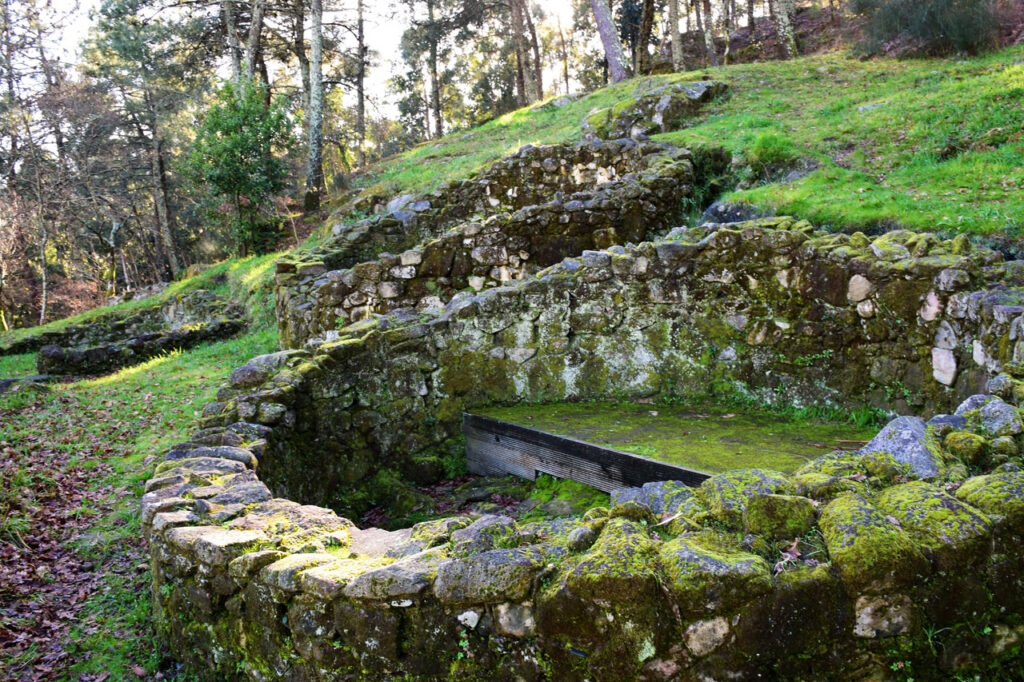
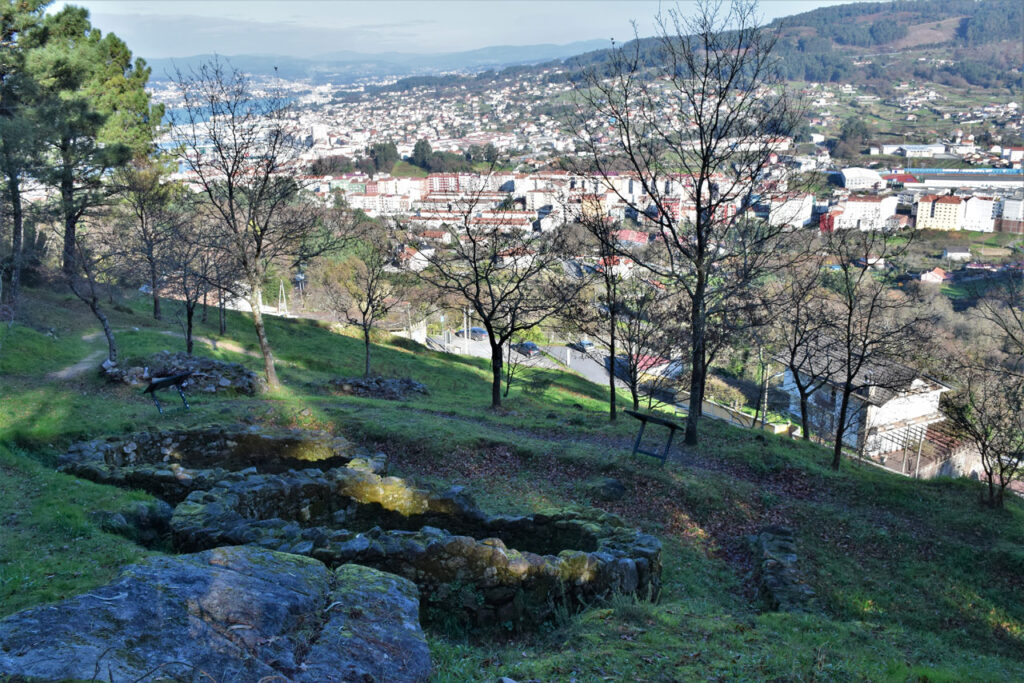
The Castro of “A Subidá” is a fortified settlement located on the Mount of the Seven Swords (Monte de las Siete Espadas) in Marín a Pontevedra's town. This Castro is also known as the Castro of the "Porteliña," it sits on a mound of steep hills allowing the visitor a privileged view of both the Marín town and the Pontevedra estuary.
The Castro occupies an area of approximately 30,000 m2; the percentage excavated is 1% allowing the uncovering of some circular houses and two rocky headlands, which might be two defensive towers. The abundance of materials was so high that there was no need to excavate to locate remains. The abundance of materials was so high that there was no need to excavate to locate remains. Today, many of these lay in the Provincial Museum of Pontevedra, but others were uncounted due to the clandestine and uncontrolled excavations.
Despite the multiple aggressions suffered, it is one of the best-preserved archaeological fortified settlements. At the end of the 19th century, parts of its double-walled enclosure were still intact, and by the beginning of the 20th century, some of its circular dwellings were still standing.
This settlement was inhabited from the 9th century B.C. to the 2nd century A.D.
This fortified settlement had many roman characteristics allowing us to date it between the 1st and 4th centuries A.D. Its economy was based on agriculture and livestock, complemented by hunting, fishing, and shellfishing.
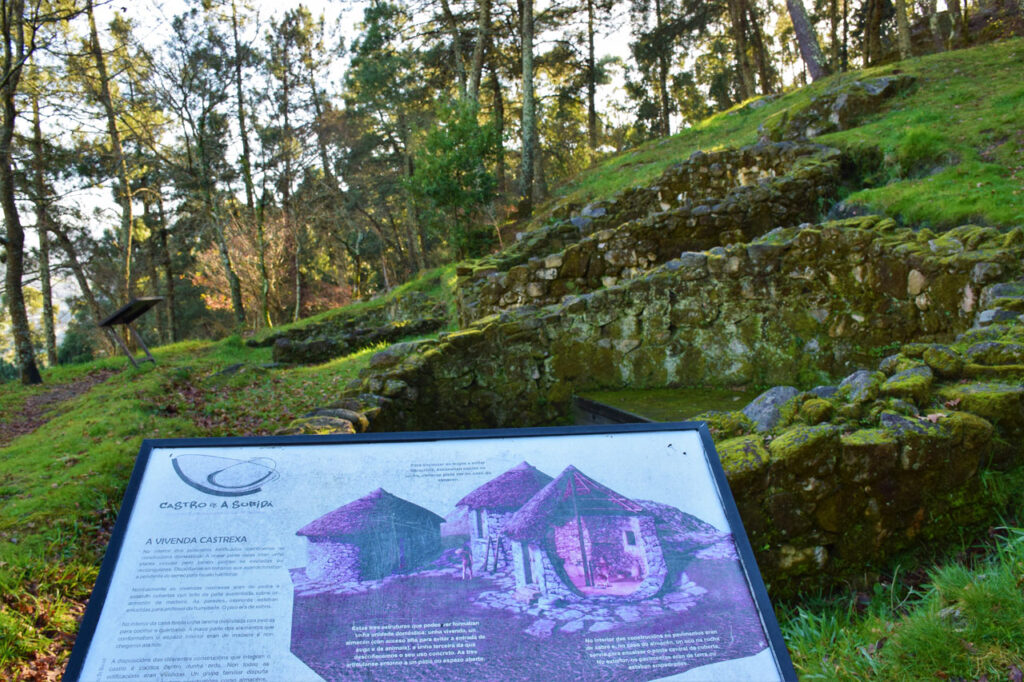
It is possible to visit this settlement because it is well signposted; it has detail information and graphs that thoroughly explain the life in the Castro and the culture of its people. The word "subidá" comes from the Latin "civitatem," related to the city, a toponymal used in many other sites of this type.
To learn more
A Castro is a fortified settlement in Roman Hispania. The "castrexa" culture in Galicia (culture of the Galicians living in ancient fortified settlements) covers a long period from the Iron Age (6th century BC) to the 6th century AD.
The Castros were located in strategic places with exceptional views; they are fortified towns in which the old inhabitants of Galicia lived and took refuge in time of war. It was believed that by being in elevated areas facilitated connections with heaven, with the afterlife.
Formerly, it was believed that the Celts were the inhabitants of the Castros, people coming from the banks of the Caspian and the Caucasus, who also brought us the technique of iron. Currently, we can no longer maintain this Celtic exclusivity of the Castrexa population, and we have to consider it as a racial mixture between the autochthonous element and the new Celtic arrivals.
Besides the Castro of "A Subidá" - the best preserved despite the multiple aggressions suffered, in Marín, we have others, such as Bearded Castle (Castelo Barbudo) in Pardavila-San Xulián parish, the Castle of Ardán in Ardán, and other possible Castrexos settlements in Pedreiras (O Campo), Penizas (Currás), Sobareiro (Loira), and Castro (Seixo).
In Mogor, one can enjoy the Beach of Mogor, a shell-shaped 400-meter long with fine and golden sand beach protected by a leafy forest. The beach offers multiple services, such as less than 500-meter bus stops, bar and restaurant, parking, showers, ramps for disabled access, and bathrooms.
Nearby are the petroglyphs of Mogor, where visitors can appreciate a panoramic view of the estuary and the island of Tambo.
To know it better
Marín was known as "Saint Julian of the anchored" (San Xiao de Ancorados) because of the ships that anchored around it. This marine county belongs to the province of Pontevedra. It is located in the south Estuaries (Rías Baixas) of Pontevedra, more specifically, in the Estuary with the same name, the Estuary of Pontevedra. Thanks to its location, the port of Marín has quality marine products, among others, crayfish, sole, sea bass, turbot, cuttlefish, octopus, sardines, spider crabs, velvet crab, and clams.
In Marín, there are different ancient settlements, such as Castro of the "A Subidá," - "A Subidá" comes from the Latin word "civitatem" meaning "city" - also known as the Castro of the Porteliña. This fortified settlement is situated on one of the slopes of Mount Portal (Monte da Portela) and was occupied from the 9th century BC to the 2nd century AD.
Today, we have information about discoveries made of some circular houses built between the 1st century BC and the 1st century AD. We can also find some petroglyphs from the Bronze Age; that is, drawings and engravings on the stones of circular, quadrangular, and elliptical combinations.
Gallery
Location
- Town
- Mogor
- Municipality
- Marín
- Province
- Pontevedra
- Country
- Spain
The asset
- Type
- Castro
- Eco-destination
- Ría de Pontevedra
- Environment
- Rural
- Relevance
- Regional
How to get there
- Access
- By sea By land
- Distance
- 4,000 km
The visit
- Visitable
- Yes
- Interpretation
- Currently the site has been valued with signs and information on the Castrexa culture and the Castro itself.
- Accessible
- Sí
- Parking
- No
Coordinates
- Latitud
- 42.38230300
- Longitud
- -8.70869300