
The Isle of Tambo and the Cassiterides
About this heritage
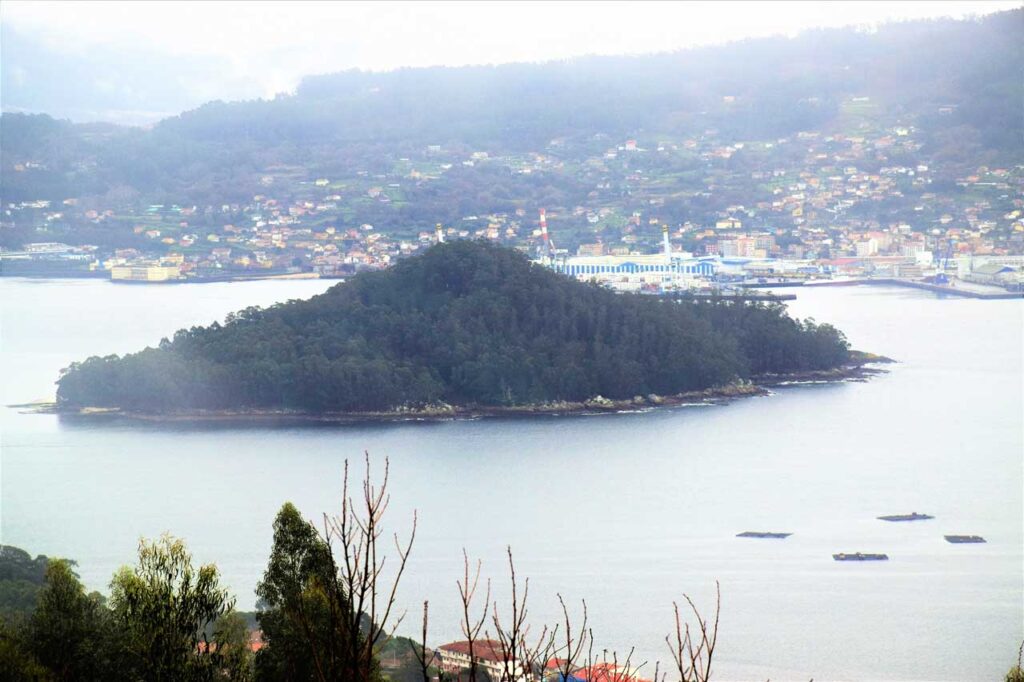
The isle of Tambo, part of the Ministry of Defence, presides the Pontevedra estuary, between the municipalities of Marín and Combarro, although administratively speaking, it belongs to Poio. This, virtually dream island, oval and pyramidal in shape, treasures a long history and holds many legends. One of the legends relays the story that Saint Fructuosus travelled on foot from there to Poio. There he founded the well-known medieval Benedictine monastery of San Xoán, declared an Historic-Artistic Monument.
For years, Tambo was sought out by pirates. The island monastery was destroyed by the unpopular pirate Drake, who attacked it several times. However, the old monastery church dedicated to St. Michael and its beautiful fountain, are still standing.
To learn more
The history of the island, however, dates back many centuries. The first indication of Tambo's inhabitance can be found on the peak of this pyramid-shaped island, where castro (ancient fortification) remains of the Iron Age can be found. Due to its geographical location, it is an ideal place to cast anchor. This could be the reason for which, in ancient times, it was one of the most sought out islands of the Cassiterides.
Cassiterides is the name given by the Greeks to the production of tin (kassiteros) islands situated at the West Coast of Europe. Pliny the Elder, in his 'Natural History', points out that the first Greek to reach the Cassiterides was Midwritte, an individual of whom nothing else is known. Historians and geographers such as Ptolemy, Herodotus and Strabo also allude to these rich islands, which the 18th century Galician geographer José Cornide, undoubtedly situates on the Altantic coast of Galicia. It is believed that the Phoenicians were already aware of tin route or Cassiterides. These were routes that the Carthaginians would have kept hidden until Roman times, given their great importance. According to Cornide, Sálvora would have been one of these ten mythical islands.
Herodotus, when referring to the boundaries of the western world in his III book of “History” mentions the Cassiterides and identifies these as island from which Greek tin came from, although he acknowledges that he cannot confirm its existence. Strabo, in his “Geography”. Strabo, in his "Geography", affirms that these are ten islands located near the port of the artabros (which inhabited the region around present-day A Coruña) and maintains that the Phoenicians were the first to arrive there. He also refers to how the Romans insistently attempted to reach the Cassiterides Islands, but when the Phoenician ships sailing the ocean towards the Galician coasts discovered that they were being followed, they had their boats grounded in order to preserve the secret of the route. The Greek mathematician, geographer and astronomer Ptolemy also mentions them.
From Aveiro's work "Ora marítima" (4th century B.C.), which relates the maritime feats of the Phoenicians 800 centuries ago, the main archaeological school of thought identifies their exact location in Brittany or the British Isles and that Phoenicians trading throughout the northwest of the Iberian Peninsula was a step ahead toward the Cassiterides. Today, however, archaeological data seems to indicate otherwise. There is no Phoenician evidence either in French Brittany or Great Britain, while in Galicia there is. The richness of tin in the Galician estuaries and the numerous samples of important metallurgical activity in the transition from Bronze to Iron seem to prove it.
The Galician geographer, naturalist and humanist José Cornide de Saavedra y Folgueira (A Coruña, 1743-Madrid, 1803) defends the geographical situation of the Cassiterides on the Galician coasts, known since ancient times for their abundance of mines, and points out that the Phoenicians traded with the inhabitants of Galicia. The geographer based this on the texts of classical historians and geographers and identifies these islands in "the lowlands of Corrubedo, the islands of Sálvora, Arousa, Cortegada, Grove, Ons and Cíes, Baiona, and smaller ones of the Arousa Estuary".
To know it better
Located in the province of Pontevedra, the island of Tambo is situated between the towns of Marín and Poio, covering a surface area of 28 hectares. It was initially denominated Thalavo, Tanavo and Toambo, although it is connected to the Latin word tumulus or Greek word tumbos, in relation to the island’s circular shape.
The different investigations place the first settlements on the island in the Iron Age, as there are ruins of the castra settlements at the top of the island. The castro culture was characterized by its circular constructions and rampart remains, which served to protect the village.
Furthermore, Tambo may have been part of the Cassiterides Islands, which was the name the greeks gave the Tin islands. Since the Bronze Age, tin was a required metal, together with copper, for the production of bronze, thus allowing for utensils to be made from a more resistant metal. The Phoenicians were aware of the importance of tin, which they went in search for through the Mediterranean.
Gallery
Location
- Town
- Poio
- Municipality
- Poio
- Province
- Pontevedra
- Country
- Spain
The asset
- Type
- Island
- Eco-destination
- Ría de Pontevedra
- Environment
- Natural
- Relevance
- National
How to get there
- Access
- By sea By land
- Distance
- 0 km
The visit
- Accessible
- No
- Parking
- No
Coordinates
- Latitud
- 42.41143800
- Longitud
- -8.70893100