


Tui. Mount Aloia Fortress. Mount Aloia Natural Park. Petroglyphs and Traditional Galician Fortress (Castro)
About this heritage
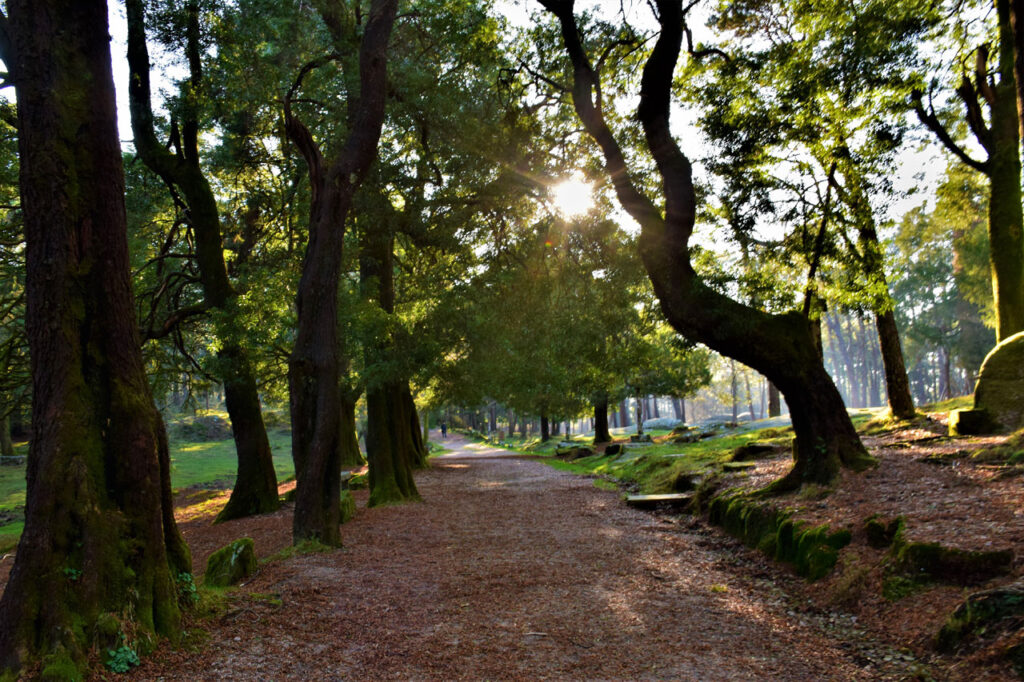
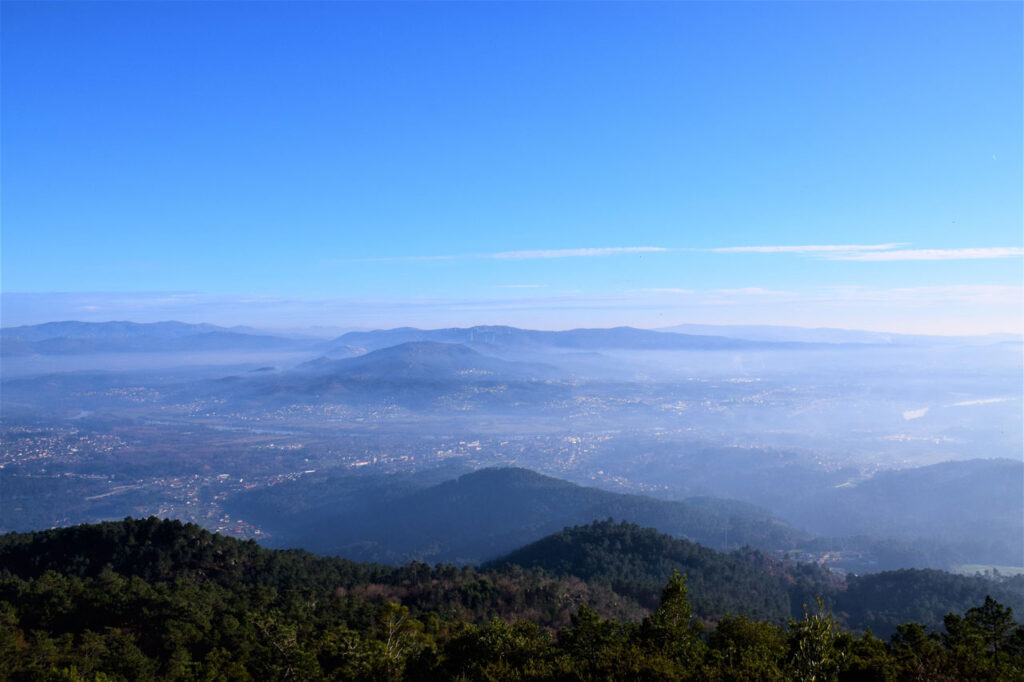
In Galicia, there are six Natural Parks distributed throughout the community, and Mount Aloia is one of them. Founded on October 4, 1978, it was the first Natural Park of Galicia. It has an area of 746.29 hectares and has five viewpoints, where one can enjoy exceptional panoramic views of the landscape.
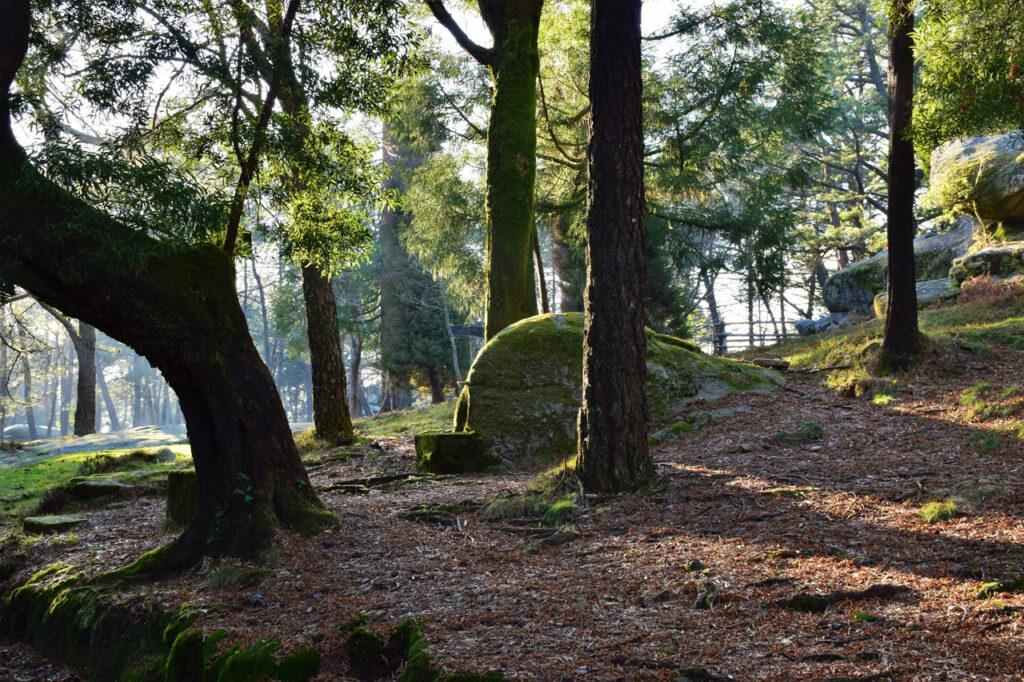
Located at the southern limit of the Galiñeiro mountains, it rises to 629 meters at the top of Saint Julian (Xiao), forming a watchtower. It has a wide network of trails, such as the Botanical Path, os Muiños de Tripes, Rego da Pedra, Muiños de Paredes, Cabana-cabaciña, and Castro dos Cubos. These pass through mills, traditional irrigation systems, Celtic-like settlements, and oak woods show the natural and ethnographic heritage of the Natural Park.
Aloia is also within the Natural Network 2000 declared as Special Conservation Zone ZEC Monte Aloia, for its natural areas as shrub habitats and alluvial forests. Its abundant flora and fauna stand out, among others, the common bent-wing and lesser horseshoe bats (Miniopterus schreibersii and Rhinolopus hipposideros ), the marsh fritillary (Euphdryas aurinia), the stag beetle (Lucanus cervus) or the cyclamen-flowered daffodil (Narcissus cyclamineus).
At the beginning of the 20th century, the mountain was completely deforested. The landscape underwent a great transformation thanks to the forest engineer, Rafael Areses, who persuaded the locals and various authorities to replant with trees. Although the intention was good, most of the replanting was through foreign species with invasive behavior, such as the Australian Blackwood (Acacia melanoxylon). However, because of its denomination as a Natural Park since 1978, large areas recovered, becoming an indigenous Galician forest, currently with numerous species of fauna and flora.
The Visitors' Center is located inside the park since 1998. It is an old forest house built in 1921 by the engineer Areses. Here, one can appreciate an exhibition on the evolution of the park, its conforming natural elements, and ethnographic material.
To learn more
It seems that, in Monte Aloia, there were settlements already from the Palaeolithic because the orography of the mountain allowed the protection and sustenance based on hunting and gathering.
Between the Neolithic and the Age of Metal, they built their villages on soft terrains and protected slopes as well as burial mounds, such as the remains of the "Mámoas da Chan Longa." From this period, there are also stone engravings and petroglyphs like those of A Macoca in Tui.
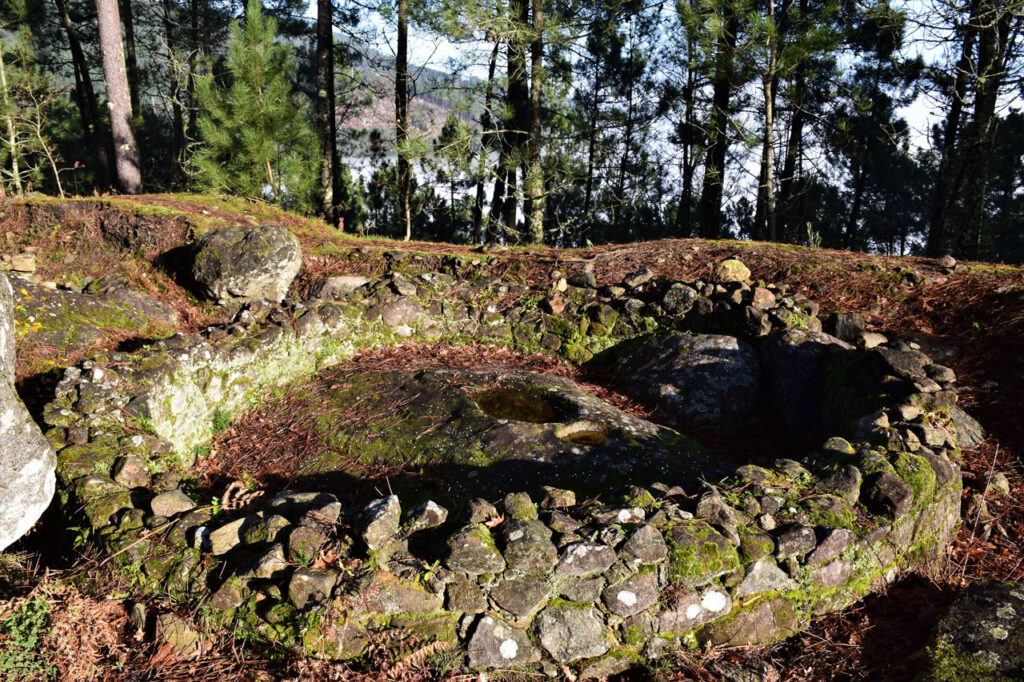
The fortified Celtic-like settlement of "Alto dos Cubos" dates back to the Iron Age, which consists of several circular constructions, some of which have an extension as a vestibule or lobby at the entrance. Several remains of this settlement were found and are exhibited in the Monte Aloia Nature Class.
In further excavations, they found remains of a variety of ceramic material, different pieces, such as mooring bollard (bolardos de amarre o "amarradoiros"), mortars ("morteiros"), and hand mills. These foundings confirmed that the settlements underwent a Romanization process.
In the 5th century A.D., the Germanic invasions occupied the Roman territory, and it is in this context that the great wall was built in Monte Aloia. Apparently, the Galician-Roman population took refuge behind the wall on the Suevi, invading Germanic tribe, arrival. That imminent danger clarifies this rough structure despite having knowledge of construction techniques, which they had acquired during the Roman Empire.
Called cyclopean because of the size of the rocks, it has a length of more than three kilometers and contains about 30 hectares, making it one of the largest walled enclosures in Galicia.
To know it better
In 1978, Tui declared Mount Aloia, the first Natural Park in Galicia. It comprises prehistoric and Roman remains, such as Castro Alto dos Cubos. In this enclave, one can enjoy different hiking routes, which gives a clear idea of the houses' distribution. In this green mountain, several streams rise to meet the Miño River.
There is also a wall or fortress dated between the 5th and 8th centuries A.D. It could be from the Roman Empire and the barbarian invasions even though experts are not entirely certain. The fortress of Mount Aloia is three kilometers in length and considered one of the main high-rise fortified enclosures in Galicia.
Tui is a Galician county in the eastern part of the lower Miño region, in the province of Pontevedra. This town stands out for its proximity to Portugal, for being an episcopal city and for having one of the most famous cathedrals in Galicia, the Cathedral of Santa Maria de Tui.
Gallery
Location
- Town
- Tui
- Municipality
- Tui
- Province
- Pontevedra
- Country
- Spain
The asset
- Type
- Fortress
- Eco-destination
- Río Miño
- Environment
- Natural
- Relevance
- International
How to get there
- Access
- By sea By land
- Distance
- Distancia 7,3 km / 16 minutos en coche
The visit
- Visitable
- Yes
- Accessible
- No
- Parking
- No
- Signposted
- Yes
Coordinates
- Latitud
- 42.07560700
- Longitud
- -8.67996000