
Tui´s Port. Tui´s International Bridge
About this heritage
Tui´s International Bridge was inaugurated in 1886 by the engineer Pelayo Mancebo de Agreda, from La Rioja. But, to prevent the spread of diseases it was not used until two years later.
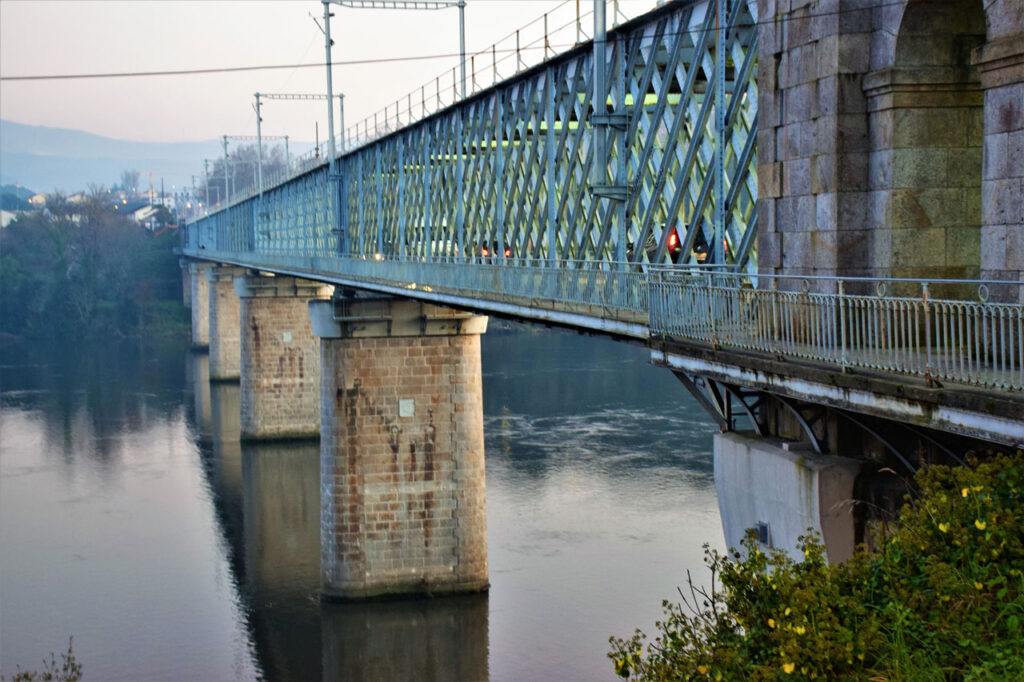
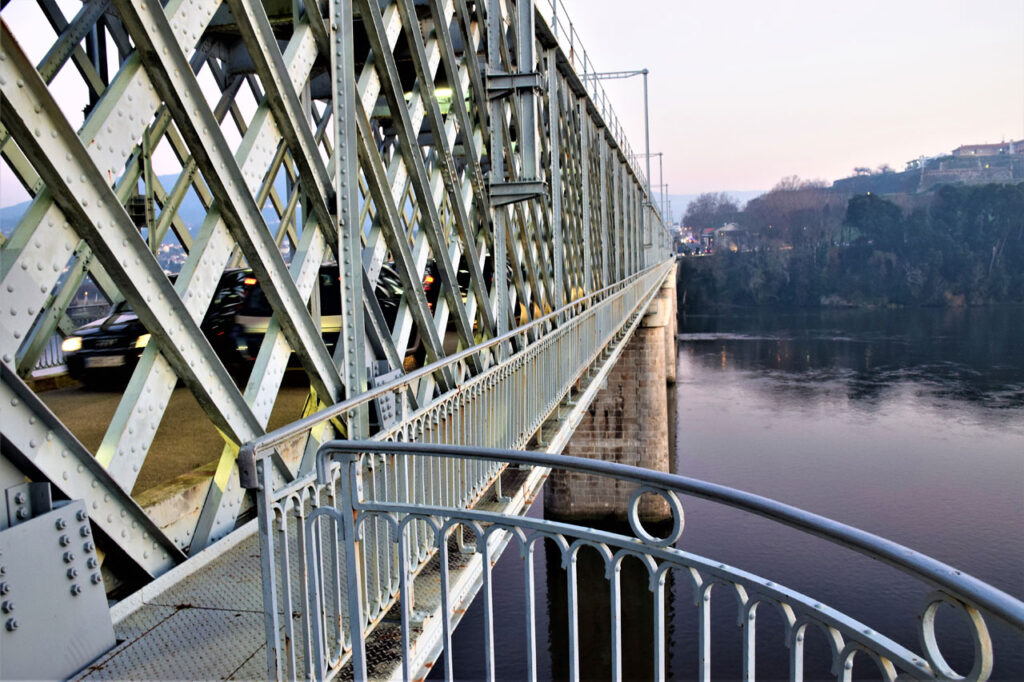
It is built on the river Miño, which acts as a natural border between the neighbouring country of Portugal. It connects both countries by road and rail, which is still in use. It consist of a metallic, lattice-like structure in a box shape resting on thick stone pillars.
The authorship of the viaduct was attributed, by the time and by similarities with the French welding system, to the famous Eiffel, however, it was made by his discipline, the engineer Pelayo Mancebo de Agreda.
This international bridge allows access to the thousands of pilgrims who make the Portuguese variant of the Way of Saint James, thus, beginning the first stage of the Way in the Spanish territory.
Due to the increase in communications with the Portuguese country and because the width of this bridge is not enough, it was necessary to build another connection, so, since 1993 a new bridge that links both banks has been operating. It consists of two independent twin structures with two lanes in each traffic direction.
It is possible to navigate through the Miño river in its last 30 kilometres, which would be from its mouth until Tui - where the Tui´s Fluvial-Marina is located-. It is located very close to the Parador and its navigability is characterized by the changing depths and currents, as the tides can be felt about 40 kilometres upstream with a flow variation of, more or less, two meters between high and low tide.
To learn more
The international bridge was conceived due to the need to connect the Vigo-Ourense line with the Portuguese line from Porto-Valença and it has been used for more than 130 years without interruption.
It is a road-rail structure that has the particularity of allowing the passage of vehicles, people, and railways together. The design of the project fell to the engineer Pelayo Mancebo y Agreda. The work was awarded to the Belgian company “Societè Anonyme Internationale de Construction et d´Entreprise des Travaux Publics Braine-le-Comte”, which introduced reforms in the original project, such as the replacement of metal pillars with other made of stone. The engineers, also Belgian, Eugène Rolin Auguste Cazaux, together with the Galician Andrés Castro Teijeiro, were in charge of directing the works.
The duration was from November 1881 to October 1884, a total of 34 months. The resistance test were carried out afterwards and the official inauguration was held on the 25th of March, 1885.
Mancebo, native from Calahorra, was born in 1845 into a family of land-owners. He obtained the title of civil engineer in Madrid in 1868.
While he was the chief engineer of the Railway Division in Ourense, he was appointed to head one of the star projects of Alfonso XII. It would be the bridge that would link Galicia and Portugal. It was a joint decision agreed by the governments in Madrid and Lisbon.
For years, the authorship of the bridge design was wrongly attributed to Eiffel, as Mancebo, a faithful follower of the Eiffel current, was inspired by the metal structures of the French master. This international bridge allows access to thousands of pilgrims who make the Portuguese variant of the Way of Saint James, thus beginning the first stage of the same, in Spanish territory.
To know it better
Since the 1st of February 2005, the municipality of Tui has had the San Telmo Sailing Club as its fluvial-marina. It is located in the biggest Galician river, the Miño, which is navigable until Tui. These facilities provide service to small boats and, in addition, the Club offers a wide range of water activities for all ages to enjoy the river.
Tui and Valença do Minho (Portugal) are two towns connected by the Tui International Bridge, as it links the two banks of the Miño river. The construction of this bridge dates back to 1884 and, according to legend, was carried out by a disciple of Eiffel, although, in reality, its engineer was Pelayo Mancebo. It is a bridge with long metal structure that rests on thick pillars.
Tui is a Galician city located in the eastern part of the Baixo Miño region, in the province of Pontevedra. This municipality stands out for its proximity with Portugal and for the passage of the Miño.
Gallery
Location
- Locality
- Tui
- Municipality
- Tui
- Province
- Pontevedra
- Country
- Spain
The asset
- Type
- Bridge
- Eco-destination
- Río Miño
- Environment
- Rural
- Relevance
- International
How to get there
- Access
- By sea By land
- Distance
- Distancia 3,2 km / 10 minutos en coche
The visit
- Accessible
- Sí
- Parking
- Sí
- Signposted
- Yes
Coordinates
- Latitud
- 42.03623300
- Longitud
- -8.64669400