


Vilagarcía de Arousa. Petroglifos de os Ballotes
About this heritage
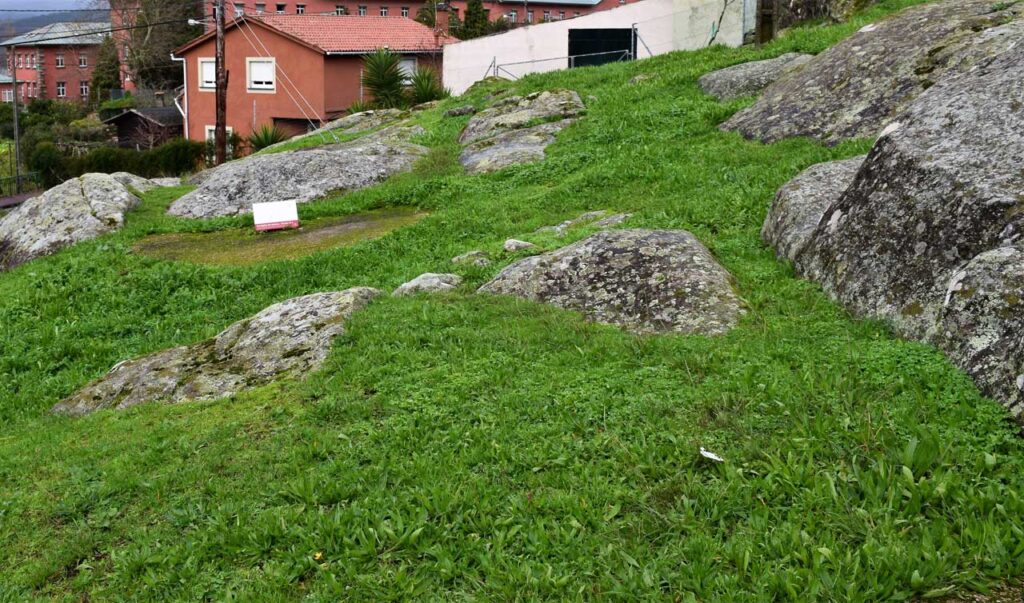
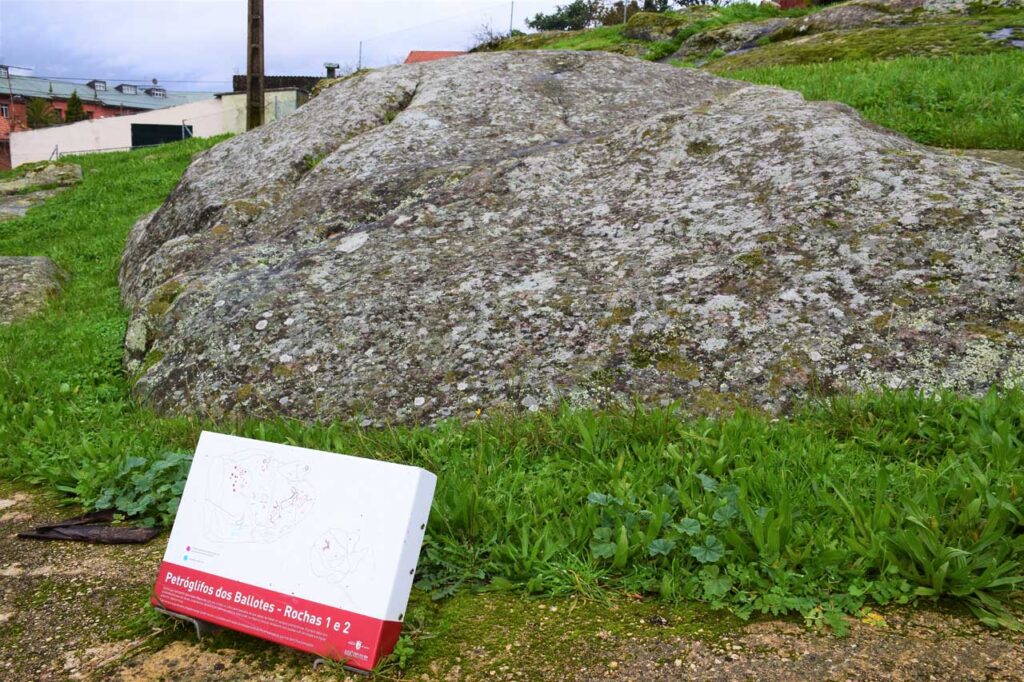
Vilagarcía de Arousa has one of the most studied and important rock art ensembles in Galicia. Discovered in the early 20th century, these petroglyphs are located in the parish of San Xens de Bamio, near the estuary shore. Engraved on granite, they date back to the Bronze Age, with an age between 4,000 and 5,000 years.
In this set of figurative engravings, we observe a large number of zoomorphs, among which deer stand out. According to the report of the work carried out during their discovery: they appear as figures of different sizes and shapes, especially cervids with large antlers: static or in motion. There are also scenes of animals in rutting behavior and compositions in which the quadrupeds are arranged linearly. Others depict deer dragging possible solar discs and one that could represent an equestrian scene.
In the section of geometric petroglyphs, the composition of the "Pedra do Encanto" in Meadelo stands out for the complexity of its design. It is the northern area of the ensemble: about a dozen cup marks of different sizes without a specific geometric arrangement. It is worth highlighting the existence of a natural basin with an irregular circle next to it, inside which there are three more cup marks. Besides this site, nearby along the path to Rianxo, there are others that also served as a base for various rock art engravings.
It is recommended to visit these petroglyphs at sunset; experts indicate that this is the ideal time to discover the engravings thanks to the play of light and shadows, which helps better visualize the representations of circles or the different animals.
To learn more
The Rías Baixas have provided endless wealth to the peoples who have inhabited their shores over the centuries. This is the case of the Ría de Arousa which, besides being a natural source of resources for its inhabitants, has left archaeological remains of the castro culture. Right in the inner coastal strip of the estuary, we find one of the most valued and studied rock art ensembles in Galicia; these petroglyphs are located in the parish of San Xens de Bamio and are called Os Ballotes.
Discovered in the early 20th century, they date back to the Bronze Age, with an age between 4,000 and 5,000 years BC. The documentation of the engravings on these stones records seven sites composed of fifteen rocks, featuring a great variety of geometric shapes and animals. It is precisely this great diversity in their themes that has sparked greater interest among specialists. Of the seven now documented sites, only one remained unpublished until now. It is a large rock where the drawings were hidden by soil and vegetation protecting it. Others, although already known, had never been subjected to thorough documentation work.
Os Ballotes contain a large number of zoomorphs, among which deer stand out; figures of different sizes and shapes appear, cervids with large antlers, static or in motion. Scenes of animals in rutting behavior and compositions in which quadrupeds are arranged linearly. Other depictions of deer dragging possible solar discs attract attention, and there is also one that could represent an equestrian scene. In the section of geometric petroglyphs, the composition of the "Pedra do Encanto" in Meadelo stands out, leading for the complexity of its design. Some of the engravings were made with a stone chisel and others with a metal punch, suggesting they were created by different artists at different times.
In the northern area of the ensemble, animal figurative art is replaced by the symbolism of circles. About a dozen cup marks of different sizes without a specific geometric arrangement. Among them, a natural basin with an irregular circle that contains three more cup marks inside. In the vicinity of Os Ballotes and up to Xiabre or Rianxo, there are other remains that also served as a base for this type of rock art.
The choice of location was not random; it does not stand out in the landscape, although from there we can admire the surroundings, as is the case of Os Ballotes, which experts recommend visiting at sunset. It is often associated as a place suitable for hunting, a sign of a nearby spring, or a geographical boundary for a cultivation area.
To know it better
San Xens de Bamio is a parish in the municipality of Vilagarcía de Arousa, belonging to the province of Pontevedra. This locality has petroglyphs dated thousands of years ago. These petroglyphs are engravings on rocks that usually represent figures and/or drawings of animals.
In this Vilagarcía parish are the petroglyphs of Os Ballotes, engraved on granite from the Bronze Age, with an age between 4,000 and 5,000 years. They were discovered in the 20th century and have been one of the most studied and well-known rock art ensembles in Galicia. On one of the rocks, three animals can be seen moving forward. The second engraving is anthropomorphic, that is, with a human appearance. The last has been classified by specialists as a recreation of the Solar System.
Gallery
Location
- Town
- Bamio
- Municipality
- Vilagarcía de Arousa
- Province
- Pontevedra
- Country
- Spain
The asset
- Type
- Petroglyphs
- Eco-destination
- Ría de Arousa
- Environment
- Rural
- Relevance
- International
How to get there
- Access
- By sea By land
- Port
- Puerto de Carril
- Distance
- 2,3 km / 7 minutos en coche
The visit
- Visitable
- Yes
- Accessible
- No
- Parking
- No
Coordinates
- Latitud
- 42.62283700
- Longitud
- -8.76601200