


Vilanova de Arousa
About this heritage
To carry out the mussel farming process, besides the rafts, it is necessary to use auxiliary material with machines such as the splicer, which facilitates the assembling of the ropes by introducing the "sticks." It consists of a double rod that penetrates the rope to open it in two and allows the toothpick insertion.
The shelling machine separates the mussels from its set, cleaning them from the associated flora and fauna, and classifying them by size. The machine models vary, from the selection table ones, where the mussels are separated by hand, to the cylindrical ones that shell and classify at the same time while a jet of water eliminates the sediments of the accompanying fauna.
The stringing machine (stringer) makes it easier to gill the mussels on the rope. In essence, it consists of a hopper, where the clean mussel coming from the shelling machine is deposited, a channel, through which the rope is passed, and a mechanism that incorporates the cotton net around the mussels. The most important quality of these machines is their degree of precision supplying the desired quantity of mussels or meters of rope, which leaves the operator's job as a simple control task with no direct action.
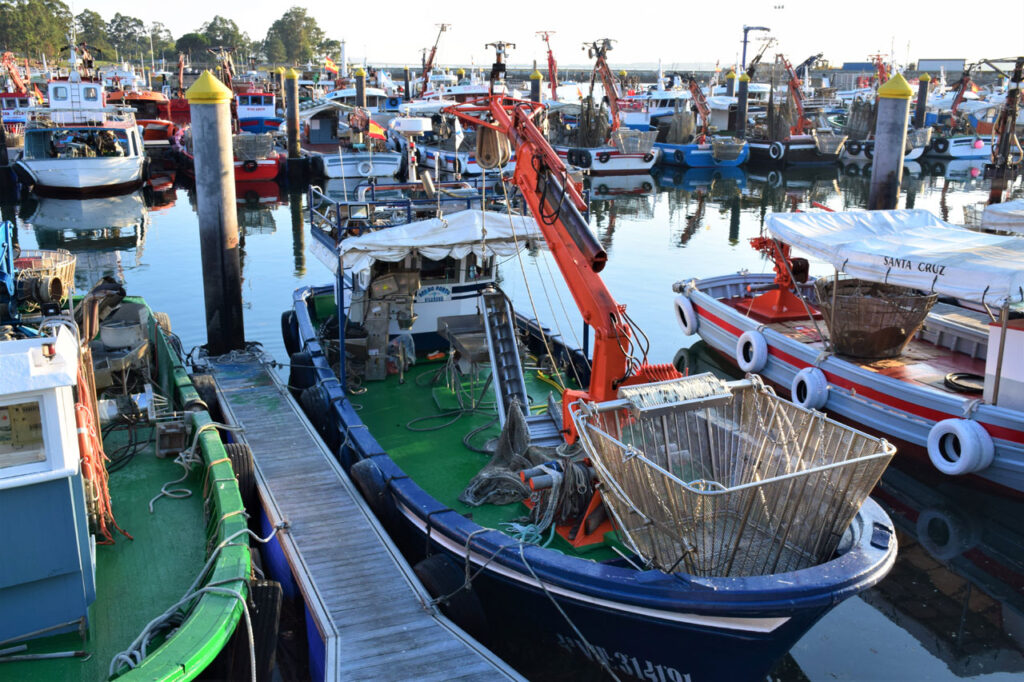
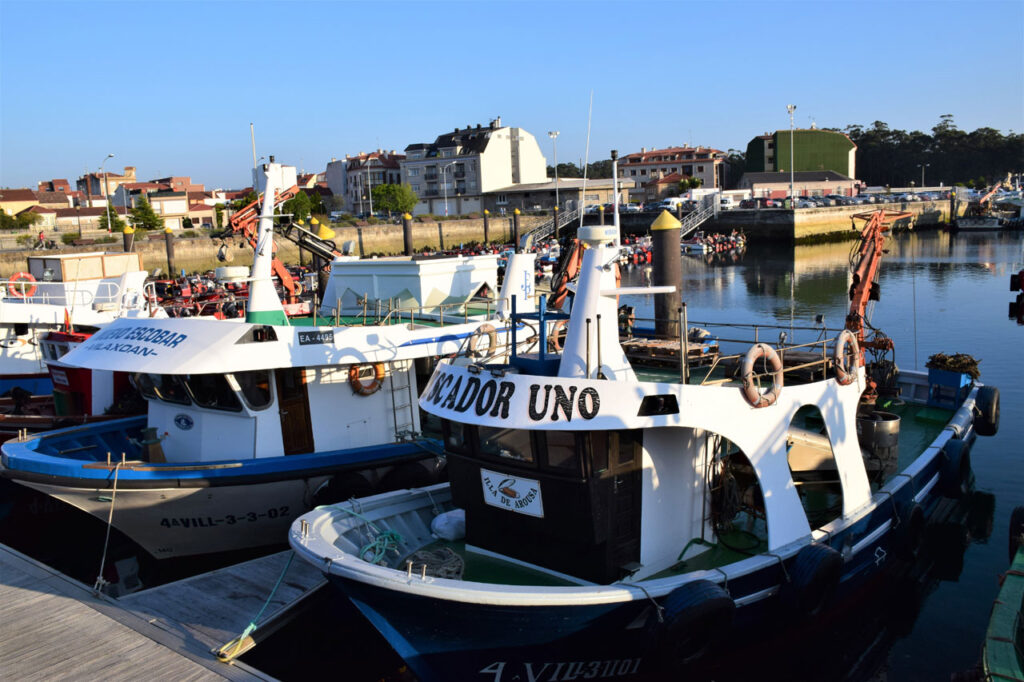
Almost all the mussel farming tasks are carried out on the wide deck aboard the mussel boat, also called the auxiliary vessel. Formerly, it was made of wood, but now most are made of fiber. They are usually between 15 and 20 meters long, with a wide deck and a bridge from bow to stern. They are equipped with powerful hydraulic basket-cranes to ease the lifting of the ropes to the deck.
To learn more
The breeding of the mussel in the raft begins at the time of this mollusk reproduction. The eggs become tiny larvae called glochidia, and then developed into pediveliger larvae ("mexilla") or mussel seed that adheres to the coastal rocks, and it is there where the spat collectors (bateeiros) get these seeds with a scraper. During this phase, their size oscillates between 0.5 and 1 centimeters. Another way of capturing the seeds is by placing some ropes at the bow and others at the stern between the months of April and September.
The next phase is to place the right amount of seeds in the culture rope using a cotton net to keep the mussel as close to the rope as possible, so that after a few days, when the byssus develops, each of them has adhered, and when the rope rots and disappears, they are all firmly fixed. This process is called stringing.
Afterward, the unfolding is performed. Regularly, at six months old, the mussel weight has increased in such a way that it requires unfolding each initial string into two or three. Therefore, it is necessary to raise the ropes – where the initial stringbed was made – with the auxiliary crane of the mussel boat and lift them carefully to avoid the collapse of the mussel.
A basket placed at the lower end of the rope collects possible landslides. The mussel sets are then separated - a thorough cleaning is performed - with the brush system installed in the crane or basket, and selected by sizes. Later, the stringing machines distribute the mussels of each initial string on the unfolded strings (50 kilos of mussels per 5 centimeters of rope).
After the desalination, the second phase of mussel fattening takes place, which lasts between eight and fourteen months until the marketing sizes reach between seven and ten centimeters. The harvest is carried out when three fundamental parameters are met: the size of the marketing, the weight of the (meat inside) viand is between 18 and 25% of the total (shell + water + viand), and the weight per unit of rope length (15 kilos per meter).
Once again, the sets of mussels are separated using the shelling machine, and selection is conducted at the corresponding tables. Mussels intended for fresh consumption have to be cleaned, classified, and bagged in 11 to 15 kilos legal black sacs for their next destination, the treatment plant.
To know it better
The town hall of Vilanova de Arousa in the Pontevedra province within the O Salnés region is a place with antiquity, and thus, history. Since the 16th century, this municipality has always stood out as a fishing port, for supplying fish to the entire region of Castile. Moreover, the arrival of the Catalans set up salting and preserving factories. Nowadays, fishing and shellfishing activities are one of the most important of this area.
To obtain shellfish, they use two techniques: fishing afloat and shellfishing on foot. The first one is carried out from the boat. Within this modality, there are two ways to perform it: On the one hand, the manual, which prohibits the use of mechanical devices for dragging; thus, the utensils used are, among others, a rake-like to catch cockles and clams and the basket-rake (Raño or gancha), which is lighter requiring less effort. On the other hand, there is a mechanical way, which involves dragging, authorized in Galia to catch the king scallop, razor-clam, clam (towed), and shrimp. This art is used in deeper waters, and supposedly, the boat tows the utensils, giving rise to this mechanical art.
However, mussels are usually culture in rafts (bateas o mejilloneras). They are structures placed in the estuary, where thick ropes called "maromas" hang.
Gallery
Location
- Town
- Vilanova de Arousa
- Municipality
- Vilanova de Arousa
- Province
- Pontevedra
- Country
- Spain
The asset
- Type
- Boat
- Eco-destination
- Ría de Arousa
- Environment
- Rural
- Relevance
- National
How to get there
- Access
- By sea
- Distance
- 0 km
The visit
- Accessible
- No
- Parking
- No
Coordinates
- Latitud
- 42.56356800
- Longitud
- -8.83019900