
Votive temple of the Sea
About this heritage
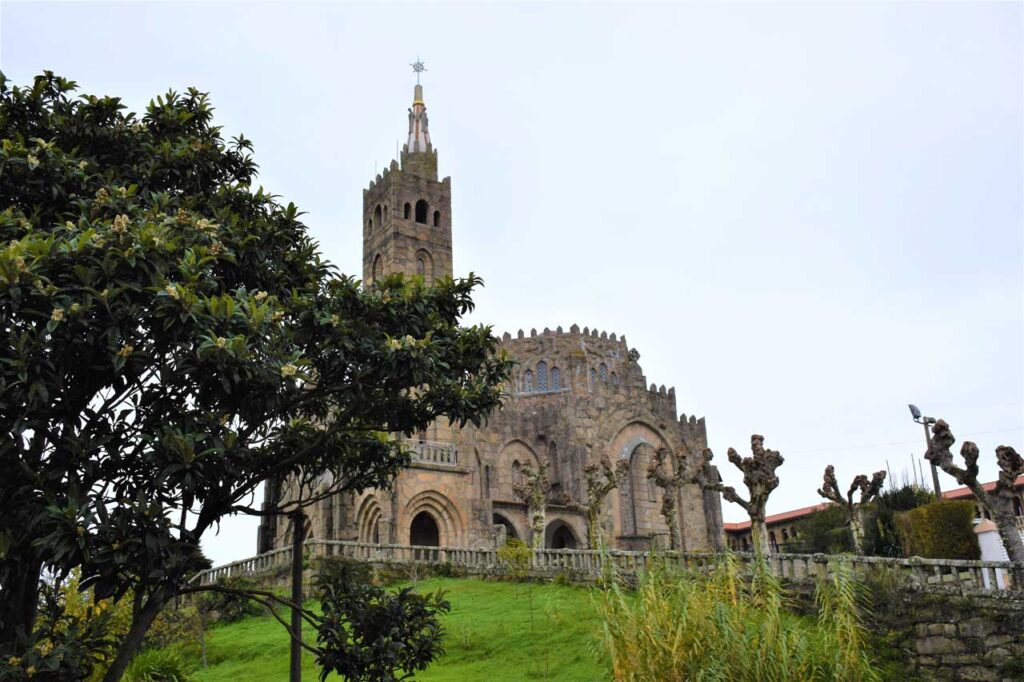
This undertaking was carried out by Antonio Palacios Ramilo, born in O Porriño, and conforms to the ideological movement at the beginning of the 20th century, which tendency is that of an indigenous architecture, with traditional essence, aiming to convey typical cultural content.
Antonio Palacios travelled throughout the territory of Galicia, visiting Romanesque and Baroque constructions, from which he acquired a knowledge which later defined his own style.
The Votive Temple of the Sea was built between 1932 and 1937, on a surface area of 340 square metres. It has a Latin cross plan, a sole nave, and three sections at the beginning.
The temple was initially meant to form part of a group of constructions, which were eventually not executed.
In the forepart is the bell tower which is on the left, and the baptistery is on the right. The apse is polygonal, behind the transept which is completed with a polygonal lantern tower and dome, on top of the pointed arches.
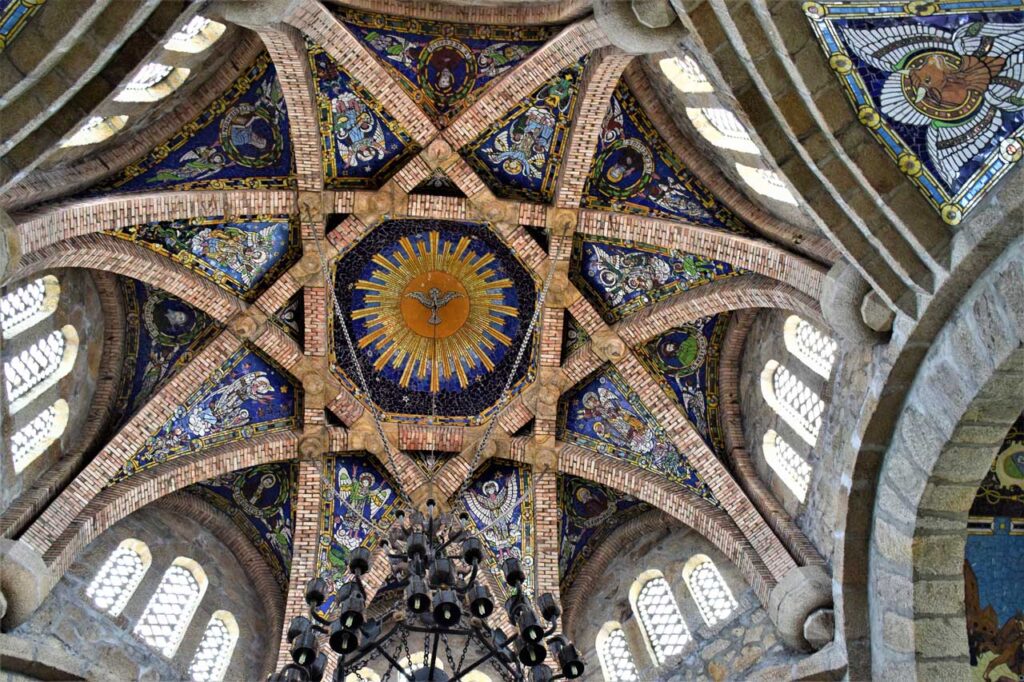
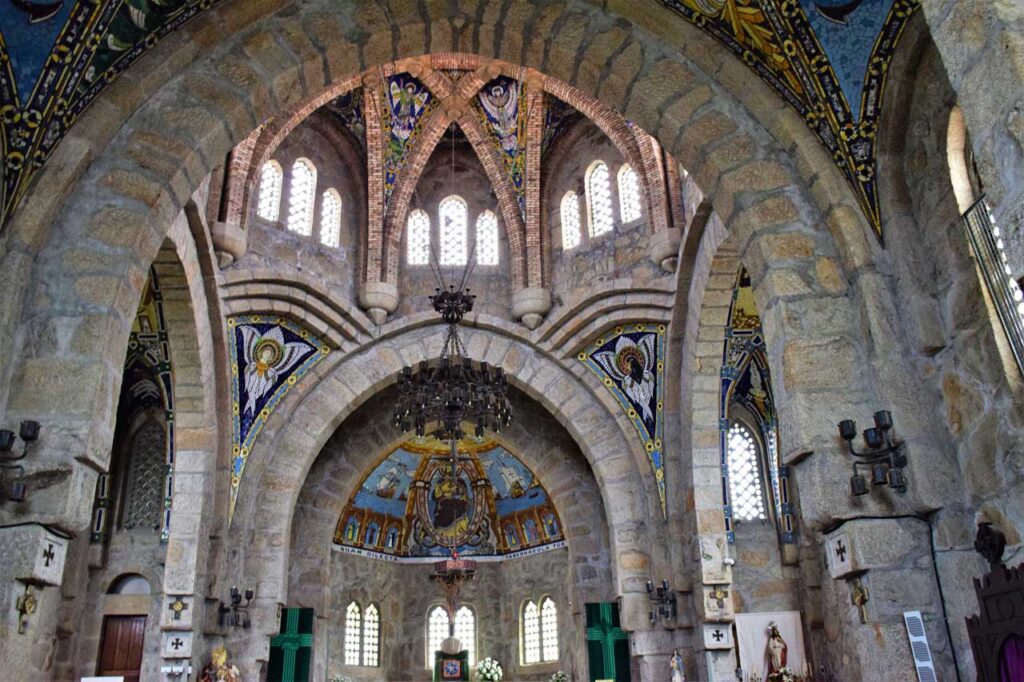
What stands out are the mosaics which were laid by the builder José Mogimes, with the help of volunteers from Panxón, and assembled with tile scraps.
Another component to be considered in this church are the stained-glass window and rosettes. Antonio Palacios tried to innovate and play with the light by means of openings which appear from combining glass industrial tiles, inserted into the reinforced concrete.
The Votive Temple of the Sea is one of the architect’s most grandiose creations and the best preserved structure in Val Miñor.
To learn more
Panxón is a small parish pertaining to the town of Nigrán, which is defined for its marine tradition, has its own port and is famous for celebrating the St. John’s bonfire day (Día de San Juan) on its beaches at the beginning of the summer season, coinciding with the local festivities.
Ascending Arco Visigótico Street, very close to the Votive Temple of the Sea, we come across a structure with the same name. The Visigothic Arch was part of the no-longer existing parish church of San Xoán de Panxón, which remained unnoticed until 1926. What remains of it today are the ruins of the quadrangular apse at the entrance of the Moorish triumphal arch.
The arch is formed by 21 keystones of varying sizes, sustained by two smooth-shaft columns and Corinthian-inspired spires, with two rows of acanthus leaves and protruding volutes. The arch was originally sustained by two sets of columns on either side, as can still be appreciated.
Based on the appearance and execution technique, it seems most definitely to be of German production.
In 1963, a stola sarcophagus lid was found as part of an adjoining wall, and was later relocated in the apse of the temple. This could be situated in the Suevi period of the 5th-8th centuries.
As a consequence of the restoration work carried out on the arch in the 1980’s, a minor excavation was carried out whereby the original foundations were found to be Germanic, establishing a Greek cross plan. Making partial use of these foundations, the church was rehabilitated during the 17th century, taking on the appearance it kept until the 20th century, when it disappeared.
These ruins were declared a Historic-artistic Monument and Asset of Cultural Interest.
To know it better
The Votive Temple of the Sea or Parish Church of San Juan de Panxón, is situated on the coastal town of Nigrán and more specifically, in Panxón. This catholic temple was built between 1932 and 1937, by the famous Galician architect, Antonio Palacios Ramilo, one of the most important Spanish architects of the 20th century.
Aside from having a rib vault, it is distinguishable for its Latin cross plant and for its tower in the form of a lighthouse, which the sailors benefit from, in order to assist their reaching land. Furthermore, next to this there is a more elevated cylindrical tower, crowned with four custodian or guardian angels, each facing the cardinal points.
Antonio Palacios attempted to capture Galician art in this church, despite its origin holding a mix of gothic art (pointed arches), modernistic touches and Muslim influence.
Gallery
Location
- Town
- Panxón
- Municipality
- Nigrán
- Province
- Pontevedra
- Country
- Spain
The asset
- Type
- Temple
- Eco-destination
- Ría de Vigo
- Environment
- Urban
- Relevance
- Regional
How to get there
- Access
- By land
- Port
- Puerto de Panxón
- Distance
- Caminando desde el puerto de Panxón 5 minutos. En coche 2 minutos
The visit
- Visitable
- Yes
- Interpretation
- There is a panel at the beginning of the slope
- Accessible
- No
- Parking
- Sí
- Signposted
- Yes
Coordinates
- Latitud
- 42.14572400
- Longitud
- -8.82369800