
Ons island. Lighthouse and island´s history.
About this heritage
It is said that a working farmer, on the top of O Canexol neighbourhood, found a treasure composed of some old coins. This was the first news about the military occupation of the island. They date back to the Bronze Age and are known as “Castelo dos Mouros"; and another castro (traditional military fortress), known as “Cova da loba", would have remained in the northern part but there are only remains of pottery, tiles and abundant shells-storage.
On Canexol beach you will find the first salting factory on the island dating from Roman times. Salted fish was used for everything, especially to feed the army. To transport the salted fish, they used amphoras that were made on land, in Bueu. It is a “San Martiño de Bueu" type of pottery, and thanks to the fact that researchers have been able to trace findings of this type of pottery, it is known that Ons canned food reached places as far as Lisbon or France.
At this time the island of Ons was known as Aunios, the origin of the current name.
At the end of the ninth century, Galician estuaries suffered from attacks by Viking looters. It was very difficult for the crown to defend them, and it is believed that this was the reason why in 899 King Alfonso III donated these lands, which were then called Islas Aones, to the Santiago´s Council of Canons. During this time the documentation reflects the existence of the San Martin church there, but there is no indication or trace of its congregation or population.
Associated with the existence of a 15th century monastery, of which no evidence remains, is the presence of an anthropomorphic tomb located on a rock surrounded by the sea known as “A Laxe do Crego".
In the Modern Age, in the 16th century, the church granted the island in fief to the Montenegro family, and the people who lived on the island paid a tithe to their owners. It stayed that way until the pirate attacks started. The most famous was by the privateer Francis Drake. The continuous looting that they suffered until the 18th century caused the depopulation of the island.
In 1810 the Armament and Defence Provincial Board decided to fortify the island, thus allowing the settlers to return. From this action there is a visible fortress known as “Castelo de Rueda"; located in Punta do Castelo from where you can have a panoramic view of Pontevedra´s estuary and the Cíes islands to the right, also from there, you can see the pier of Ons and to the left the largest sandbox of the island, Melide beach.
Between 1835-40 the first modern salting factory was installed, located near the quay. This construction changed the life of the islanders, improved the economy of the island and increased the population. Fluctuations in sardine fishing caused the decline and final closure of the company.
In 1929, at the beginning of the 20th century, Mr. Manuel Roibó bought the island and set up a trading company under the name “Isla de Ons"; dedicated to octopus and conger eels drying and commercialising, occupying the old salting factory. With the outbreak of the civil war and Don Didio Riobó´s suicide, the island was left without direct management until it was expropriated for national defence purposes in 1940, which it never had.
In the 1960s the state appointed a neighbourhood mayor to manage the island and “a colony"; was established. The National Institute of Colonization had a neighbourhood built, in the Curro´s neighbourhood, with a new church, a school and houses for the priest, the teacher and the doctor.
During the 40s and 50s the island lived its best time, with almost 500 inhabitants.
The biggest problem on the island was the dock, which is badly located and was much smaller than the current one, people had bigger boats and could not dock. So little by little, tired of the administration's disinterest, they settled their main homes on the coast and decided to keep the island's homes as second homes.
Since 2002 the island has belonged to the Maritime-Terrestrial National Park of the Atlantic Islands of Galicia (PNMTIAG). And the inhabitants of the city, three of whom are living there all year round, are houses licensees with a 75 year permit.
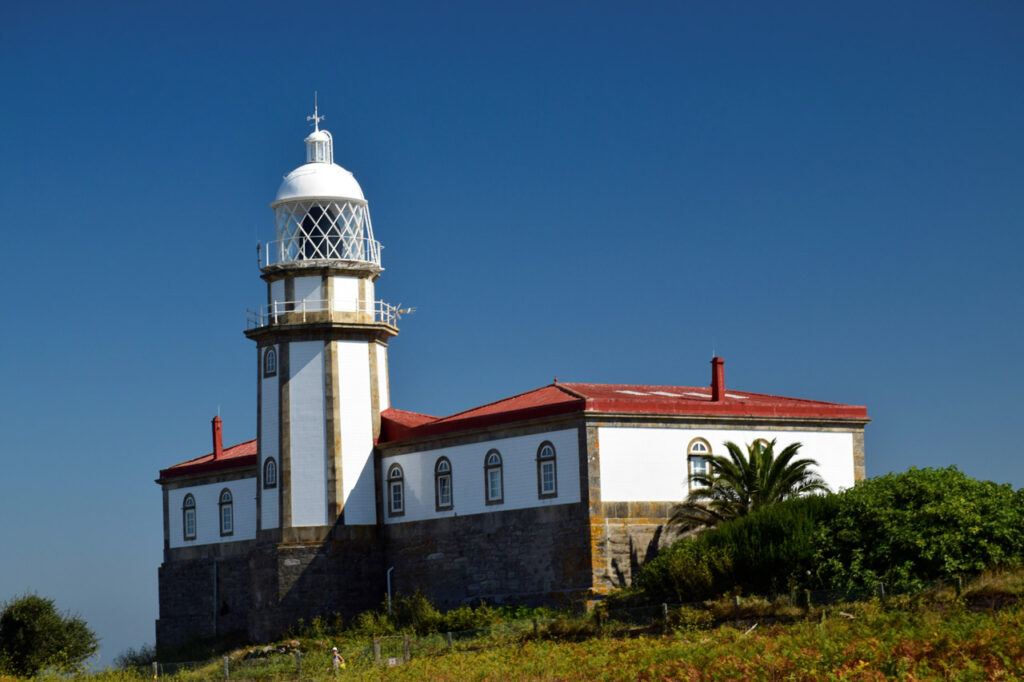
Ons island is one of the few places in Spain that keeps its lighthouse keepers. Located at the top of Cucorno mountain at 128 meters, Ons lighthouse has been illuminating the estuary since 1926, reaching 35 miles. It consists of an annex building that includes housing for lighthouse keepers, a warehouse and a workshop.
Previously, there was another lighthouse in the same enclave, from the year 1865, with a piston oil lamp and a range of 17 miles.
Following the island´s north route, you will find Alto da Cerrada at 106 meters and then you will arrive at Punta Centolo, from where you can see to the left the cove of Pociña and Punta Xubenco, if you look up you can also see the island of Sálvora. In front you can see the Centolo grande, a big rounded rock that makes you think of a big spider crab because of its shape. On the coast you can admire O Grove peninsula and San Vicente´s cape, the big beach of A Lanzada and the beaches of Pragueira and Montalvo, the entrance to Pontevedra´s estuary.
Returning along the same northern route and going along the cliff side, you will reach the Canibeliñas cove, a steep coast with furnas (grottos) and sea inlets.
To learn more
The island´s inhabitants were subjected to a great deal of isolation which, together with the lack of both spiritual and medical services, generated a unique popular culture.
There was a great popular knowledge about the medicinal plants of the area. Elements, substances and plants with particular properties were used - in kitchens - such as sorrel, hemlock, mauve, elder. . . Rites were also performed to ensure the correct effect of the remedy applied. They treated respiratory and digestive disorders, rheumatism and also other ailments in animals.
Superstitions were part of the everyday life and many sayings, that even conditioned life on the island, became very popular. For example, if a pregnant woman ate barnacles she had to avoid being splashed in the face by the barnacle water, if it happened, the baby would be born with a barnacle-like stain on its body.
They also believed in the Santa Compaña and the story of Eugenia Otero, an islander who said:
“The Holy Company must be watched at night. It is known by a light incarnated as fire and other white lights that precede and close its march.
It comes from Noalla to the Centulo and from there it walks high above the gorses to the cemetery, where it disappears underground. When it's over, everything looks better than it does now, like it's daytime. They can talk to the living, and if two people meet and one does not see it, the other just steps on the left foot and sees it.
Wherever he leaves the box, if not today, then tomorrow someone has to die”.
To know it better
The first settlements on Ons Island date back to the Bronze Age. These are the castro (traditional military fortress) at Canexol (Castelo dos Mouros), which retains the circular defensive structure, and the castro at A Cova da Loba, located in the north of the island.
In Area dos Cans there is a tomb that makes people believe that a convent or a hermitage existed, since, according to legend, it would be a monk´s tomb who lived in this place. Later, in the 16th century, Ons archipelago became property of the Montenegro noble family. The island was left empty at the end of the century, after the struggles of corsairs and pirates.
Ons island was repopulated with pine trees that would have been dedicated to shipbuilding and a factory was created that focused on the salting technique. In 1929, Manuel Riobó bought the archipelago and, in the factory, he built a space to dry the conger eel and the octopus. He then went on to commercialize it, but the harsh living conditions on the island made it depopulate. In 1982, the Ons archipelago passed into the hands of the Xunta de Galicia (Galician government).
The lighthouse of O Cucorro, located in the highest part of the island, is one of the largest in Spain and is the work of Rafael de la Cerda. It first came into being in 1865 and was one of the last oil pressure lighthouse. In 1990 it was already operating with photovoltaic energy.
Ons island is a parish of Bueu. This municipality is located in Pontevedra´s province.
Gallery
Location
- Locality
- Bueu
- Municipality
- Bueu
- Province
- Pontevedra
- Country
- Spain
The asset
- Type
- Lighthouse
- Eco-destination
- Ría de Pontevedra
- Environment
- Natural
- Relevance
- International
How to get there
- Access
- By sea By land
- Distance
- 1 km
The visit
- Visitable
- It can be visited all year round, previously they must have the authorization of the Xunta de Galicia to visit the natural park.
- Interpretation
- At the end of the access dock there is an information panel with a map of the archipelago,with services, points of interest and itineraries. A map and route catalog of the Natural Park can be downloaded from the website of the Islas Atlánticas National
- Accessible
- No
- Parking
- No
Coordinates
- Latitud
- 42.38229000
- Longitud
- -8.93615100