


Pobra do Caramiñal Center. Catalan Neighborhood
About this heritage
Pobra do Caramiñal is in the Barbanza peninsula in the province of Coruña. It is a beautiful coastal municipality, which borders with Boiro, Ribeira, Porto do Son towns.
This village, as we know it today, is the result of the union of another two with a strong seafaring tradition: Pobra do Deán and Caramiñal.
Walking through this beautiful town, visitors can easily understand its fascinating history. Thus, one can visit the Castelo historical center. In it, travelers can find the church of Santiago da Pobra do Deán, which stands out for its various styles (marine gothic), as well as its chapels and the transept in its atrium. This chapel is part of the route of the Procession of the Nazarene or das Mortallas, held on the third Sunday of September, an event declared a Festival of Tourist Interest in Galicia, a tradition dating back to the 15th century. The different chapels are composed of various styles: Plateresque, Renaissance, Baroque, and Neoclassical.
Near this church, there are two Lordly Houses (Pazos): the Casa Grande de Aguiar, which dates back to the 16th century, and later renovated, and the Pazo do Couto, which together with the church and a road from the 18th century form a small historical site worth visiting.
Walking through this village, everyone can see the church of Santa Maria A Antiga of Caramiñal, which began its construction in the 16th century. However, they did not finish the work until almost two centuries later, and even in the 20th century, it was subject to some expansion.
Continuing the journey towards the sea, travelers find the promenade of Areos, and at the end of it, the 18th-century church of Santa María de O Xobre, the rectory, the ruins of the convent of San Antonio, and the remains of the pre-Roman fortress (Castro) of Punta Ostreira.
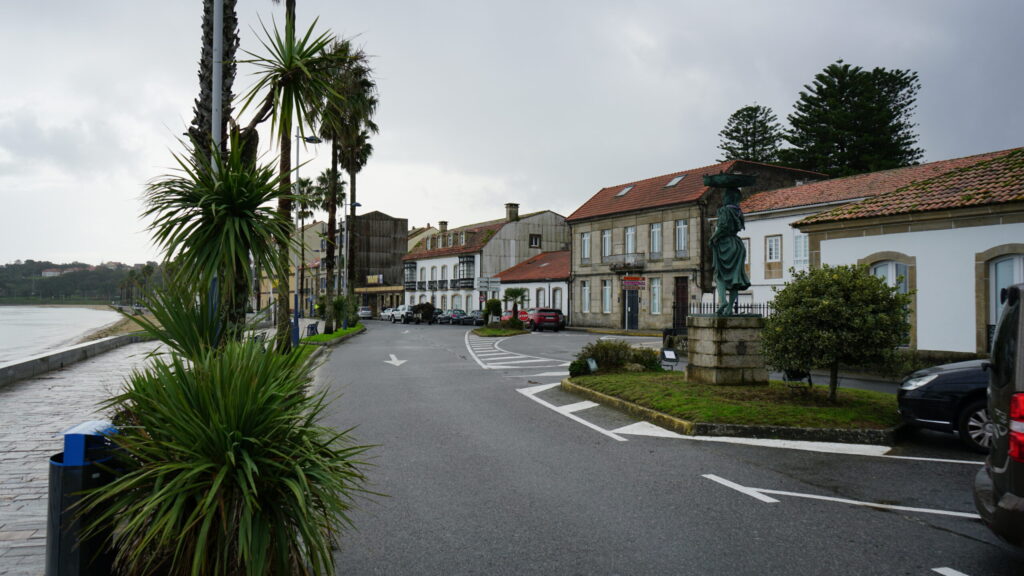
On the promenade itself, visitors can find the old Catalans Neighborhood. It receives this name because it was the place chosen by the developers from Catalonia and for the establishment of their sardine salting factories. At the end of the 19th century, Catalans settled in this town, attracted by the abundance of this fish on our coasts. Initially, the single-height buildings consisted of a family home on one side, and on the rest for manufacturing activities. Later, these buildings evolved into two-story ones, with the family home on the top floor and the factory-warehouse on the bottom.
It was during this period that the naval industry: fishing and port activities were reactivated, linked to the vanguard of a sector that would become, over time, one of the economic pillars of the town, as it is the origin of what today is the canning industry.
A few meters from the Catalans neighborhood, visitors can see the Bermúdez Tower cataloged as a Historic-Artistic Monument of National Interest and a Site of Cultural Interest, which houses the Valle-Inclán Museum. The 16th-century building has ornamental figures, such as gargoyles on the outside, while on the inside holds and displays several images and objects related to this significant Galician author. First editions of his books, manuscripts, sculptures, paintings, or posters of the premieres of his plays are some of the items found when visiting.
To learn more
In the mid-eighteenth century, there was a migratory movement of Catalans, known as the Fomentadores (instigators), who began to settle in the towns and villages at the foot of the Vigo, Pontevedra, and Arousa Estuaries. At first, these entrepreneurs dedicated their activities to the salting of sardines for subsequent sale and export. In the following years, the remaining ones focused on the canning industry.
On the Areos beach, one can find the Arenal neighborhood or "Barrio dos Cataláns," where Catalans from the movement built a series of family houses/salting factories in an organized way so that all constructions were around a street that runned parallel to the beach. Currently, there is a road and a promenade, but as far as we know, there used to be no separation between the buildings and the sand area. The explanation for this is the industrial process. When there was no dock or the fish-purchase boat was full, to facilitate the unloading, the boats carrying the catches steered directly into the sandbank and beached. This way, they could transfer the fish from there to the industry to start the salting process.
Some 140 Catalans settled in Pobra do Caramiñal, and there were up to 16 salting factories by 1830. The buildings have a characteristic architectural typology, modified over the years. They were oriented in an east-west manner to preserve them from the inclement weather. In the beginning, these rectangular buildings were of a single height, where the family home occupied one side and the rest for the manufacturing activities. Over the years, this distribution evolved into a two-story construction, where the family home was on the upper store, and the factory-warehouse occupied the lower one. This winded typology filled the Galician coastline, but today, it has practically disappeared. Although in many cases in a dilapidated state, Pobra do Caramiñal and its Arenal or Catalanes neighborhood is one of the few existing examples.
In the beginning, the promoters developed their activity in small wooden barracks located near the sea and had a colonial character. They acquired from the sailors the "escochada" sardine, which consisted of removing the head and gutting with the subsequent dehydration by the direct action of salt. Then, they exchanged it for Levantine products, such as wine, brandy, spirits, oil, and soap, among others.
Over time, they settled on the banks and became integrated into Galician society, with the sole objective of exploiting the natural resources of the Galician estuaries, mainly sardines. They reinvested a large part of the profits in the salting activity, making substantial purchases in all types of goods destined for this industry: buildings, boats, nets, and fishing gear. This way, they generated colonies and, with them, new urban spaces, real settlements in which the promoters maintained their customs, their language, and their existence apart from the life of the natives of the place, which increased the confrontations with the population.
There were three innovations introduced by the Catalan promoters. The first was the trawl nets (the xávega), which was more productive than drift nets (xeito and volantas) and seine nets (chinchorro, traíña, xareta). The second was new salting techniques, such as "salprensado," consisting of the introduction of sardines in brine and their subsequent pressing, as opposed to the "escochado" technique. The last innovation was a new work system, consisting of the privatization of equipment and the remuneration of work with wages.
The sterilization of the fish and its subsequent packaging in airtight containers, first in glass and then in tin foil, is a much more efficient and durable way of preservation than the salting. Therefore, from 1880, they began with glass packaging by hand, and in 1879, they improved with the opening of the first modern canning factory owned by Juan Goday Gual in Arousa Island.
To know it better
Pobra do Caramiñal is a coastal municipality in the province of Coruña, located in the Barbanza Region. The word "Caramiñal" comes from a plant that used to be easy to find on the Galician coast, the Caramiña; however, nowadays, this shrub species is hardly ever seen in this land.
During the Middle Ages, two urban centers emerged, specifically in the 14th century: Pobra do Deán (belonging to the Señorío del Deán de Santiago) and Caramiñal (belonging to the Señorío da Xunqueiras). After several confrontations between them, in the 19th century, both centers united. The two parish churches, still preserved in the current town center, are: Santa María A Antiga do Caramiñal and Santiago do Deán.
During the 19th century, the population's main activities were fishing and working in the salting factories. Catalan promoters founded and owned these factories in an industrial area of Pobra do Caramiñal known as Areos. For this reason, they called the neighborhood “Barrio dos Cataláns.” Today, visitors can still see these old salting factories, which the local administration intends to restore since they have deteriorated.
Location
- Town
- Si
- Municipality
- A Pobra do Caramiñal
- Province
- A Coruña
- Country
- Spain
The asset
- Type
- Village
- Eco-destination
- Ría de Arousa
- Environment
- Rural
- Relevance
- National
How to get there
- Access
- By sea By land
- Distance
- 1 km
The visit
- Visitable
- Yes
- Accessible
- No
- Parking
- Sí
Coordinates
- Latitud
- 42.60502600
- Longitud
- -8.93745500