
Route of the Pinzón
About this heritage
The discovery of America was a historic milestone of great impact. Initially, the discoverers, thinking that all lands had already been discovered, wanted to create an alternative trade route with the spice route. What a surprise, when in reality what they found was a new continent. On March 1, 1493, the Caravel Pinta, captained by Martín Alonso Pinzón, docked in these waters of Baiona, which was the first port in all of Europe to receive the news of the Discovery of America.
The Royal Town is full of elements to commemorate this arrival, and with them, there is a Pinzonian Route that covers all these monuments and lasts approximately 45 minutes.
Starting at Pedro de Castro Square opposite the Mendoza palace, there is a monolith of the Arrival. It is a twenty-ton rock that has a caravel sculpted on its front by the Bayonés Ángel Fernández. This monolith was erected by order of the Hispanic Culture Institute in 1965 to commemorate the arrival of the Caravel Pinta. Crossing the road towards the seafront, straight ahead you can see the port of Baiona, to the right is the dock where the Maritime Station and the fish market are located. There are many pontoons where the sailboats of the Real Club de Yates Monterreal are moored, and in the distance, you can see the large breakwater, the Doca, which protects the port of Baiona.
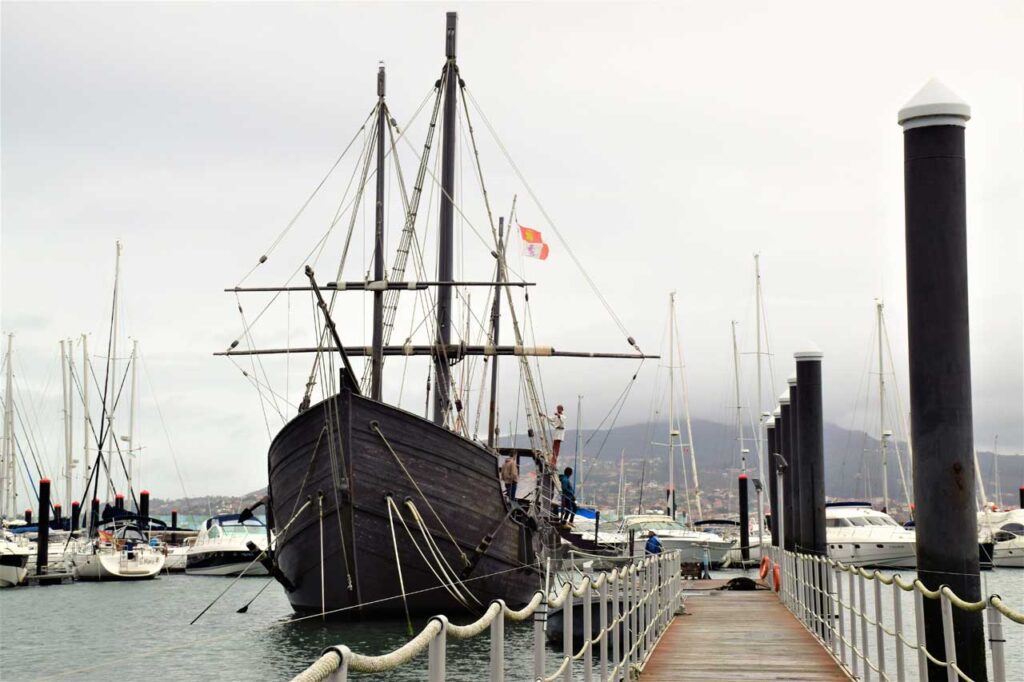
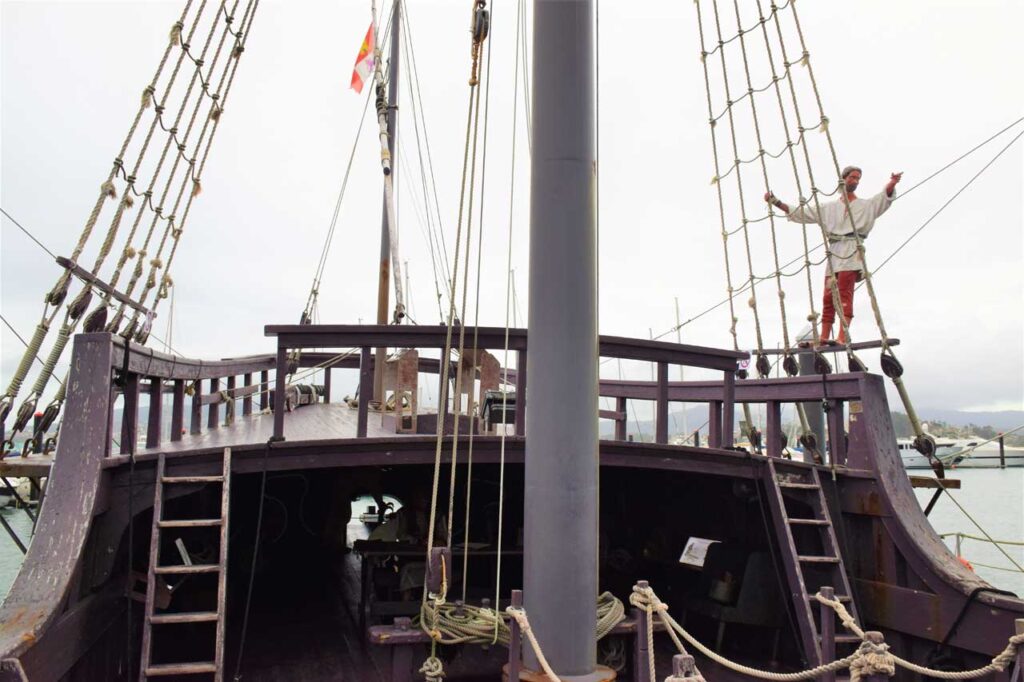
On one of the pontoons is the replica of the Caravel Pinta, built in 1993 on the occasion of the celebration of the 5th Centenary of the Arrival of the Caravel Pinta to Baiona. It houses a small museum inside, where you can see figures representing the crew and the American natives, as well as reproductions of metals, plants, foods, and exotic animals found in the New World.
Continuing along the seafront towards Ribeira beach, above it, there is a wall that belonged to the old fish market. It features several arches and contains several elements such as the Arrival Tile, placed between two of the arches. This mural reflects the routes taken by Pinzón and Colón, with the caravels "Pinta" and "Niña," respectively, on their return from the discovery of the New World. The work was inaugurated in 1963.
Behind this wall is a unique construction, the Pozo de la Aguada, which, according to tradition, served to supply water to the Caravel Pinta before departing from Baiona to Palos on March 11, 1493. The crew manually filled the barrels that served for consumption during the voyage; it is believed they carried nine barrels of water and nine of wine. It is a stone construction in a square shape, notable for its superb design, typical of such constructions at that time.
Opposite is the Parque de la Palma, the largest park in the municipality, located at the beginning of the Monte Boi Peninsula. Its location is unique as it closes both shores by Cuncheira beach and Ribeira beach. Closing the park is the majestic Fortaleza de Monterreal, and in the foreground, you can see the bastion where the well-known monument "Encounter between Two Worlds" stands, erected very close to the place where the first Native American who died in the Old Continent was buried. It was inaugurated on March 1, 1993, by H.R.H. Don Felipe de Borbón to commemorate the 5th Centenary of the Arrival of the Caravel Pinta to Baiona. It is the work of sculptor Magín Picallo.
Finally, descending the other side of the bastion slope, on the Cuncheira beach side, observing the wonderful view from this side. At the top is Mount Sansón crowned by The Virgin of the Rock. Looking down, we have a view of the Breakwater, a place where the waves crash on stormy days. This side of the peninsula faces the open sea and is noticeable on Cuncheira beach with its sand made of crushed shells. Here was the old spa built at the end of the 19th century, taking advantage of the supply of iodine-rich seaweed.
The route continues around this beach and reaches the Pinzón Promenade. First, there is the compass rose, placed in 1998 in honor of two Galicians, Diego Carmona and Vasco Gallego, who circumnavigated the world on the ship "Juan Sebastián Elcano." The route culminates at the statue of Pinzón, a gift from the sister town of Palos de la Frontera (Huelva). The work is a sculpture representing the great captain of the Caravel Pinta, architect of the Discovery, and was inaugurated in 1977. It is the work of sculptor A. León Ortega.
From here you can see the Estelas islands, the battlemented wall of the fortress, and in the distance, the Cíes islands and the vastness of the sea.
To learn more
The Catholic Monarchs decided to support the sailor Cristóbal Colón, who intended to find a new route to India as the Portuguese had done before. So, on April 17, 1492, Colón signed the "Capitulaciones de Santa Fe" with the monarchs, documents that authorized, without financing, the expedition to the Indies by sea westward.
The expedition departed with three ships, La Santa María, La Pinta, and La Niña, from the port of Palos de la Frontera in Huelva on August 3, 1492. Cristóbal Colón was on the Santa María while the Pinzón brothers captained the other two.
The first setback occurred shortly after departure; the Pinta had a broken rudder, which is why they stopped in the Canary Islands to repair the ship.
It would not be the only setback. Colón had estimated that the distance between Spain and Japan (where he believed he was headed) was between 3,000 and 5,000 kilometers, when in reality it was 19,000 kilometers. The American continent is located 6,500 kilometers away, and after two months without sighting land, discontent among the crew increased.
Soon the sailors began to mutiny against their captain, but Colón, with the help of the Pinzón brothers, managed to calm them. As the days passed, anxiety increased, and the high-ranking officers, including the Pinzón brothers, opposed this enterprise. Two months and nine days after the start of their journey, on October 12, 1492, land was finally sighted. They had arrived at Guanahani, in the Bahamas, and it was renamed San Salvador. From this island, they traveled to the Bahamas and discovered small islands such as Santa María de la Concepción, another named Fernandina in honor of King Fernando, and a few days later another island called Isabela.
On December 25, 1492, the Santa María ran aground on some rocks on the island of La Española, currently composed of Haiti and the Dominican Republic, and became unusable. Cristóbal Colón had an idea, and with the remains of that ship, he decided to build the first Western settlement in America, consisting of a tower and a fortress he called Fort Navidad. They began the return journey with the two remaining ships, and near the Azores, a storm separated them. The Pinta was commanded by Martín Alonso Pinzón, who was ill with syphilis and decided, following the advice of the Miñorano Cristóbal García Sarmiento, to land in Galician waters to rest. Thus, on March 1, 1493, the Prince's Tower of the Monte Boi castle sighted the arrival of a famous ship: "La Pinta," making it the first town in Europe to learn of the discovery of the New World. The Pinta sailed around the Monte Boi castle, with Pinzón disembarking on Ribeira beach.
La Niña would not arrive until March 11 in Portugal, specifically in Cascais.
To know it better
The town hall of Baiona, belonging to the province of Pontevedra, has celebrated since March 1, 1493, being the first port in Europe to receive the news of the discovery of America. To not forget this important date, the municipal capital has different monuments related to the Caravel La Pinta that can be discovered by following the Pinzonian Route.
First, there is the replica of the Caravel La Pinta made in 1993, which is docked in the port. Continuing the route, the Plaza de Pedro de Castro stands out, followed by the Baiona fish market, where the "Manolito de la Arribada" is located. This monument consists of a rock with a carved caravel created by the Baiona sculptor Ángel Fernández in 1965. On the promenade of A Ribeira beach, there is a tile mural from 1963 that describes the routes followed by Pinzón and Colón with the caravels La Pinta and La Niña. Near the mural, we find a 15th-century well, known as "El pozo de la Aguada," which is supposedly where the crew of La Pinta obtained water for their subsequent journey from Baiona to Palos de la Frontera (Huelva).
Another work of the Pinzonian Route is the "Monument Encounter between Two Worlds," created by the Galician sculptor Magín Picallo in 1993, which shows groups of human figures made of stone. Finally, the "Statue of Martin Alonso Pinzón," the captain of La Pinta, marks the end of the route. This statue has been on the Pinzón promenade since 1977 and is a stone work created by the sculptor Antonio León Ortega.
Gallery
Location
- Town
- Baiona
- Municipality
- Baiona
- Province
- Pontevedra
- Country
- Spain
The asset
- Type
- Route
- Eco-destination
- Ría de Vigo
- Environment
- Urban
- Relevance
- International
How to get there
- Access
- By sea By land
- Distance
- 650 m
The visit
- Visitable
- Yes
- Accessible
- Sí
- Parking
- Sí
Coordinates
- Latitud
- 42.11928300
- Longitud
- -8.84972600