
Cape Silleiro
About this heritage
Cape Silleiro is a geographical landform located in the southwest of Galicia, in the parish of Baredo (Baiona), which encompasses the estuary in the south, marking the start of the Rías Bajas in the north.
It is a rocky front of Atlantic sea cliffs with vast pebble and rocky beaches. Its coastal slopes are densely populated with heather bushes, such as Cornish coastal heather (Erica vagans), appearing also in riverbeds with a certain degree of hydromorphism, Erica ciliraris and Erica tetralix heather bushes.
The rocky islands of A Carral, A Negra, As Polbeiras, Laxe do Lobo and Lobo do Silleiro, sit opposite the cape. Given its rocky terrain, strongly pounded by the sea, it is an ideal place for the cultivation of barnacles, where the percebeiros (shellfish farmers) can often be seen at work, removing these delicacies with the help of scrapers.
During the 1940s, a J-4 coastal artillery battery was built in this area in order to protect the port of Vigo.
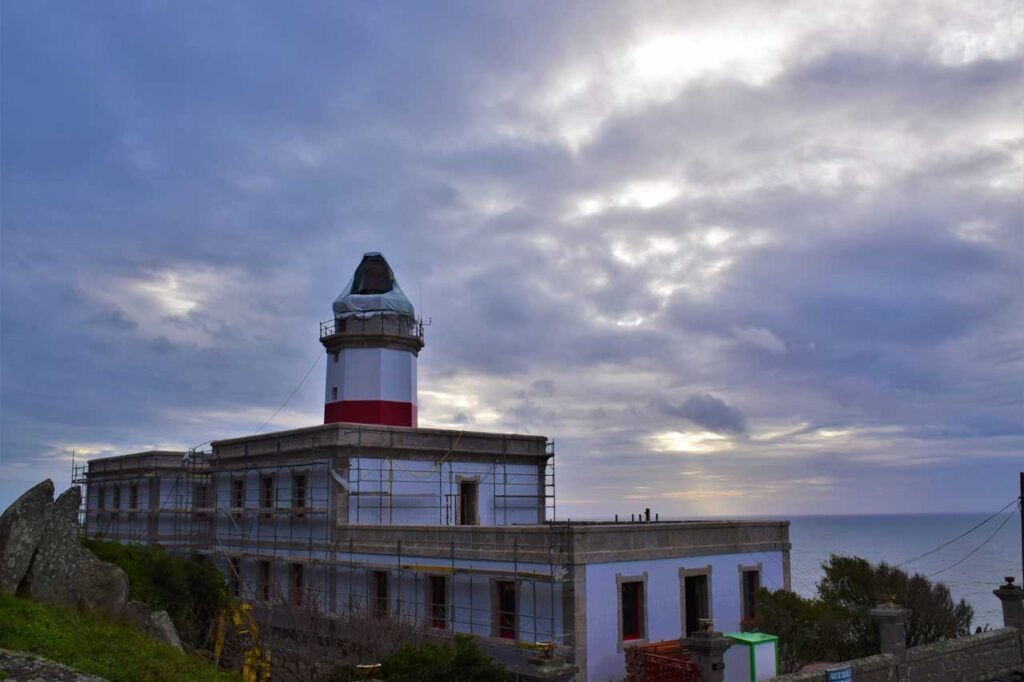
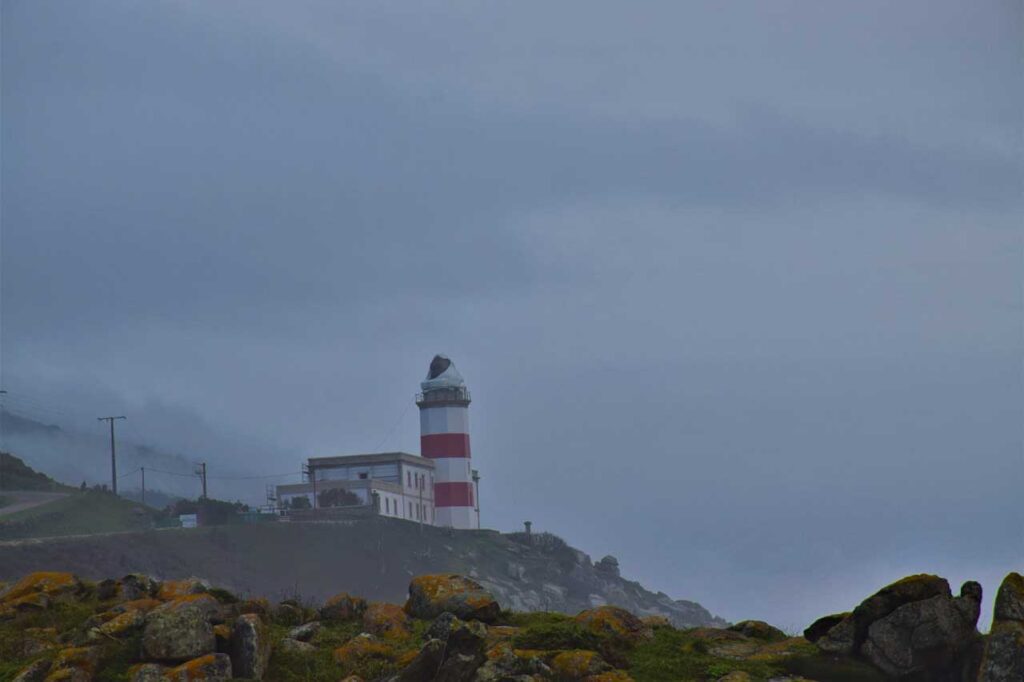
At the top of the slope is the Silleiro lighthouse, the most meridionally-located lighthouse on the Galician coast. A new building, inaugurated in 1924, which replaced the old lighthouse of 1866, and of which granite façade is still preserved on the frontal coastline.
At the foot of the old lighthouse there is a path that leads down to the playa de los cristales (glass beach), so named because of the rubbish dump that used to be on the cape. Fragments of bottles, ceramics and other elements were swept along and smoothed by the action of the sea, creating this varied-colour greenish-toned beach.
To learn more
The Silleiro Lighthouse, situated on the cape with the same name, was inaugurated in 1866. The old lighthouse still preserves its granite façade on the frontal coastline.
In August 1924, the new building that lodges the lighthouse at 85 meters on the mountain top, was inaugurated. This building has a rectangular floor plan and on its western façade there is the lighthouse tower, which has had a 3000-watt lamp since 1960 that can be seen from a distance of 40 miles away, provided the weather is clear. In addition to the siren, it has a 200-mile range electric transmitter. Today it is one of the main orientation points for vessels sailing the seas.
In 1955, it was converted into an aerial beacon, by fitting lenses that produce an aerial beam of 70º on the horizontal, and can be identified by airplanes from up to a distance of 20 kilometers.
At present, in addition to continuing to serve as a luminous signal, it is the receiver base for two different systems for measuring waves and currents, and also has a receiver-emitter station for the AIS navigation aids system.
Next to the Cape Silleiro lighthouse Cape there are ruins of a military site that, in its days, served to guard the mouth of the Vigo estuary and the entrance to Baiona. These are the battery J4 of Cape Silleiro. These installations date back to the period after the Civil War and came into service at the beginning of the 1940s as a coastal battery to protect Spain from a sea attack that never took place. Thousands of young people performed their military service duties at these installations.
The above-ground facilities consisted of the Sergeant's and Chaplain’s residences, as well as the common buildings (canteen, soldier's home, kitchen, officers' rooms and sports court).
In addition, underground, there are 200 meters of galleries dug into the granite connecting the artillery pieces with the telemetry bunker, through a tunnel with a main axis and several ramifications. There was also an evacuation tunnel that reached the Baredo mountains, now completely sealed.
The command and observation post sits above the lighthouse that regulates the port traffic. The highest battery has the most complicated access and is therefore the best preserved. The cannons had a maximum range of 16 kilometers and could all four be fired at the same time at both in manual and automatic mode (with electricity). The projectiles were 50 Kg and 45 cm and were transported to the cannons, through the tunnels, in carts. About nine people were needed to fire the cannons and roughly a total of fifty people worked on the battery.
The battery ceased to be used in the late 1980s, and both the cannons and tunnels were sealed. The military complex remained intact until the early 1990’s and was guarded by a small squad until 1999, after which it was completely abandoned.
The upper floor of this telemetry bunker was reopened in 2002, to observe the evolution of the oil slicks dumped by the Prestige on the Galician coast.
The Oia - Baiona stage of the Portuguese Coastal Way of Saint James passes through here, where many of the pilgrims choose this option to transit.
To know it better
Cape Silleiro is located in Baiona (Pontevedra) and forms part of the Galician coast. A cape or tip is an earth-formed geographical landform that extends into the sea. This one in particular, marks the point of entry to the Vigo estuary from the south.
The Silleiro Lighthouse was inaugurated there in 1866, initially using a vegetable oil wick lamp to alert ships of the presence of coastline. Later, in 1909, an oil lamp was used and in 1924, the lighthouse was inaugurated as we can see today.
It also contains the old military battery J4 Cabo Silleiro, built after the Civil War to protect the entrance of the Vigo and Baiona estuaries. It consists of about 200 underground metres with a main tunnel connected to the Vickers artillery.
Gallery
Location
- Town
- Baredo
- Municipality
- Baiona
- Province
- Pontevedra
- Country
- Spain
The asset
- Type
- Cape
- Eco-destination
- Ría de Vigo
- Environment
- Natural
- Relevance
- Regional
How to get there
- Access
- By sea
- Distance
- Caminando desde el puerto de Baiona: 1 hora y 20 minutos (5,7 km). Distancia en coche desde el puerto de Baiona: 9 minutos (5,7 km)
The visit
- Visitable
- Only outside
- Interpretation
- Interpretive panel at the entrance of the lighthouse
- Accessible
- Sí
- Parking
- Sí
- Signposted
- Yes
Coordinates
- Latitud
- 42.10488600
- Longitud
- -8.89639900