


Carril´s clam. General clams
About this heritage
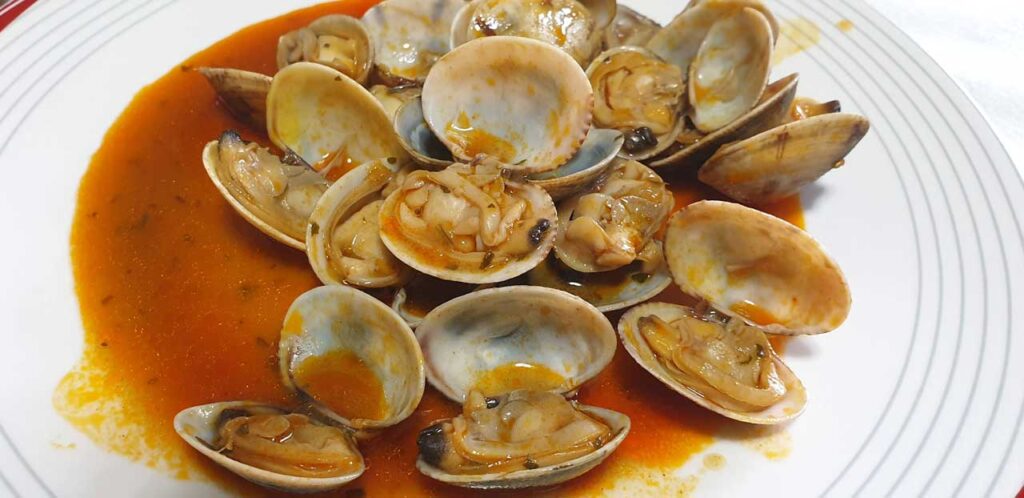
Carril´s clam is well known for its taste, considered a delicacy. These are bivalves that live in brackish water and have characteristics that differentiate them from other species.
The shell is quite thin, and in it are the radii and radial lines that make them different from other clam´s species. There are parts of the shell where the lines are quite pronounced and when they cross each other they give rise to grids. These characteristics make them perfectly different from other clams. Shells are rounded and have a ligament that is formed by a protein with elastic characteristics that opens and closes the shells. They have a bulge in the dorsal area called an umbo. They have a cream-like coloration. It's like a yellow to brown colour and has some darker markings.
These bivalves are cultivated in artisanal aquaculture parks. The “parquistas" have their plots where they plant and pamper the clams. It is a crop that needs certain requirements such as eliminating algae from the whole land, controlling all natural predators and ploughing its bottoms to increase the oxygenation of the substrate. The young specimens are sown alternately at different depths so that they have a good water current.
Nowadays, about 650 families live thanks to its cultivation, and it represents one of the first economic activities in Vilagarcía de Arousa. Some 3,200 tonnes are produced annually, equivalent to an average of more than 16 million euros. These clams have exceed sales other clams, slug and Japanese.
To learn more
The clam is a bivalve mollusc whose body is protected by symmetrical shells, like the mussel, oyster or razor, composed of calcium carbonate. They withstand temperatures of 5 to 35ºC, the low sea, and changes in salinity. Some species such as the slimy clam are more delicate and cannot withstand variations in salinity or changes in temperature.
It is a filtering organism that feeds on small living beings, seawater is ingested by its siphon, this allows them to live buried at a depth of 15 to 30 cm, being able to perfectly support the low tides.
The species commercialized in Galicia reach a weight between 20 and 50 gr and dimensions that go from 25 to 50mm.
They are distributed along the Atlantic coast, in the English Channel and are also found in the Mediterranean.
For greater production and better harvesting, it is cultivated. This practice began some years before the middle of the last century. The species that offer more interest are the fine clam and the slimy clam, because of their better quality and price, and because their cultivation techniques are more developed. Throughout these years, new species have been introduced such as the Japanese clam, which is more resistant and easier to grow than the fine clam, and research is being carried out into the cultivation of other species.
Fished with raño from small boats, this fishing gear is a special rake capable of removing the sand from the bottom and collecting the bivalve. It has separate tips so that they can select those that are of a good size to be considered as adults. They are also collected on foot using rakes and weeding hoe, instruments similar to those used in the vegetable garden.
To know it better
One of the most prized products of the estuaries and seas is the clam, a bivalve mollusc that lives buried in the sand about 5-30 cm from the surface. Like all bivalves, clams have their body protected by their two symmetrical shells and can withstand temperatures from 5º to 35º.
Clams belong to the oyster, mussel or cockle family. They don't have brains or eyes, but they do have a heart, a mouth, and a rectum. There are different types of clams and they vary in size and life expectancy.
Most of Santiago de Carril population (Villagarcía de Arosa) lives from the sea and from the clams cultivation. The so-called Carril clam is the fine clam or Ruditapes decussatus. It is characterized by its radius lines and for being the clam that lasts longest out of the water. Due to its fame, different gastronomic festivals have been organized such as the Festa da Ameixa de Carril (Carril clams festival) held since 1992.
Gallery
Location
- Town
- Carril
- Municipality
- Vilagarcía de Arousa
- Province
- Pontevedra
- Country
- Spain
The asset
- Type
- Fish product
- Eco-destination
- Ría de Arousa
- Environment
- Natural
- Relevance
- International
How to get there
- Access
- By sea
- Port
- Puerto de Carril
- Distance
- 0 km
The visit
- Accessible
- No
- Parking
- No
Coordinates
- Latitud
- 42.61480800
- Longitud
- -8.77738200