
Infrastructure. The art of fishing on foot
About this heritage
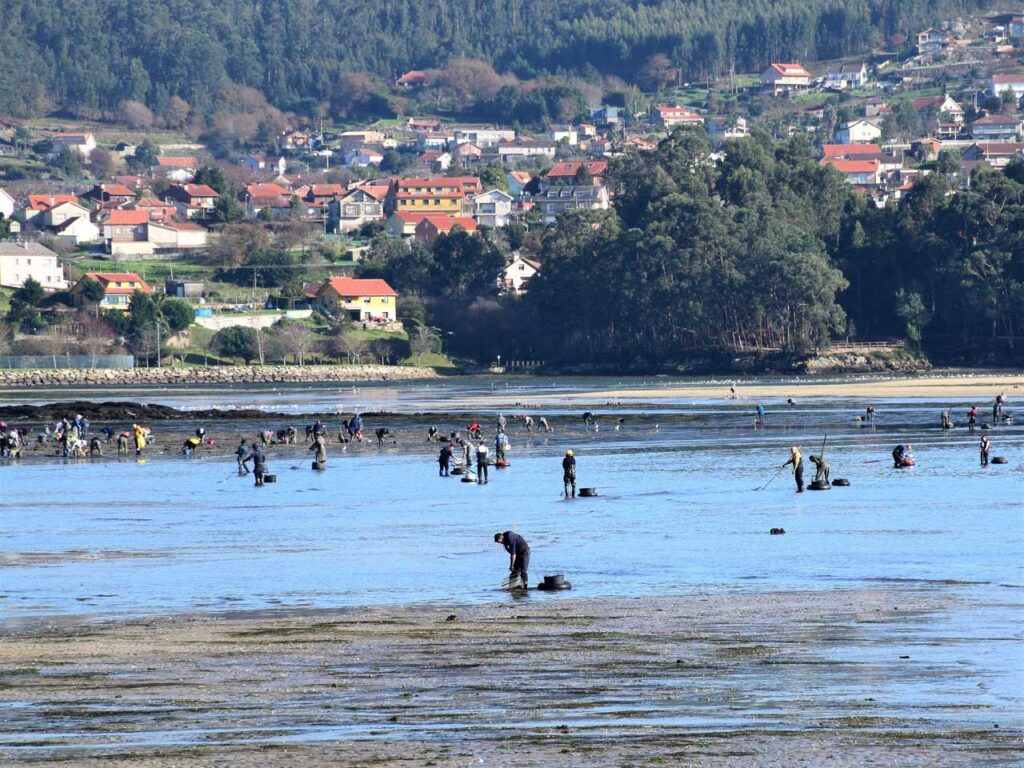
The art of shellfishing on foot is mainly pursued on beaches and rocks. The origin of these resources exploitation dates back to distant times. There is evidence that since the Middle Paleolithic, seafood was already consumed. Also, in Roman times, oysters, clams, and cockles were a delicacy, with which they traded, and their shells were also used as ornaments and beads.
Traditionally, it is an art carried out mostly by women, and to exert it, they have an Operating Permit (Permex). Nowadays, more and more men are joining this art of fishing.
The capture on foot depends on the tides; it is carried out when these are low, leaving the shellfish gatherers barely four hours to perform their job. The tide depends on the moon and is delayed about 50 minutes each day. Thus, this art relies entirely on the schedule and the calendar.
The species mainly caught are clams, cockles, barnacles, and razor clams (Ensis). Curiously, shellfishing on foot customarily uses the same tools as those employed in the fieldwork, only that these are adapted to remove the sediment in search of the precious mollusks. Thus, the clam hoes (sacho), the scrapers, the hoes, the rakes, the sickles, the hooks, clam rakes or clam basket rake, and knives are fundamental components to carry out this work.
They are simple tools used with determination by the female shellfish workers. The using the clam-hoe is an art, which simply consists of sticking the hoe in the sand and stirring it, leaving the mollusks uncovered. Whereas, in the rocks, they used the scraper tool, which has a rectangular iron blade with a wood or metal handle, employed to remove barnacles and mussels from stones.
To learn more
The geography of the Galician coast represents 31% of the 4,830 Kilometers of the Spanish coastline. In Galicia, there are about 3,970 people engaged in shellfish on foot.
Mainly women carried out this activity representing 90% in the sector. They are self-employed, which means that they are independent workers; therefore, no one monitors their work conditions and risks or work-related diseases.
Over time, shellfishing on foot has undergone a significant transformation from an individual and pure extractive work to an organized one, as mollusk culture production needs to be added to the extraction operation. This way, complementary jobs arise, such as transfer of seeds, cleaning and surveilling of shellfish banks, semi-cultures activities necessary to improve production, and other care activities, namely control, monitoring, and protection tasks.
Such complementary tasks, together with the government rules for exploitation and their implementation, are essential to achieve sustainable exploitation of shellfish banks.
Shellfishing occurs on the edge of the beach, onshore, in the intertidal zone denominated "dry;" also in the water, the subtidal area called "wet," where workers submerged to their chest; and also, in a mixed-mode in between intertidal and subtidal zones.
In general, the tasks developed by the shellfishing workers are the extraction of breeding and bivalves for sale, marketing, or transfers, as well as, reseeding, cleaning, surveillance, transport of tools, and other catches.
To know it better
The art of fishing on foot is carried out on beaches and rocks to catch species such as barnacles, cockles, or mussels, among others. The most commonly used tools for collecting these products are a clam-hoe (sacho), a clam-rake (angazo), a sickle (fouciño), a fish spear (fisga), or a scraper (rasqueta). In addition, it is striking that these tools are also often used for fieldwork.
The clam-hoe (sacho) is one of the most used and is composed of a shovel-like piece that is nailed into the sand to uncovered the mollusks. The clam-rake (angazo) is a rake-like tool that can expose species such as clams, cockles, or wedge clam (Donax trunculus; in Spanish "coquinas"). The sickle (fouciño) involves inserting the tip of the tool into holes to lift the sand. Finally, the scraper is used to detach mussels or barnacles from the rocks.
In Galicia, there are different ways to get fish and seafood. Shellfishing is the activity by which different species of shellfish are extracted and obtained. This activity has been developed for many years, and sometimes, it becomes particularly dangerous since female and male shellfish workers face strong swell when standing extremely close to the rocks.
They used two techniques to catch mollusks, one is shellfishing afloat, and the other is shellfishing on foot.
Gallery
Location
- Municipality
- Baiona
- Province
- Pontevedra
- Country
- Spain
The asset
- Type
- Fishing gear
- Eco-destination
- Ría de Vigo
- Environment
- Natural
- Relevance
- Regional
How to get there
- Access
- By sea By land
- Distance
- 0 km
The visit
- Accessible
- No
- Parking
- No
Coordinates
- Latitud
- 42.11818400
- Longitud
- -8.84484700