
Monterreal Castle

About this heritage
The castle of Monterreal (Royal Mount), dating from the 2nd century B.C., is located on Mount Boi, a small peninsula next to the port and a heritage reference of the town of Baiona. The Catholic Monarchs granted to the enclosure the settlement charter, beginning a period of commercial splendor that gradually lost importance until it was uninhabited in the nineteenth century.
The fortress can be visited any day of the year to enjoy the magnificent sunsets over the estuary and the Cíes Islands. The access gates to the fortification and the towers (Porta do Sol, Principe, Tenaza, and Reloxo) stand out, and the old 19th-century Elduayen Lordly House (Pazo) was extensively modified in the 1960s to house the current Parador Hotel.
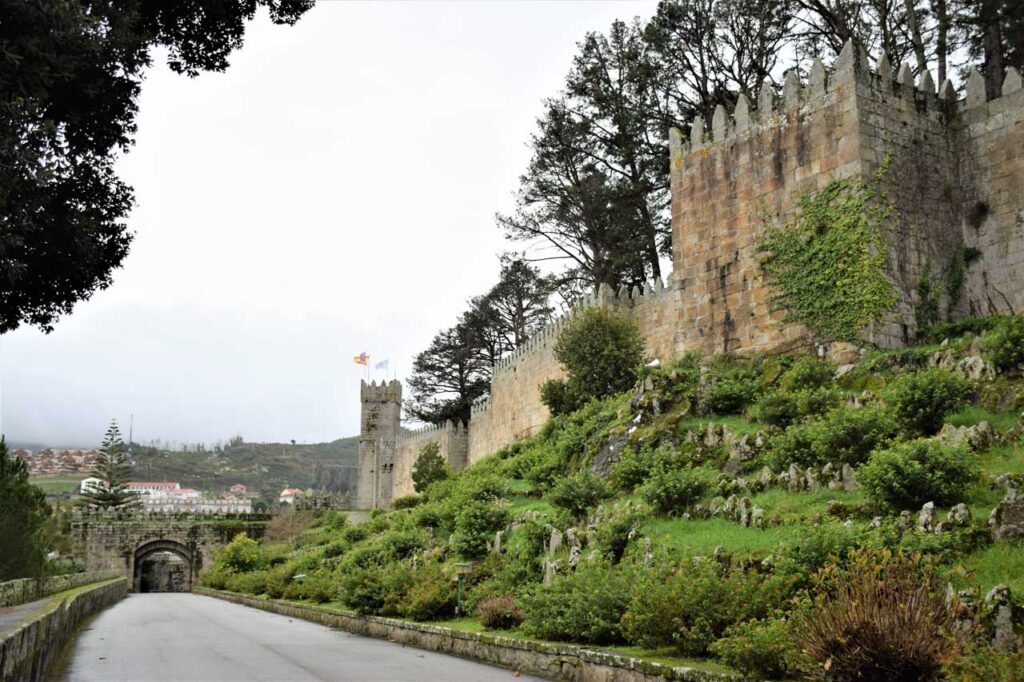
The Parador Hotel "Conde de Gondomar" (Count of Gondomar) is one of the best situated in the entire network of Paradors. It has an area of 180,000 m2 and three kilometers of defensive-wall, built in the 14th century by the King of Castile, like the rest of the Spanish Paradors, the one in Baiona is decorated with Castilian furniture and complements from other periods. In its enclosure are preserved the old defensive towers that were part of the castle.
It has an infinite number of corners, rooms with different atmospheres, and spacious rooms overlooking the bay. Its gastronomic offer is excellent, based on a menu that distinguishes the typical Galician specialties. The Parador - half-medieval fortress and half Galician Lordly House (Pazo) - occupies the Monterreal peninsula, a splendid viewpoint over the ocean surrounded by a beautiful forest of native vegetation.
To learn more
The fortress of Monterreal is the patrimonial reference of the town of Baiona. The primitive walled enclosure dates from the 2nd century B.C. Later, Alfonso IX of León (late 12th century, early 13th century) ordered other relevant works and Felipe IV, who was the promoter of significant reforms to the walls. The current building replaced the one assigned by the Marquis of the Lordy House (Pazo) of the Mercy (Merced), Don José Elduayen, as a summer residence, on the old site occupied by the ruins of a Franciscan convent.
The current complex is distributed within an area of around 18 hectares, combining classical elements of a marked military character with modern elements created as a consequence of the establishment of the Parador Nacional (National Parador). Highlights include: the Puerta del Sol (the Sun Gate) - the oldest of the three passways to access the interior – the Torre da Tenaza (the Pliers Tower) formerly used as a ammunitions stockroom and a prison, the Royal Gate of the 16th century emblazoned with a large coat of arms of the house of the Austrias, the Felipe IV Gate honoring this monarch, the clock tower of considerable height and crowned by battlements, and the Prince named probably due to the historical fact that around 1137 Prince Alfonso Enriquesuso of Portugal was the prisoner of Alfonso VII.
It has an excellent state of conservation, currently belonging to the "Ministry of Energy, Tourism, and Digital Agenda," which holds the Parador Nacional Count of Gondomar, an L-shaped building and typical Galician manor house architecture, very in line with the environment. The fortress can be visited any day of the year, where it is delightful to watch the magnificent sunsets over the estuary and over the Cíes islands and the maritime line over which Baiona lies.
To know it better
The Baiona County, located in the province of Pontevedra, has an impressive building, the Castle of Monterreal or also known as the Fortress of Monte Boi. This fortification counts on a strategic and privileged position, which prevented that different pirates and corsairs, and even Portugal, could attack the zone.
In the 14th century, the town was taken over by our Portuguese neighbors, and unfortunately, it was razed to the ground. Subsequently, the recovery construction work began on the walls and a tower. During the 15th century with the Catholic Monarchs, March 10, 1493, should be highlighted as a key date, since Baiona became the first European port to know about the discovery of America, as Martín Alonso Pinzón docked on its coasts after his trip.
Nowadays, the castle wall maintains three towers that were used to watch over the fortress: Torre del Reloj (the Clock Tower), Torre de la Tenaza (the Pliers Tower), and Torre del Príncipe (the Prince Tower). The latter is the oldest, and where Prince Alfonso Enriquez of Portugal was imprisoned in the 12th century.
The town became the residence of military governors, including the Count of Gondomar. Subsequently, it was transferred to private ownership until 1963, when the Parador Hotel "Count of Gondomar" was installed and promoted by the then Ministry of Information and Tourism.
Gallery
Location
- Town
- Baiona
- Municipality
- Baiona
- Province
- Pontevedra
- Country
- Spain
The asset
- Type
- Castle
- Eco-destination
- Ría de Vigo
- Environment
- Urban
- Relevance
- International
How to get there
- Access
- By sea By land
- Distance
- 0 km
The visit
- Visitable
- The fortress can be visited any day of the year
- Accessible
- No
- Parking
- No
Coordinates
- Latitud
- 42.12432100
- Longitud
- -8.85048900