


Pontevedra. Roman Bridge of Ponte Sampaio. Battle of Sampaio
About this heritage
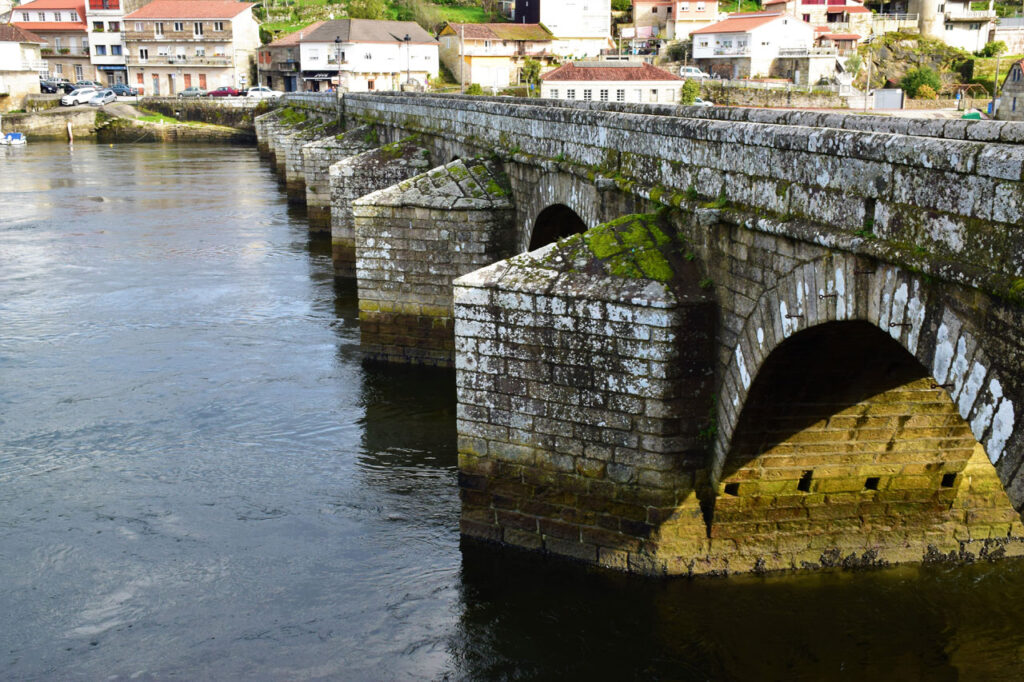
The Roman bridge of Ponte Sampaio is of medieval origin and gives its name to the parish where is located, Pontesampaio in Pontevedra. It joins the Pontevedra and Soutomaior counties and is at the mouth of the Verdugo River. The bridge has undergone modifications and reconstructions during the 16th and 17th centuries, and despite its age, it supports the traffic of vehicles even today. The Portuguese Way to Santiago de Compostela passes through this enclave. History tells that in 977, Almanzor crossed this bridge to continue towards Compostela on the Roman road of the Canicouva.
The Roman bridge is 144 meters long and made up of ten semi-circular arches and robust cutwaters that rest on a rock. Between the 10th and 11th centuries, the Counts of Burgundy owned the bridge; references from that period called it "San Paio de Lodo Bridge." The legend said that there was a fortress nearby the bridge, where the armies of Lady Urraca and Archbishop Gelmirez clashed. At that time, there was a toll to cross the river on the bridge, until the 12th century, when Archbishop Gelmirez arrived and canceled it.
The battle of Sampaio, during the War of Independence, was the last in Galicia against Napoleon's army. It took place on this Roman bridge during the seventh and eighth of June 1809, when the French army under the command of Marshal Michel Ney, Duke of Elchingen, was defeated, ending the French occupation of Galicia.
To learn more
The Roman bridge of Ponte Sampaio is of medieval origin formed by ten semicircular arches located at the mouth of the Verdugo River. Near the bridge, there is a recreational area composed of a children's playground, a picnic zone with tables, a football field, and a fluvial beach by the river. History tells that in 977, Almanzor crossed this bridge to continue towards Compostela along the Roman road of Canicouva. Besides, in its surroundings, everyone can appreciate rustic houses with ornamental motifs, such as commemorating plaques of the battle that took place there.
The battle that took place there is the Battle of Sampaio, where Napoleon's French troops commanded by Ney and Soul fought against the Spanish army and the people's militias. At the end of March in1809 in Galicia, when the sixth corps of the French army withdrew, the Spanish recovered the Vigo, Tui, and Pontevedra squares. However, a few months later, on the seventh and eighth of June, the French troops returned intending to recover what had been lost; thus, they had to cross the bridge. The militias, who hardly had any war weapons, created thick trunks that looked like real cannons, calling them "wooden cannons" ("canons de pau"). Thanks to these fake cannons, they resisted up to twelve explosions, caused by the attacked shots. Thanks to these fake cannons, they resisted up to twelve explosions, caused by the enemy shots. The locals' drive and the militias managed to stop the French troops and forced them to withdraw, this time for good. The year 2009 marked the 200th anniversary of this battle.
To know it better
Pontesampaio or Ponte Sampaio is a parish in Pontevedra, whose name comes from the town hall bridge on the Verdugo River. This infrastructure, of medieval origin, links Pontevedra and Soutomaior Counties. It was here that Galicia and Napoleon's army fought the last battle during the War of Independence. It took place on the seventh and eighth of June 1809, when Galicians definitively defeated the Sixth Corps of the French army, ending the Gallic occupation.
The defeat was thanks to the town's heroes and heroines, along with the troops of the Spanish army. Together, they destroyed part of the bridge to stop the access, preventing the advance of the French.
Located in the northwest of the Iberian Peninsula, Pontevedra is an administrative, architectural, tourist, and service city. A city of art and history, it has a monument area that, after Santiago de Compostela, is the most significant in Galicia.
Gallery
Location
- Town
- Ponte Sampaio ( Santa María)
- Municipality
- Pontevedra
- Province
- Pontevedra
- Country
- Spain
The asset
- Type
- Bridge
- Eco-destination
- Ría de Pontevedra
- Environment
- Rural
- Relevance
- Internacional
How to get there
- Access
- By sea By land
- Distance
- 1,100km
The visit
- Visitable
- Yes
- Accessible
- No
- Parking
- No
Coordinates
- Latitud
- 42.34623200
- Longitud
- -8.60682200