
Rande Strait. Railway remains and tungsten
About this heritage
Near the Rande Strait, there are the remains of a turbulent period, where Vigo was involved in the trickeries of the Nazi army.
Hitler needed a precious mineral called wolfram, which is a metal of exceptional hardness. He used it to armor battle chariots and the head of his projectiles and to harden the shells. The tungsten was used for the filament of the old light bulbs since it has a greater point of fusion than other metals.
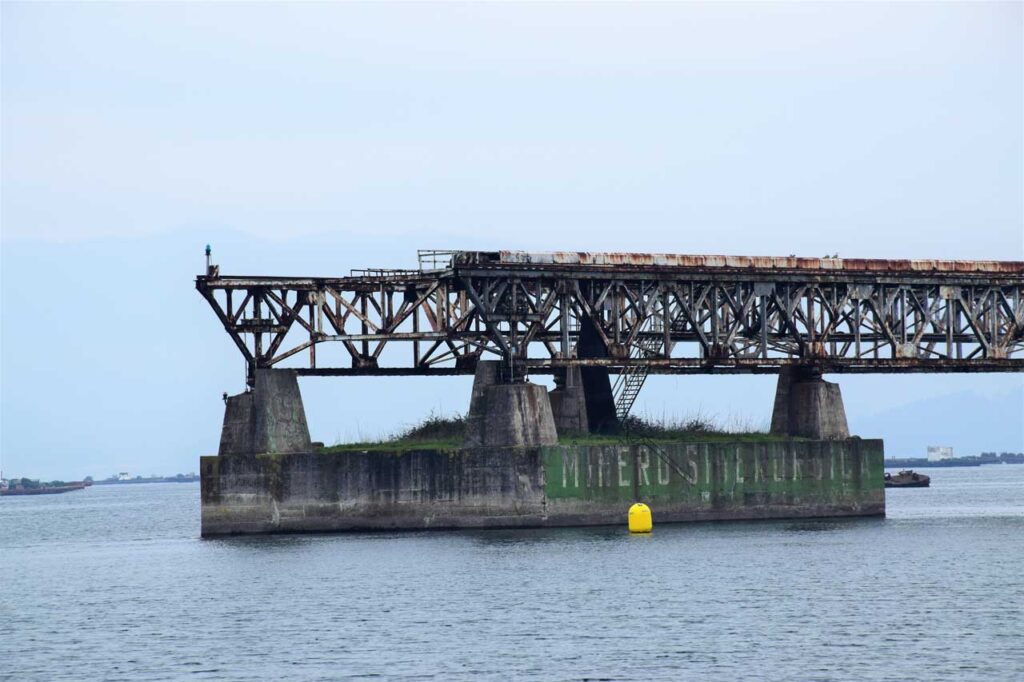
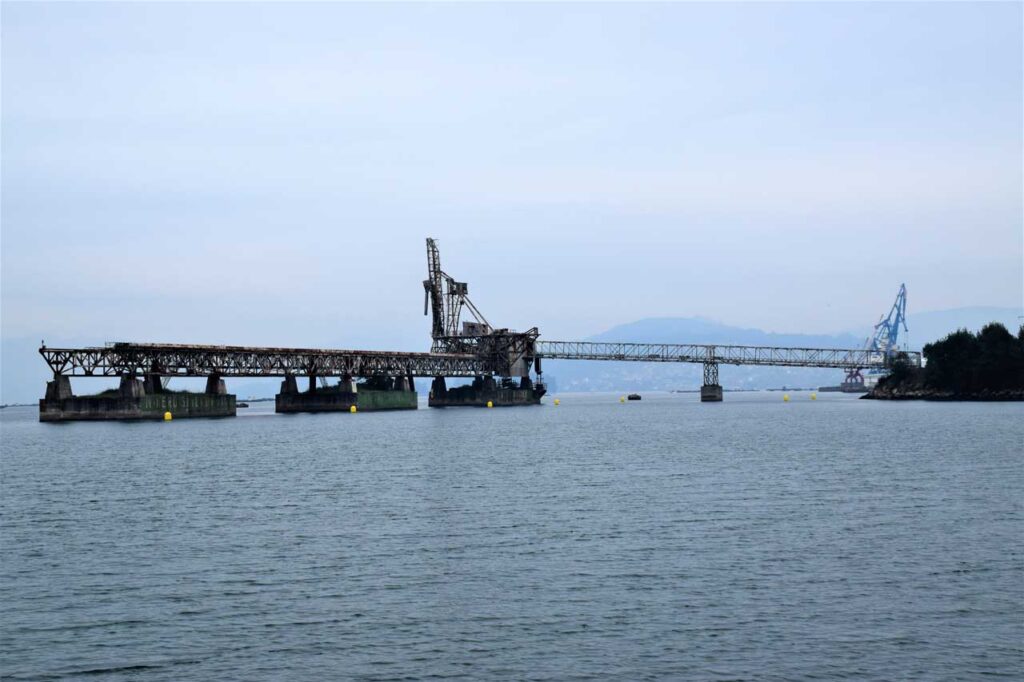
In 1925, the Company of "Minerales de Hierro de Galicia S.A." built an old concrete structure near the Rande Bridge. It was an old loading bay, where the coveted ore arrived by train tracks and loaded onto ships for transport to Germany. This structure was linked to the German Friedrich Wilhelm Cloos, known in Galicia as "Don Federico Guillermo," who settled in Monforte de Lemos to exploit the iron mines of Freixo, in Marcelle.
In 1926, the steamship Estoril made the first shipment to Germany. However, it would be a few years later when "Don Federico Guillermo" himself would put this freighter at the service of Nazi Germany; thus, beginning the economic battle for Wolfram.
The exploitation of this mineral was commanded to Franco's government as a payment for the help given during the Spanish Civil War. Galician wolfram became the only source of supply for the Reich, turning Galicia into a strategic enclave. Between 1939 and 1944, more than 20,000 people worked in the mines of the Community, occasionally resorting to smuggling the precious metal to increase their income.
Vigo became a strategic place for the third Reich in Spain, and the city was the center of activity among spies. On the one hand, German agents managed the material, and on the other hand, the allies boycotted the traffic of tungsten towards Germany, who made "preventive purchases" to raise prices.
On some occasions, the German tankers, already in Galicia to supply the fleet, were used to transport tungsten, heavily escorted by the submarines.
However, in August 1944, the exportations stopped, after a meeting in the Pazo de Meirás between General Franco and the British Ambassador Sir Samuel Hoare. Among other things, they required the Spanish ports to stop receiving German ships and halted the trade-in tungsten. Moreover, the dictator received an ultimatum with the threat of an allied invasion of the Peninsula, possibly through Galicia. That same year, the US Department of State included "Minerales de Hierro de Galicia S.A." in its blacklist. Other German companies and German Vigo residents were added to the blacklist, as well as some citizens of Spanish nationality, with whom the US government forbade their citizens from trading due to the Second World War.
Nevertheless, this mineral continued to be exported from a small pier, the Valarés Port in Ponteceso in the northwest of Galicia, which became a significant point in Europe for smuggled tungsten cargo.
To learn more
After the civil war, Vigo became a strategic enclave both because of its proximity to the famous tungsten mines and because of its capacity as a refuge port, as well as its geographical position in the center of the eastern facade of the Atlantic.
Estimated in more than two hundred people, the German colony in Vigo gradually established themselves in the most favorable positions within high society. There were multinationals, such as the Deutsche-Atlantische Telegraphengesellschaft cable company. Moreover, there were also a strong colony of industrialists and some traders attracted by the regular shipping line that linked Vigo to Hamburg, as well as entrepreneurs of business, such as the Küne orthopedic shop, the Kindling or Meyer naval companies, the Vorkauf chemical company, and the Steinbürggen household appliance shop, which survived over time.
In 1933, the presence and influence of the German National Socialist Party were noticeable relevant. The so-called "Lighthouse Passage" installed during the First World War in Columbus Street (Calle Colón), was used by citizens to report on Germany's progress on slates and banners since there was no radio or written press.
The presence of this colony became much more visible in the city, with Hitler's rise to power. Everyone could see Swastikas on the main streets of Vigo, and in the famous German School, founded in 1910, the first section of the Vigo Hitler Youth was created. The film "The Nazi Triumph in Germany" was screened in the García Barbón theatre. A consulate was established in the Olive City, which would later become the nerve center of the Nazi influence in the city, with its own Gestapo officials.
The local Franco government, although a neutral country, expressed its support by allowing and celebrating a military parade on May 26, 1929, the embarkation of the Condor Legion. Five thousand soldiers paraded through the Puerta del Sol, La Farola de Alfonso, and down Urzáiz Street until they reached Berbés, where the legions embarked on five transatlantic ships: the Wilhelm Gutlof, the Stuttgart, the Sierra Córdoba, and the Robert Ley.
Vigo's position as a neutral refuge allowed both contenders to receive help and support for 24 hours. In 1942, Germany established a permanent fuel supply base, with the Bessel freighter in the middle of the estuary, so that German ships could be supplied and refueled in record time. The city's code name for open communications was "Bernardo." The Vigo estuary was "the wolves' lair," as Commander Doenitz, head of the U-Boots submarine fleet, called it.
Nowadays, there are three sunken wrecks near Vigo. The U-506 sunk by the American plane Liberator, causing 48 deaths. The U-134 sunk by the RAF off the Cíes Islands. The U-523 sunk by two British frigates, with 17 deaths, as well as many others located from Vigo to Baiona and A Guarda.
After the Second World War, Vigo took an important role in European history. The German high command started the operation "Derr Spinner," which dealt with the escape and safety of the high command and German officers to neutral countries. The port of Vigo was the main destination for transatlantic flights from South America and played a fundamental role in the face of the passivity of Franco's regime and a certain complexity of the British MI6.
To know it better
Redondela is a municipality in the province of Pontevedra that has been inhabited since time immemorial because, on Monte Penide or Monte Mirallo and Ventosela, different remains of dolmens, petroglyphs and rock carvings have been found that prove it.
Near Redondela, there is the Rande bridge that connects the municipalities of Redondela and Moaña. In this area, the so-called Battle of Rande took place many years ago. This was a major naval battle that occurred on October 23, 1702 in the Rande Strait. The Rande Strait is between Punta da Besta and Punta Rande and is the widest part of the Ría de Vigo.
Near Rande, one finds the ruins of the old loading bay, belonging to the company "Minerales de Hierro de Galicia S.A." There, the iron ore was loaded onto ships and destined for Germany, since it was an essential raw material for heavy industry, and therefore, crucial for the armament of the Nazi army. In Ponteceso (A Coruña), the Nazis also loaded a chemical element, tungsten.
Gallery
Location
- Locality
- Rande
- Municipality
- Redondela
- Province
- Pontevedra
- Country
- Spain
The asset
- Type
- Site
- Eco-destination
- Ría de Vigo
- Environment
- Maritime
- Relevance
- Regional
How to get there
- Access
- By sea By land
- Distance
- 0 km
The visit
- Accessible
- No
- Parking
- No
Coordinates
- Latitud
- 42.28461000
- Longitud
- -8.65969000