
San Simon Island Natural Heritage
About this heritage
San Simón is an area of sediment, much muddier than the outside of the estuary, where there is pounding of the waves. It is a very diverse and complex area, an ecosystem in which, throughout the year, the temperature and salinity vary considerably. In winter, the Verdugo, Oitavén, Alvedosa Rivers are abundant while in summer, the temperature is much higher, requiring specialized fauna and flora, very adaptable to these changes. Cataloged as a Special Conservation Area within the Natura 2000 Network, it has an extension of 2252 hectares, of which 94% are coastal marine waters. It is also included in the Special Protection Area of Natural Values (ZEPVN).
There are extensive marine meadows that are not formed by algae, but by terrestrial plants that have adapted to live in the sea. These are the so-called marine eelgrass or Zostera marina meadows, observed at each low tide. It is grass, therefore, without woody organs, easily recognizable by its long and thin stems like ribbons of up to one and a half meters that sometimes, the tides throw onto the beaches, which in this way fertilize. The Zostera are efficient natural purifiers, which fix in their roots and tissues a good part of the pollution reaching the San Simon Cove. They also serve as a refuge and food for the zooplankton and phytoplankton on which the bivalves feed. This type of ecosystem has as its enemy the rakes used for seafishing since they move the seabed and tear them off. Somehow, shellfisheries should consider the damage because they will end up losing the production of bivalves. These meadows are one of the reasons this cove is a protected natural area at the European level.
The list of species of flora and fauna intimately associated with the Zostera Marina is very extensive; however, cuttlefish inevitably stand out in this bay for finding in these meadows the perfect habitat to complete their life cycle and lay their eggs. There is a saying in the local popular culture that says "para peixe fresco Vigo, para chocos Redondela" (for fresh fish Vigo, for cuttlefish Redondela)
Every year at the beginning of winter, at the end of December or the beginning of January, they use this grass to carry out reproduction, when the adults, both males, and females, begin to enter the cove for its suitability for breeding. Then the hatchlings that emerge from the eggs have abundant food in these coastal areas.
To learn more
The San Simon Cove is in the Vigo Estuary, at the mouth of the Verdugo River, between the Moaña, Pontevedra, Redondela, Soutomaior, and Vilaboa counties, forming a large marine coastal-plain rich in bivalve shellfish and numerous wintering birds. In its waters, flow centuries of history, chanties, pirate attacks, battles, and other recent fatal events.
It is eight kilometers long and almost four kilometers wide, which decreases to approximately 700 meters in the Rande Strait. Cataloged as a Special Conservation Area within the Natura 2000 Network, it has an extension of 2252 hectares, of which 94% are coastal marine waters. It is also included in the Special Protection Area of Natural Values (ZEPVN).
In the northwest end are the remains of old salt mines, the Salinas do Ulló, currently, filled and colonized by vegetation adapted to salinity. The space includes several rocky islets, namely Alvedosas, San Simón, Lobeira, and San Antón, opposite the Verdugo River mouth between Arcade and Ponte Sampaio.
The San Simon Cove includes more than four hundred hectares of sandy-loamy esplanades and intertidal habitats. It characterized by marine eelgrass (Zostera sp.) beds. This seagrass creates an essential ecosystem for its purifying properties. It is cuttlefish (chocos) clutching area, entering the estuary and serve as a refuge and food for the plankton, on which the bivalves feed.
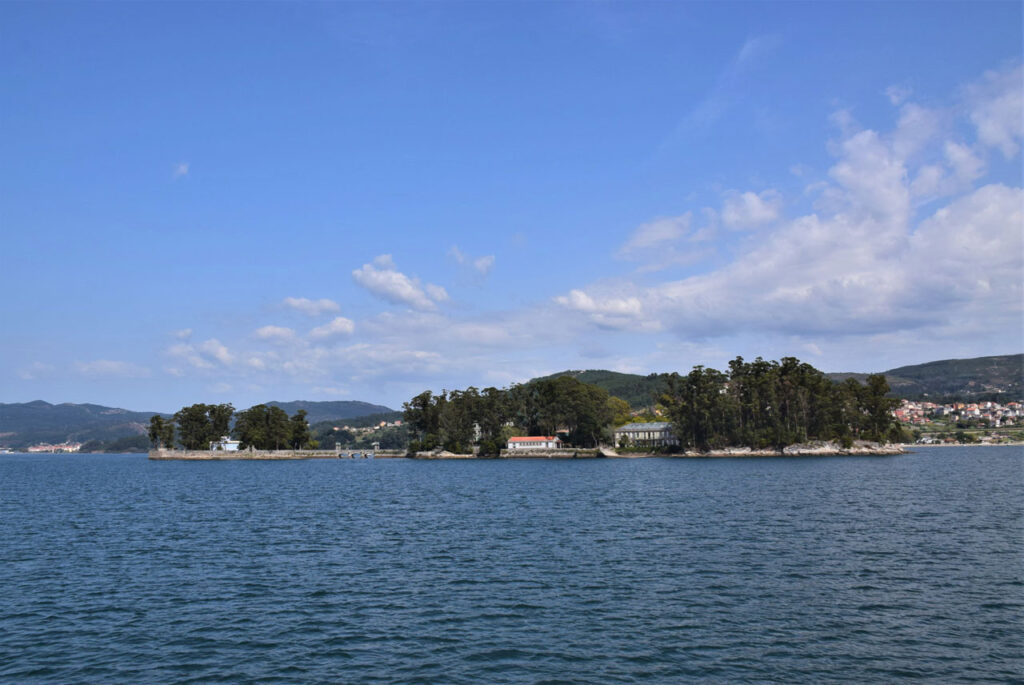
It is home to the San Simon archipelago, comprised of four islands: San Bartolomé, San Antonio, San Simón, and San Norberto.
On San Simon Island has centuries of history, divided into four stages. From the 12th to the 19th century, where various religious orders suffered multiple naval incursions. Afterward, they built a lazaretto or quarantine station for maritime travelers, which operated from 1838 to 1927.
In 1936, it was converted into a concentration camp for Republicans and came to house more than four thousand political prisoners. After the civil war, in 1948, the island was a shelter by Franco's guard, where forty-three officers drowned near Corveiro Islet when returning to the island after playing a football match on Cesantes beach.
Finally, from 1955 to 1963, it was reconverted into an orphanage for the children of sailors, where they would learn the trade of the sea. In the nineties, the area was restored and declared a Site of Cultural Interest.
To know it better
Near Redondela, the Rande Bridge linkns the Redondela and Moaña counties. In the Vigo Estuary, one finds the San Simon Island, which belongs to the Cesantes parish within the Redondela County, and currently uninhabited.
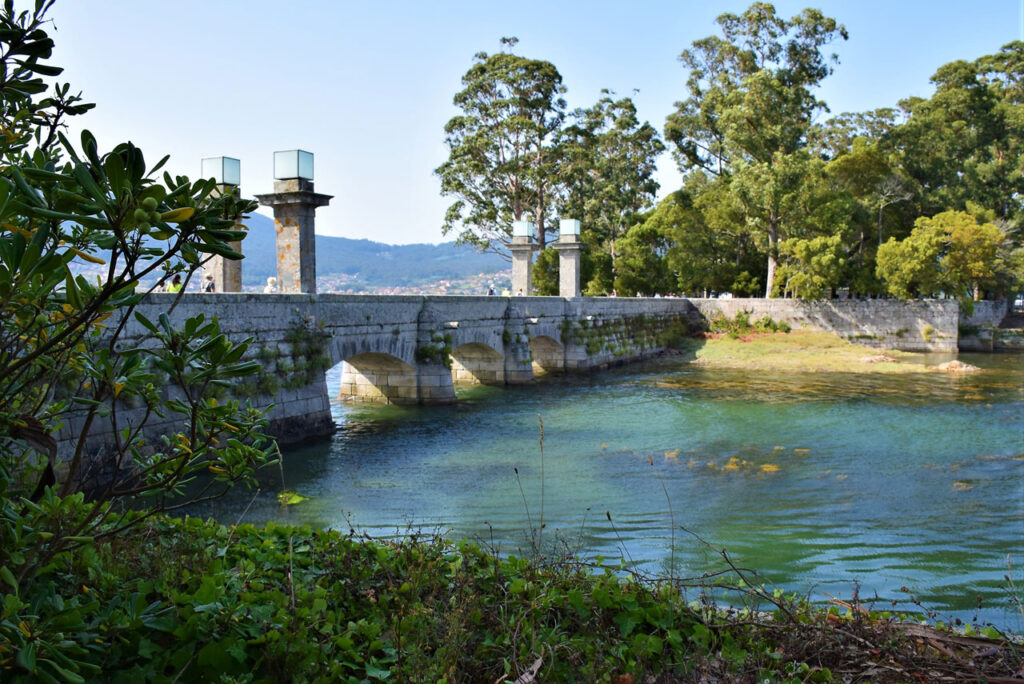
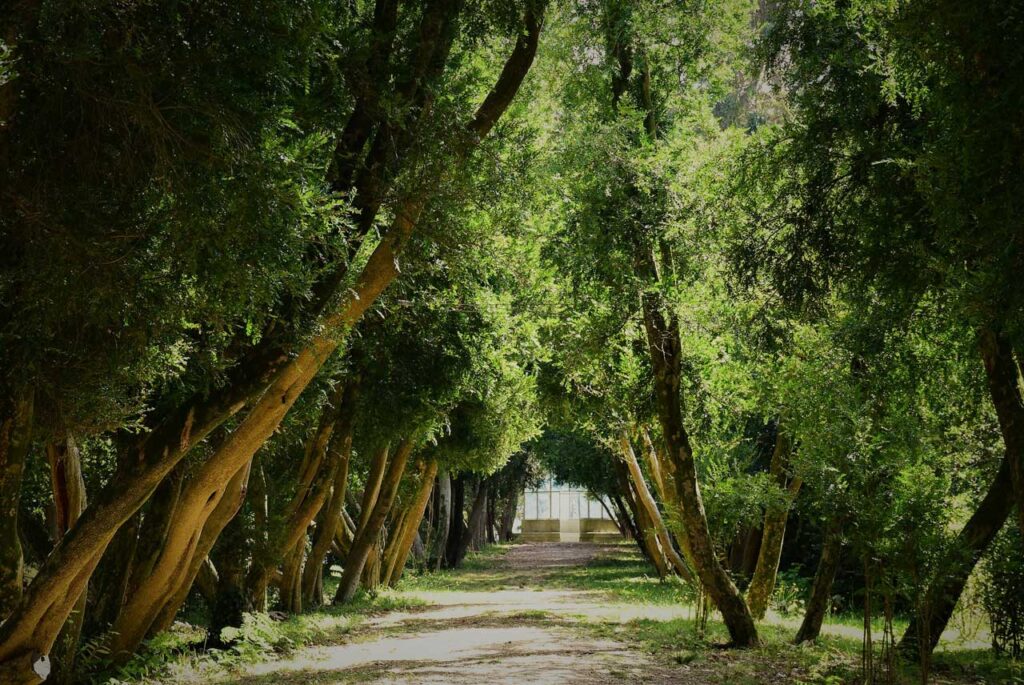
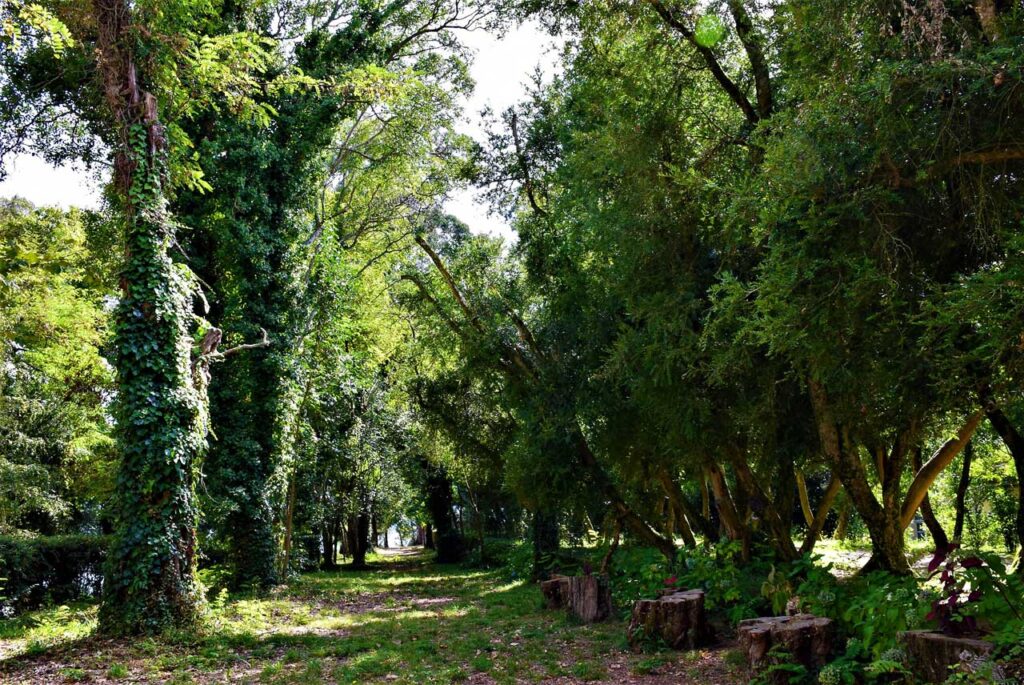
The island has a rich landscape: parks and gardens with a fabulous personality. The strength of the vegetation blends with the stone of the cliffs, the piers, and the waterfront. Different species: Canarian palms mixed with horse chestnuts, oaks, acacias, eucalyptus, Atlas cedars, Chinese bushes, and Japanese camellias. Besides, San Simón also has a small vegetable garden and nursery area to promote the memory of those products that once came from other parts of the world, such as potatoes, corn, or kiwi.
Currently, San Simon Island is a public space for the cultural development of Galicia. In 1999, the Regional Government (Xunta) of Galicia declared it an Asset of Cultural Interest. It is also part of the Natura 2000 Network as a protected European natural habitat.
Gallery
Location
- Locality
- Cesantes
- Municipality
- Redondela
- Province
- Pontevedra
- Country
- Spain
The asset
- Type
- Island
- Eco-destination
- Ría de Vigo
- Environment
- Natural
- Relevance
- International
How to get there
- Access
- By sea By land
- Distance
- 0 km
The visit
- Visitable
- Yes
- Accessible
- Sí
- Parking
- No
Coordinates
- Latitud
- 42.30941300
- Longitud
- -8.62942300