


The Goose Barnacle
About this heritage
The Goose Barnacle (Pollicipes pollicipes; Gmelin, 1790) is a type of arthropod constituting the infraclass Cirripedia in the subphylum Crustacea; hence, related to crabs and lobsters. In other words, it is a cirripede crustacean that lives in rocky coastal zones strongly beaten by the waves; thus, very oxygenated. An optimal place for them due to their low oxygen transport capacity.
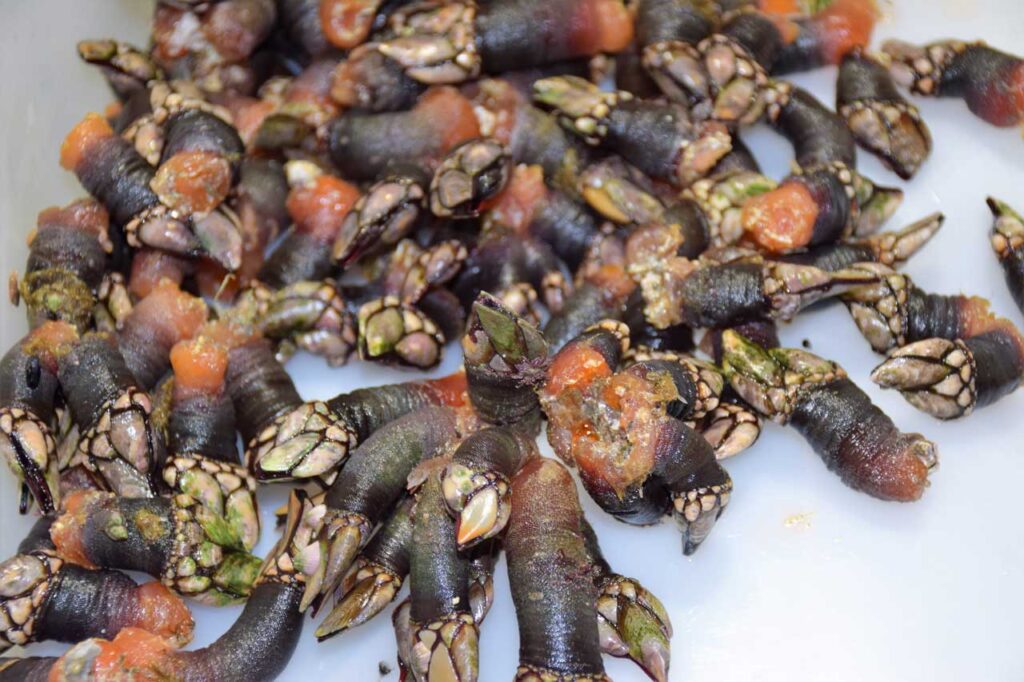
The edible part of the barnacle is the peduncle, and externally presents a purple and hard skin, made by small overlapping scales, which ends in a nail, called the capitulum, partially calcified and formed by several pieces or plates.
The peduncle or foot is composed of brownish-brown calcareous spicules, which give the barnacle the hardness and the ability to resist the conditions of the rocky substrate exposed to sea blows, forming bundles or groups with other congeners. It adheres to rocks thanks to the segregation of a substance from its cementitious glands. The Galician barnacle is thicker and darker than the one coming from Morocco, and its nail (capitulum) is sharper and reddish with fewer plates than the Canadian one.
The barnacle cover is commonly known as the barnacle nail, due to the appearance conferred by a series of grayish-white calcareous plates. This nail or capitulum opens or closes protecting the animal from the attack of a possible predator, and also from the desiccation during the low tide, where the water level descends and the animal is exposed.
Under these plates appear most of the vital organs of the barnacle. There are six pairs of cirrus and the mouth, the first link in the animal's digestive system. The cirrus acts as mobile appendages whose function is to capture food from the medium and transport it to the mouth.
The minimum size of the barnacle capture is 1.5 cm in diameter at the base of the capitulum.
To learn more
The infraclass Cirripedia includes the extremely familiar marine animals known as barnacles. The barnacles are the only sessile group of crustaceans, except for the parasitic forms. It is one of the unique groups of the subphylum Crustacea. Reason whereby the relationship between barnacles and other crustaceans was not recognized until 1830.
They are exclusively marine animals, and almost 900 species have been reported, of which two-thirds are forms of free life, which adhere to rocks, shells, corals, floating cans, and other even objects.
This species is distributed along the European and African coast of the North Atlantic, entering the Mediterranean as far as the Alboran Sea and Algeria.
The barnacle has its body divided into two parts: the capitulum and the peduncle.
The Ministry of the Sea regulates their capture through specific resource management plans. It can be caught on foot or by boat using a scraper to separate it from the rocks. They are available all year round.
The size of the barnacle is measured by the larger diameter of the base of the Capitulum, at the height of the lower plates (from the base of the rostrum to the base of the carina). When presented as bundles, at least 60% of the weight has to be formed by specimens of not less than 1.5 cm.
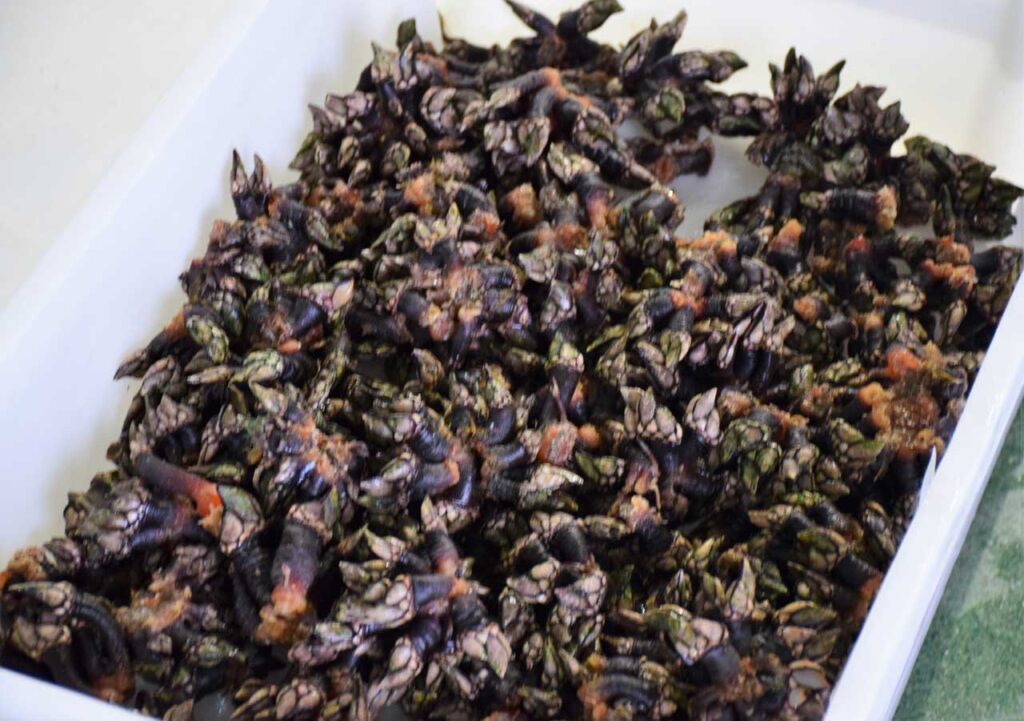
Barnacles have two clearly differentiated life stages, a first larval stage, in which they are part of the plankton, and a second stage, where they adhered to the rocks to live in a sessile form. This adherence onto the rock takes place after the larva's search of a suitable substrate to fix itself employing the gland of cement that secretes a substance allowing such attachment onto the rocks, always in zones very beaten by the sea. They form groups or bundles of up to 100 individuals. It feeds by filtration of plankton organisms and suspended particles.
Pollicipes pollicipes reproduces sexually and is a simultaneous hermaphrodite. In general, barnacles present internal cross-fertilization, with one of the individuals acting as a functional male and another as a functional female. The gregarious character of the species facilitates this fertilization, after which the embryonic development takes place inside the prosoma, forming small sheets known as egg sacs.
They are eaten cooked, if possible in seawater, with a bay leaf. By placing a cloth on top of the plate, where they are served, will help to maintain them at the ideal temperature and avoid the loss of humidity. Along with them, you can boil some local potatoes, so they get the flavor.
The average catch in the last five years of the Goose barnacle (Pollicipes pollicipes) was about 23,641.56 kg/year, which represents 11.22 % of the total annual catch in the Baiona fish market. This generated, for the same period, an average income of € 966,792.57 per year. The marketing of this species accounted for approximately 47% of total turnover in the last 5 years, a vital resource for this entity.
In recent years, the change of the management model of this species allowed to recover the level of income with much less marketed biomass.
To know it better
The barnacle is a crustacean of the Pollicipedidae family that is considered a delicatessen, because its meat has an intense taste of sea. This product grows on the rocks, where the waves of the sea break abruptly which makes its capture more complicated.
The adult barnacles have two different parts: the upper part, known as the Capitulum or "nail of the barnacle" and the lower part, the Penduncle, which is the one the part that adheres to the rock. If they are not captured, they live attached and fixed to the rocks throughout their adult life.
In Baiona, the coastline of barnacles managed by the entity extends for about 30 kilometers, from Monteferro Mount to Orelludas Point, and is subdivided into several banks. One of the most representative areas Cape Silleiro. In which, ("percebeiros and percebeiras"), the female and male collectors of goose barnacles perform the dangerous work of searching for these species throughout the year to make their subsequent sale in the market of Baiona in the Pontevedra province.
Gallery
Location
- Town
- Baiona
- Municipality
- Baiona
- Province
- Pontevedra
- Country
- Spain
The asset
- Type
- Fish product
- Eco-destination
- Ría de Vigo
- Environment
- Urban
- Relevance
- Regional
How to get there
- Access
- By sea By land
- Distance
- 0 km
The visit
- Accessible
- No
- Parking
- No
Coordinates
- Latitud
- 42.11818400
- Longitud
- -8.84484700