


Viana do Castelo. Old Town

About this heritage
Viana do Castelo is a coastal city located at the Lima river´s mouth, within the community of Alto Minho. Historically, it is closely linked to the Portuguese Discoveries participation and to cod fishing, which is reflected in this fishing port´s importance.
The old town stands out for its great historical and architectural value of Manueline, Renaissance, Baroque or Modernist inspiration. It has emblazoned palaces, convents, churches and fountains that constitute the city´s heritage.
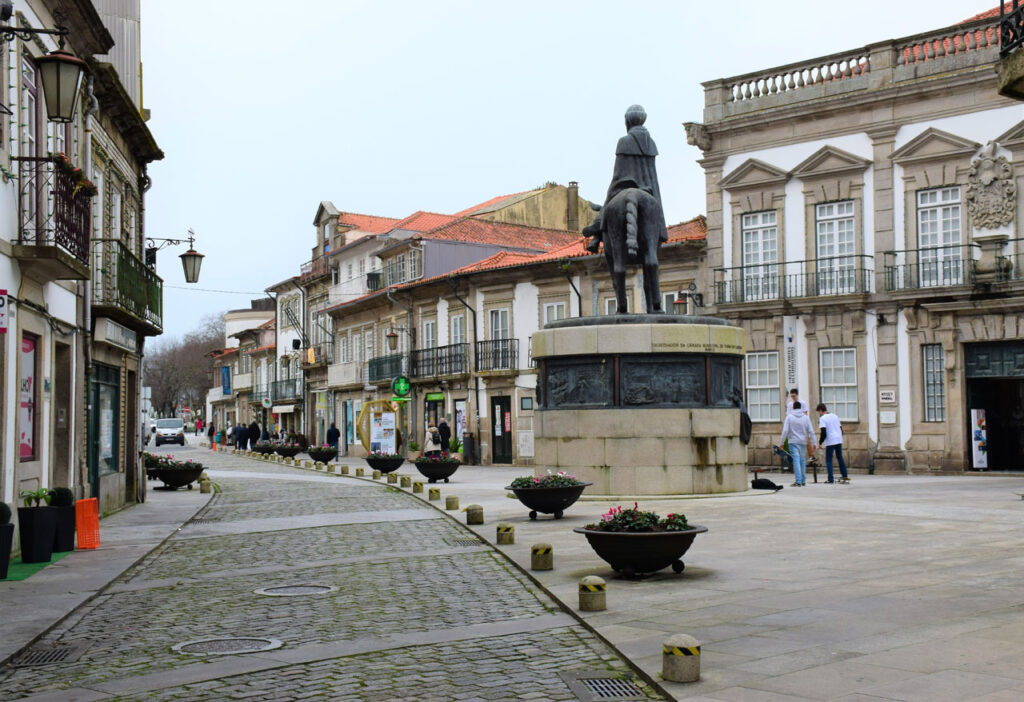
The Praça da República (Republic square) is the centre of the city where the Renaissance fountain known as Chafariz stands out. It was built by João Lopes, the Elder, in 1554 and is crowned with Manueline motifs of a spherical astrolabe and the cross of the Order of Christ.
The surrounding buildings such as the Antigos Paços do Concelho, the old town hall, which dates back to the 16th century and is currently used to host exhibitions. There is also the Misericordia Church (Mercy church), reconstructed in 1714, showing one of the most beautiful tile mosaic decorations in Portugal, created by the artist António de Oliveira Bernardes.
In the back street, is located the Igreja Matriz or also known as Sé de Viana do Castelo, which began to be built in the first half of the 15th century. It was subject to various modifications throughout history, and was finally converted into a cathedral in 1977. Its main portico stands out, with its crenellated towers, the six apostles sculptures and the emblazoned tombs inside, as well as its chapels. It has a mixture of styles such as its Romanesque towers and the Gothic door carved with figures of Jesus and the evangelists.
Nearby is the 18th century Capela das Malheiras, named after the house of Malheiro Reimão, bishop of Rio de Janeiro, who had it built. It is considered one of the best examples of Portuguese baroque architecture, whose design is attributed to Nicolau Nasoni. The façade is highly decorated with carved granite with plant motifs. It is dedicated to Saint Francis of Paul, and inside there is a polychrome wooden altarpiece with a Rococo carving.
A little over 200 metres away, in the Bank of Portugal´s old building, is the Costume Museum, which offers a tour of the traditional dress and craftsmanship of Viana.
Other buildings in the historical centre are the Velho Hospital from the 15th and 17th centuries, which was a former hostel for the Santiago´s pilgrims, founded by João Paes “o Velho" (the elder) in 1468 and restored in the 15th century; the Casa dos Nichos from the 15th century, which has two Gothic sculptures crowned by canopies representing the scene of the Annunciation or the manor houses of Casa dos Costa Barros and Casa dos Abreu Távora, both from the 16th century, which are different from each other but share decorations in the Manueline style.
Starting from the historical centre towards the long 5 of Octubro street you can see the Revolution of the Carnations monument of the 25 of April, of the sculptor Jose Rodrigues, a rectangle of simple lines with a space in the middle that allows to see the sea. A symbol in the middle of the wide Liberty Square, symmetrically guarded by two contemporary buildings, the work of the father of the School of Architecture of Porto Fernando Távora.
Nearby, there is the old Gil Eannes hospital ship that is anchored at the end of Viana do Castelo´s port. This boat used to provide assistance at sea to fishermen off the coast of Newfoundland and Greenland. It is now restored and can be visited. Also, on the same boat, the Environmental Interpretation and Documentation Centre of the Sea is located.
Continuing towards the sea, along the length of Santa Catarina you will come across, forming part of the port of Viana do Castelo, a pontoon where the smaller boats dock. Between Senhor Daniel Machado Street and Os Povoeiros Street, there are has small buildings, usually with a ground floor or a first floor, which correspond to the fishermen´s houses in the area.
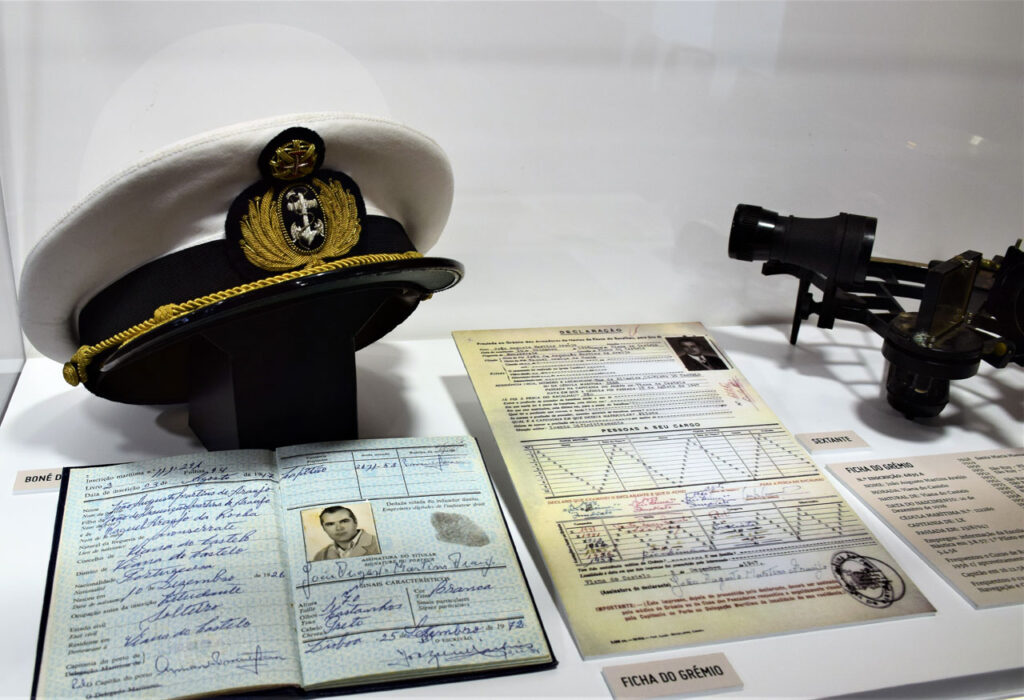
At first instance, we see an establishment made up of a two-storey building that has a shield on its upper part made up of an anchor and two oars crossed on a lifeboat and that reads “Asociación de clase dos marinheiros" (Seafaring class association). Also, in this seafaring district, is the Capela de Santa Catarina, which had originally been placed in Castelo da Barra. Due to the difficult access of fishermen to this chapel, Philip III of Spain authorized the construction of the current temple about 50 meters away from the fishing dock. Inside, you can see miniature wax boats.
In front, the pier is located and you can walk along carrer dos Mareantes where you can find ships, warehouses and workshops belonging to the sailors as well as see the boats.
Next, there is one of the first fortifications located at the mouth of the Lima River: the Santiago da Barra Castle, also known as the Viana Castle, with its characteristic polygonal floor plan.
To learn more
Joining both banks of the Lima river is the Eiffel Bridge. Structure from the iron architecture´s era made from the drawings and calculations of the honourable Eiffel House. It was inaugurated on July 30th, 1878 and allowed not only to start the railway traffic but also to replace the old wooden bridge that connected São Bento in Viana with the river´s left bank.
The bridge is 563 meters long and 6 meters wide. More than 2 tons of iron were needed to build the boards, which are based on nine pillars in granite masonry, whose foundations reach up to 22 meters deep.
On the outskirts of Viana do Castelo, at the top of the Santa Luzia mountain, there is the temple of the Sacred Heart of Jesus, undoubtedly one of the best known and most emblematic monuments in the country.
This basilica has neo-Romanesque, neo-Byzantine and neo-Gothic elements. Its author was one of the architects with the greatest national and international projection at the time, Miguel Ventura Terra (1866- 1919).
The project dates back to 1898 but the work was only started in the early years of the 20th century. The temple was opened to the public in 1926, after the death of its author, and its construction was completed in 1943.
From this enclave, there is a wonderful panoramic view of the valley formed by the Lima river and the city of Viana do Castelo, with its port area, the sands of the opposite bank and the splendour of the mouth of the river.
To know it better
Viana do Castelo is located in the north of Portugal and is known for its industry and shipbuilding. It has a historic centre where the churches, palaces, convents and fountains stand out, and more especially, the Praça da República (Republic square), the 16th century Misericórdia building and the Casa Consistorial.
Viana is known for its fishermen´s protection as it has the baroque church of the Virgen de la Agonía (Virgin of Agony) who is worshipped by sailors which goes out to bless the sea every August 20th. Another symbol of the fishing´s world is the sculpture on the quay in front of the Gil Eannes ship, dedicated to a Portuguese sailor.
The Navío Gil Eannes, built in the same municipality in 1955, is an old hospital ship that is currently a museum and is moored to the port. It served the Portuguese cod fishing fleet.
In the port, it is also interesting to visit the 15th century Santiago da Barra Castle, next to the Lima river´s mouth. This fortification is surrounded by a moat and access to it was by a drawbridge and today it has been declared a Site of Cultural Interest.
Connected to the city, we find the Eiffel Bridge, a metal bridge over the Lima river for vehicles and trains. It was named after the designer, Gustave Eiffel, and was inaugurated on June 30, 1878. Thanks to him, the railroad came to town.
Gallery
Location
- Town
- Si
- Municipality
- Viana do Castelo
- Province
- Distrito de Viana do Castelo
- Country
- Portugal
The asset
- Type
- Old town
- Eco-destination
- Costa Litoral Norte
- Environment
- Urban
- Relevance
- International
How to get there
- Access
- By sea By land
- Distance
- 0 km
The visit
- Visitable
- Yes
- Accessible
- No
- Parking
- No
Coordinates
- Latitud
- 41.68892000
- Longitud
- -8.83818700