


SEAFARING DISTRICT. Personalities and events
About this heritage
Throughout history, Baiona witnessed battles, pirate attacks, and historical events of great significance.
One of the most remarkable dates is 1201 when King Alfonso IX of Leon signed a Town Charter in the Cíes Islands, by which he granted the name of "Baiona" to Erizana, gave crucial jurisdictions and privileges for maritime trades to its inhabitants, and ordered the end of their dependency under the lordship of the Oia monastery.
Another important episode occurred in 1388 when, in his intention to conquer the throne of Castile, the Duke of Lancaster arrived in Coruña with his army, taking Compostela, Pontevedra, and Vigo. A marshal of his army, Motuax, also managed to reach the gate of Baiona with his 1,000 archers and got the surrender of the authorities, without spilling a drop of blood.
In 1425, King John II decided that A Coruña and Baiona were the only Galician ports in which goods from abroad were unloaded; therefore, he authorized Baiona's port to import and export any kind of merchandise. The important event affected the economic development of the Real Villa.
An essential figure was Pedro Álvarez de Soutomaior, known as Pedro Madruga, one of the most distinguished personalities of the Galician Middle Ages, currently considered as the prototype of a feudal knight.
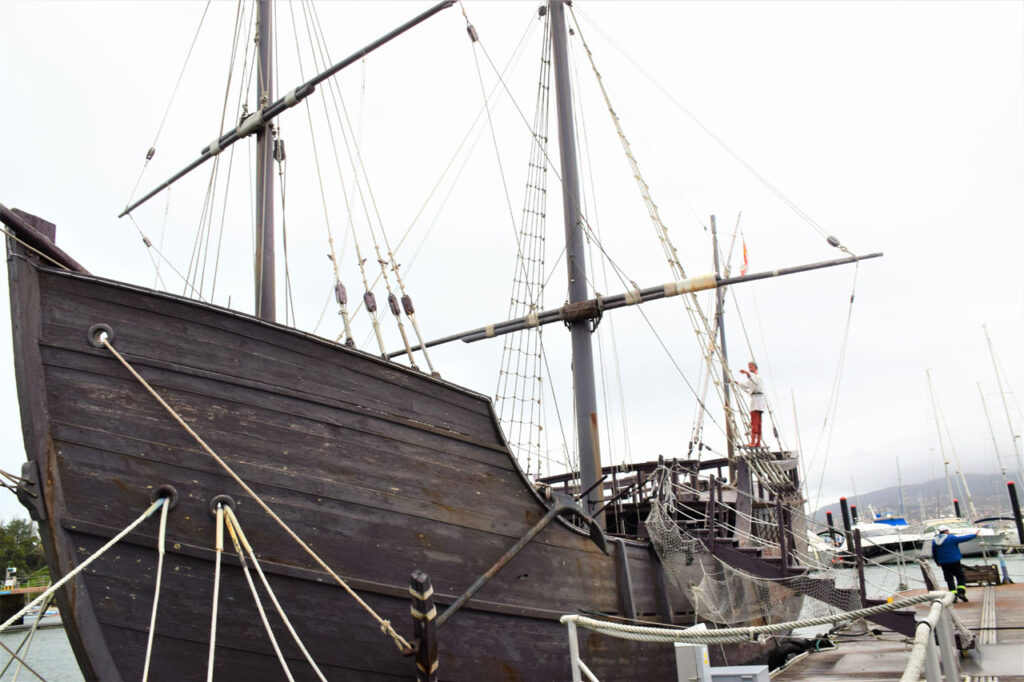
However, the most significant date in Baiona's history is perhaps March 1, 1493. That day, the Pinta Caravel commanded by Martín Alonso Pinzón and piloted by Diego Sarmiento - natural of this region- arrived at its port. Therefore, Baiona became the first town in Europe to hear of the discovery of America.
With the subsequent expeditions, the sailor Diego Carmona Pérez stands out. In 1512, he arrived in Sanlúcar de Barrameda after completing the first circumnavigation of the world, with the expedition of Juan Sebastián El Cano. Another town’s sailor, Vasco Gallego, who was part of the Magallanes' crew and member of the same expedition, died in the Moluccas.
Throughout history, pirates also attacked Baiona. The most significant was Sir Francis Drake, who was not a pirate but a corsair. In 1585, under the command of 1500 men, he attacked the fortress, but the region's population led by the then Count of Gondomar, Diego Sarmiento de Acuña, ordered him to leave the bay.
From the contemporary period, some names are noteworthy, like Ventura Misa de Bertemari (Baiona, 1802- Jerez de la Frontera, 1885). He was a winemaker executive and a Galician philanthropist. He settled in Jerez de la Frontera, and in 1844, along with his brother, Manuel María Misa e Bertemati (Baiona, 1815 - London, 1904), created an important brand for the wine trade. The town council of Baiona has dedicated the name of one of its streets to Ventura Misa.
In the mid-nineteenth century, the Galicians chose to try their luck in the Americas. The Galician famine led about 1.2 million inhabitants to emigrate between 1860 and 1970. Another area affected was the Val Miñor and many were the emigrants who, after succeeding abroad, returned and invested their profits in the development of their region. Such is the case of the Valverde-Cadaval marriage, aunion between Julián Valverde Pérez (1853-1931) and María Victoria Rodríguez Cadaval (1845-1922). In the area of Sabarís, citizens expressed to them appreciation as great benefactors of the environment, and Mayor Herminio Ramos named them "Honorary Citizens of Baiona." They also named after him a street and a square in Sabarís. They contributed to buildings and infrastructures, such as the tramline to Baiona and Gondomar.
To learn more
An essential figure was Pedro Álvarez de Soutomaior, known as Pedro Madruga, one of the most distinguished personalities of the Galician Middle Ages, currently considered as the prototype of a feudal knight. Of bastard origin, he was a bellicose man, who became the most prestigious of the Soutomaior lineage. He was a staunch enemy of Alonso II de Fonseca and defender of the inheritance rights of Juana la Beltraneja. Among his noble titles is that of marshal of Baiona. In 1474, he besieged the fortress of Monterreal, killing many of its inhabitants. He built his Tower-House at the top of the fortress, which after five centuries, is still standing and retaining its original name "Casa de Pedro Madruga."
The arrival of the Pinta caravel in Baiona occurred in a favorable historical context for the town since in 1425 King John II determined that the La Coruña and Baiona ports were the only ones that could unload goods from abroad, authorizing the Royal Villa of Baiona to import and export any variety of merchandise. Thanks to his command, the port of Baiona was essential in southern Galicia and northern Portugal, and its inhabitants enjoyed a healthy socio-economic development.
A date of transcendent significance for Baiona was March 1, 1493, since the Prince's Tower of Monte Boi Castle witnessed the arrival of the famous caravel: "La Pinta," captained by Martin Alonso Pinzon and helmed by Cristobal Garcia Sarmiento. Therefore, Baiona's villagers became the first in Europe to know of the discovery of the New World. Then, Pinzón disembarked on the Ribeira beach after La Pinta had bordered the castle of Mount Boi. The Corregidor of the Villa welcomed Pinzón and its helmsman, Cristóbal García Sarmiento, born in this region, and then, the inhabitants of Baiona, contemplated the passage of the Indians from the Guanahaní Islands, through its paved streets. One of them died in the Villa, and his remains are buried in the fortress of Monte Boi.
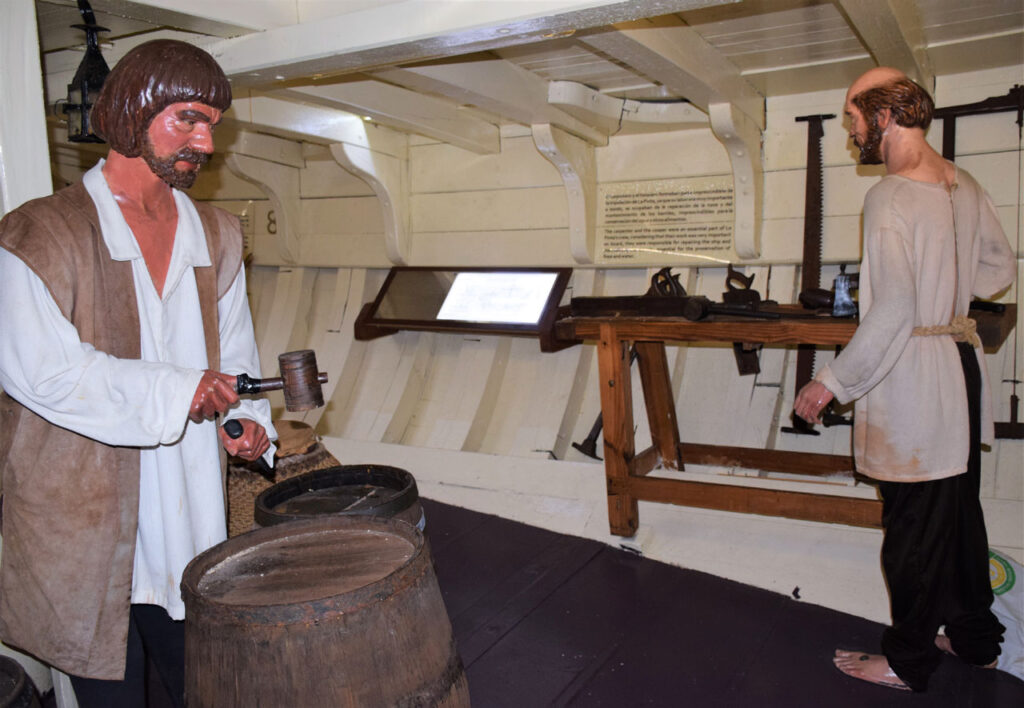
The Pinta caravel spent a few days repairing and replenishing itself. It is said that the barrels were filled by hand in the Pozo de la Aguada, a well that is still preserved next to the rest of the façade of the old fish market. La Pinta left for Palos de la Frontera to join Christopher Columbus on March 11, 1493.
Baiona was also attacked by pirates throughout history. A significant one was the corsair Sir Francis Drake, who, in 1585 under the command of 1500 men, attacked the fortress, but the region's population led by the then Count of Gondomar, Diego Sarmiento de Acuña, ordered him to leave the bay. The Count himself managed to buy the fief of Val Miñor from King Philip II; thus, becoming the ruler of twenty thousand vassals. Later, the monarch himself would help the town with privileges (exemption to serve in the Royal Navy and creation of a Grammar Chair) and would gather in the bay an Army of 17,000 soldiers to defeat the pirates that prowled the Galician coasts.
From the contemporary period, some names are noteworthy, like Manuel María Misa de Bertemati (Baiona, 1815 - London, 1904). He was a winemaker executive, a Galician philanthropist, Count of Baiona, and Marquis of Misa. Among other charitable activities, Manuel Misa donated to Baiona a House School, inaugurated in 1886, currently is the House of the Sea. In 1888, he financed the restoration of the former Collegiate Church of St. Mary of Baiona and built the water supply. Along with his brother Ventura, he paid a whole year of public lighting. He donated money for people in need. He sent a postal order of 3000 reals for the orphan's widows of twenty-eight shipwrecked sailors in Porto do Son.
In Jeréz he contributed to the construction of schools and the Infantry Quarters. He donated money for the war wounded in Cuba, the floods in Murcia and Consuegra, and to alleviate the tragedy of the Cabo Machichaco steamship.
He funded the creation of the Spanish Chamber of Commerce in London, of which he was honorary president. He paid the stained glass windows of Westminster Cathedral and donated a building to Spain to use as an embassy.
In the mid-nineteenth century, the Galicians chose to try their luck in the Americas. The Galician famine led about 1.2 million inhabitants to emigrate between 1860 and 1970. Another area affected was the Val Miñor and many were the emigrants who, after succeeding abroad, returned and invested their profits in the development of their region. Such is the case of the Valverde-Cadaval marriage, aunion between Julián Valverde Pérez (1853-1931) and María Victoria Rodríguez Cadaval (1845-1922).
In the area of Sabarís, citizens expressed to them appreciation as great benefactors of the environment, and Mayor Herminio Ramos named them "Honorary Citizens of Baiona." In 1924, the town hall dedicated a square to them, which keeps its name. Among the contributions of the couple are the improvement of the regional cemetery and the construction of the Sabarís Casino. They also set up student grants in the Conciliar Seminary of Tui for local students, and they handled the restoration of the Romanesque bridge of A Ramallosa. Valverde's main efforts also included the donation of the tramline from Vigo to Nigrán, Baiona, and Gondomar.
After the death of his wife, Julián Valverde continued his altruistic work and transferred land to create the football field of Lourido. Perhaps because of his fondness for football, he was also part of the society that built the Balaídos stadium in Vigo. He died in 1931 at the age of 78.
To know it better
The town of Baiona, located in the province of Pontevedra and south of the South Estuaries (Rías Baixas), is marked by a unique history. Thus, in 1201, the town was named Bayona and was a strategic place for all related to maritime life. In 1331, the kingdoms of Castile and Portugal were at war, and consequently, the town suffered significant damage. By 1388, the British Duke Lancaster managed to enter Baiona and forced the authorities to surrender before him and his archers. In 1425, Baiona and A Coruña would be the only ports that unloaded goods from abroad.
Another outstanding event in Baiona is that it was the first port in Europe to receive news of the discovery of America. In 1493, the Pinta caravel, captained by Martín Alonso Pinzón, docked in its waters.
In the 16th century, the English pirate Francis Drake attacked the fortress of Baiona, but the population forced him to abandon his fight. In addition, in the Reconquista (reconquest) of Vigo, female and male neighbors helped to free themselves from the domination of France.
Gallery
Location
- Town
- Baiona
- Municipality
- Baiona
- Province
- Pontevedra
- Country
- Spain
The asset
- Type
- Fishing neighborhood
- Eco-destination
- Ría de Vigo
- Environment
- Urban
- Relevance
- International
How to get there
- Access
- By sea By land
- Distance
- 130 metros / 2 min. caminando
The visit
- Accessible
- No
- Parking
- No
Coordinates
- Latitud
- 42.11921400
- Longitud
- -8.84714600