


Arcade. Old cannery
About this heritage
Conservas Sueiro is the name of an old cannery founded by Ramón González Sueiro in 1945. Located in the town hall of Soutomaior and belonging to the parish of Arcade, it was in operation until 1978.
Before founding the cannery, Ramón and his wife Consuelo Rodriguez Mosquera traded fish in Arcade for 4 months in autumn of 1940 and repeated in the following seasons. In 1943 he sets up a stand in Madrid's Central Market as a "Fish and Seafood Steward", which he kept until 1951.
In 1944 he began to buy land by the sea and near the Arcade train station where he decided to build his house with a large ground floor with annexes for productive use.
Ramón requests concessions from different nurseries to overcome the seasonality derived from the ban on shell-fishing. Thus in 1945 he obtained his first concession of 300m2 in Punta Sobreiro, in Soutoxuste, which was later extended to Punta Rotiveiro up to 500m2, and in 1957 he obtained another concession of 400m2 nursery in the area of Arcade´s port.
He decides to become a cannery and buys machinery, but it was very difficult for him to obtain the government license to legally start the activity.
In 1946 he obtained the licence for salting fish and packing natural clams in glass jars. To do this, he had a staff of 5 men and 15 women, a 15 HP steam boiler, 2 autoclaves, a glass sealer, a salting vat, 6 presses and several tools.
Finally, in 1957 he obtained the license to make tin cans, which he acquired from "La Artística" in Vigo. This license came at the end of his professional life and "Conservas Sueiro" was already a consolidated company, employing 50-60 people.
From 1961, Ramón rented the factory for 6 years to Jaime Díaz Montenegro, a contract that was cancelled in 1964. Ramón G. Sueiro, at the age of 79, returned to manage it until he found another lessor in 1965 with the company of José Rodríguez and Berta Pascual.
Ramón G. Sueiro dies in 1969, and his daughter Leonor inherits the Arcade's house-factory.
A new tenant, Alipio Santiago Ferro, "Conservas Sampemar" used the facilities as a seafood cooker until 1978, when it went bankrupt and meant the end of this cannery´s industrial activities.
The heirs still live there and keep the memory and much of the machinery used at that time.
To learn more
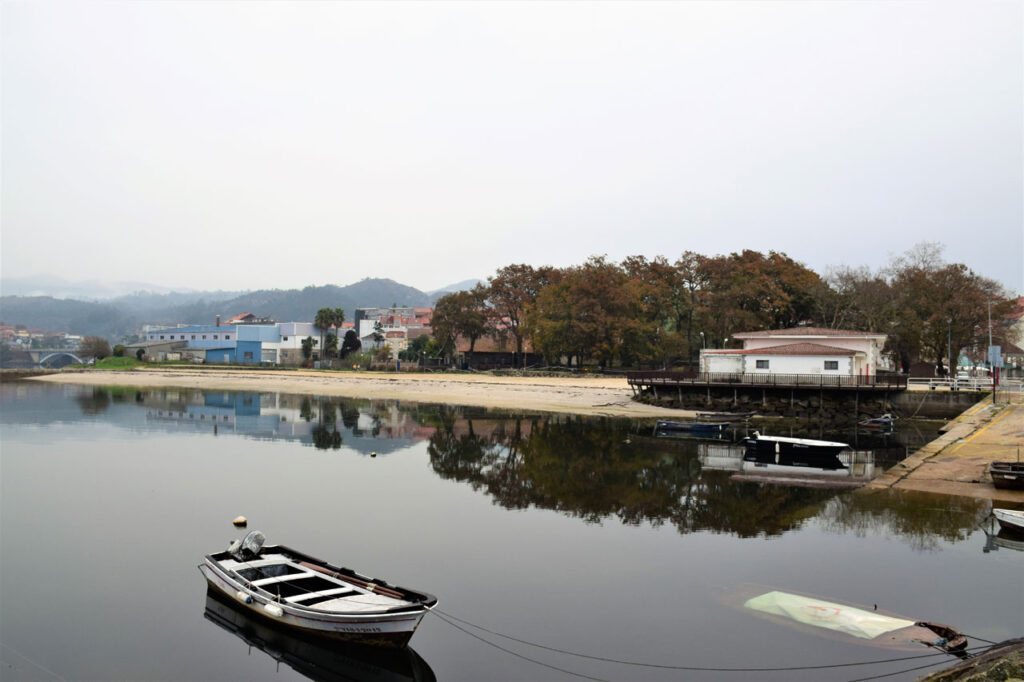
The site of Arcade´s port was perfect for the distribution of both fish and seafood with which Ramón G. Sueiro worked, as it was also perfect for the marketing of the salted fish due to its proximity to the Arcade railway station and the N-550.
In the salting process, the first work that the women did was the fish cleaning and evisceration. To do this, they would open them in hal,f one by one, before throwing them into the buckets with dead salt. They would remain there for one or two weeks and after that time, the fish was drained, more salt was added and they were carefully stacked in wooden barrels, called tabales, to be pressed.
Ramon G. Sueiro had a unique pressing style. Instead of using the original presses with a beam and ballast, which took up a lot of space, he adapted continuous screw presses to compress the sardines in the tabales.
The most complex process was the hermetic preserve; although it was small in volume, "Conservas Sueiro" had a wide variety of preparations: cooked seafood and octopus; sardines, anchovies, longfin tuna with oil; mussels, clams and other pickled species.
The oil was used to preserve sardines and similar fish. In addition to opening and gutting, the workers had to remove the heads and even fillet some species. Once cleaned, the pieces were salted and placed on grids, which were also stowed in a cart that was introduced into the autoclave for a first cooking. The pieces were then placed in tins, and then stacked on specific tables covered with zinc sheets to collect the excess oil. At this point the oil and sauces prepared by the women themselves were added.
The cans were then closed in the racks and stacked in baskets on a specific trolley and returned to the autoclave to be hermetically sealed. Most of the production corresponded to large cans of 1, 1'6 and 2kg, but also to small cans of ¼ kg.
The cannery had three entrances, one of which was a rear entrance that allowed the loading and unloading of trucks directly into the warehouse buildings. It also had a ramp landing stage, through which the raw material was unloaded directly into the entrance yard.
The main building consisted of a two-storey house with two floors. The ground floor was dedicated to productive work, which would be the "clean" area of the cannery, with the salting presses, the saws and the canning tables. The rest of the annexed buildings were dedicated to other processes such as the salt deposits, placement of the raw material, salt storage and merchandise storage.
To know it better
Arcade is one of the parishes of Soutomaior, in Pontevedra, where Sueiro preserves have always been outstanding. The beginnings of this company date back to 1940, when Ramón González Sueiro arrived at Arcade with his wife to sell fish and seafood.
After several years of hard work, and with the necessary machinery for this job under its belt, the company obtained a series of authorizations to dedicate itself to food preservation. When Sueiro was too old to continue dedicating his life to canning, he got different partners who took over the company. However, after several years, it went bankrupt. Today, Sueiro's heirs still live in the old cannery to remember its memory.
Soutomaior is a municipality in the province of Pontevedra. It is located at the Verdugo river´s mouth and San Simón island.
Gallery
Location
- Town
- Urbano
- Municipality
- Soutomaior
- Province
- Pontevedra
- Country
- Spain
The asset
- Type
- Cannery
- Eco-destination
- Ría de Vigo
- Environment
- Urban
- Relevance
- Regional
How to get there
- Access
- By land
- Distance
- 0,260 km
The visit
- Accessible
- No
- Parking
- No
Coordinates
- Latitud
- 42.34055900
- Longitud
- -8.61107300