


Baiona. Historical-artistic site
About this heritage
Coinciding with the celebration of the 5th Centenary of the Arribada in 1993, the historic centre of Baiona was declared a Site of Historical-Artistic Interest by the General Directorate of Heritage. Its protection is contemplated in development and protection programmes limiting, among other measures, the height of the buildings and the quality of the materials.
The old quarter is located between Burgo and Sabarís. But the main nucleus is located in the heart of the town and occupies a nearly circular enclosed area.
It has three entrances: via the Santa Liberata square, the Padre Fernando square and from the Cruceiro A Trinidade.
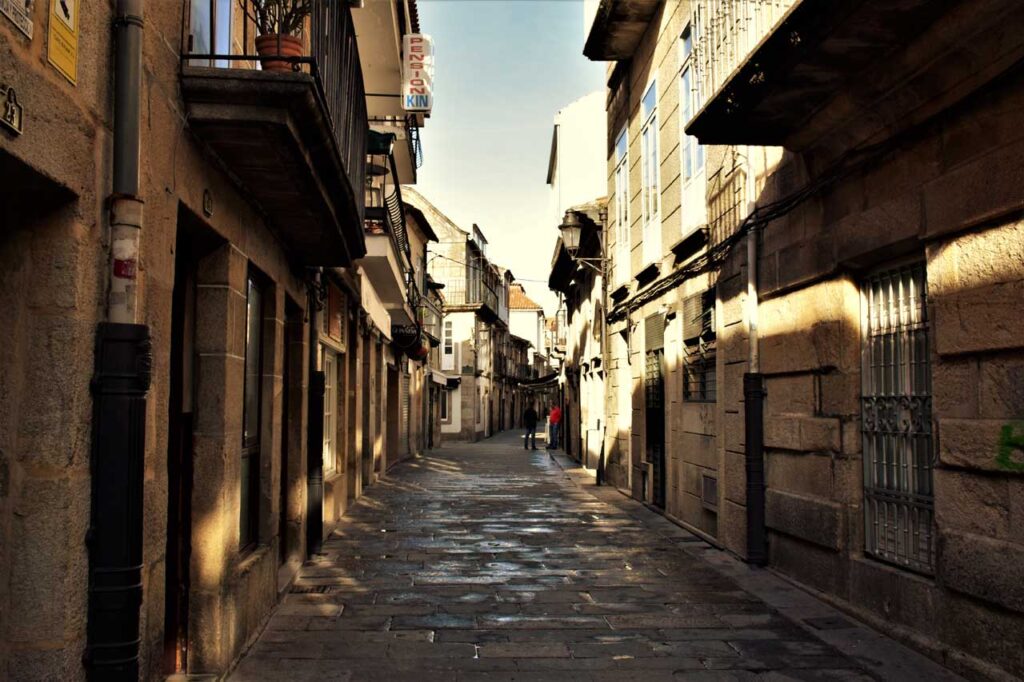
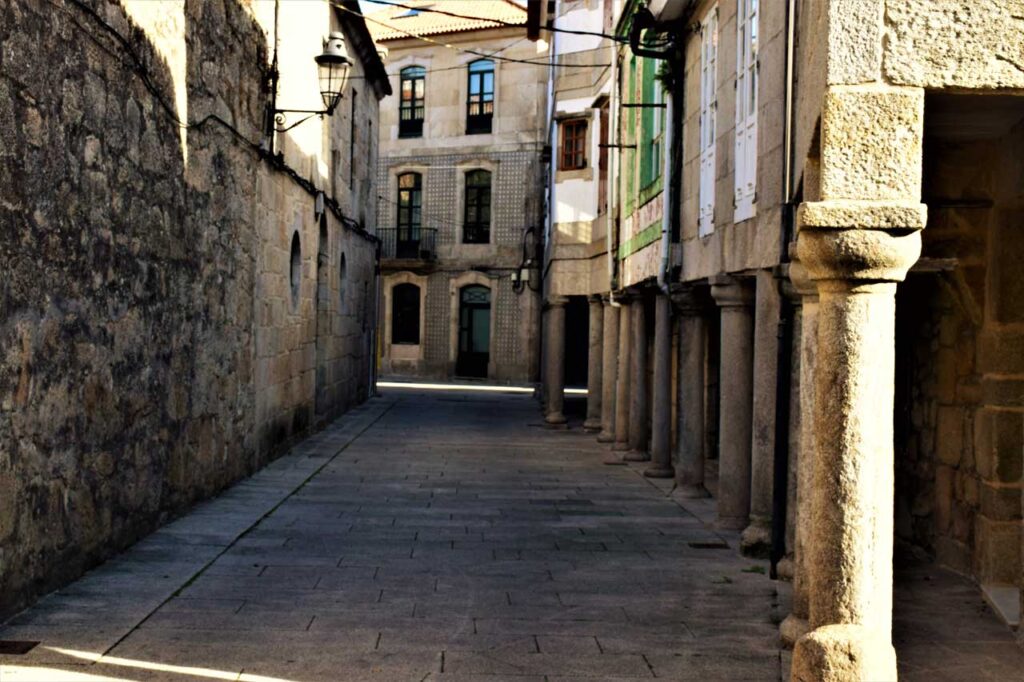
Its streets are narrow and cobbled, its buildings are low-rise made from stone or granite and most of them have porticos. Typical fishermen houses, large mansions, farmhouses and temples of worship are compacted into this small area.
The frontages of the houses extend along Elduayen street, just opposite the sea promenade, most of marine style with windows looking onto the sea. The Pinta Caravel museum is also on this Street.
The rear of the majority of these houses face Ventura Misa street. The characteristic of these houses are their balconies and wide entrances, with wide double opening doors and low windows just below the belt course.
It is within these inner streets where Baiona’s life unfolds, as most of the commerce, hotels and nightlife is concentrated in this area.
To learn more
Heading into Ventura Misa street in the old quarter of Baiona, on leaving behind the As Monxas fountain located in Carabela Pinta street, fountain which was restored in 2011), one comes across the Dominican Convent. It is a cloistered convent that was built in 1547 on an previous building from the 13th century. It consists of a chapel, a convent, a farm and an orchard. The Baroque altarpiece of its High Altar is dedicated to the Virgin of the Annunciation, Patron Saint of Baiona. Here you can buy sweets made by the nuns through a small door, specially set up for this purpose.
Walking toward the town hall square is the Capilla de la Misericordia (Chapel of Mercy), built by Felipe II in 1595 at the entrance of Monterreal. In 1656 it was rebuilt in the old quarter. It has a rectangular floor plan and an austere appearance. The most worthwhile feature is the baroque altarpiece inside, with a huge crucifix, that came from Mexico filled with gold coins as a donation to the people of Baiona, in defrayal of the cost of the temple’s construction.
Across from the chapel is the Casa Lorenzo Correa, which is now the town hall of Baiona, construction of which was under the command of Don Lorenzo Correa Fidalgo del Val Miñor who, on his return from Mexico, where he held the positions of mayor of Cuernacava and administrator of the Lid de Galos, ordered the construction of this manor house, which took three years to build.
In the same square as the town hall square, there is a building that is currently in ruins. This is the Casa de Os Ceta, a building from the turn of the 14th century which, aside from others, preserves of the coats of arms of the Ceta, Figueroa and Fitado families.
The house is also known as the "house of forgiveness" due to a cruel privilege granted by the Catholic Monarchs, which pardoned those sentenced to death if, at the moment when they were subjected to the public punishment, they were able to cling onto the chain hanging from the front door of the house.
Strolling through the centre and heading upwards is Manuel Valverde Street, where you can find the municipal library, formerly the 16th century Hospital de la Caridad, which arose with the purpose of providing shelter to the poor and destitute of the region. The structure of this building, with walls of stonework and masonry, is formed by a first floor and a ground floor, covered by a gabled roof. There is only one floor leading to the orchard, from which there are stone staircases that connect with the three spaces in which the complex is distributed.
Next to this building stands the Parish Church of Santa María de Baiona, construction of which began in the second half of the 12th century, although most of its structure is from the 14th century. It is of Romanesque style, Romanesque-ogival heterogeneous with Cistercian influence, as its construction was completed by the monks of that order, dwellers of the monastery of Oia.
About 50 metres across from this building, is the Chapel of Santa Liberata, consecrated in honour of the martyr from Baiona and the first woman in history to be crucified. It is an Italian style plateresque and its construction began in 1695, through public donations.
Other interesting constructions are the Fountain of Ceta which dates back to 1678 and restored in 1863 by order of Ventura Misa, the Cruceiro de la Santísima Trinidad declared Asset of Cultural Interest and built in the 15th century on some stones in Calle del Marinero; and other houses and manors such as Pazo Mendoza of 1768, whose coat of arms was the one of the Dean of the cathedral of Santiago de Compostela, Don Policarpo de Mendoza. It bears the inscription "Ave María", the family motto.
To know it better
In 1993, the old Bayonne was declared a Site of Historical-Artistic Interest by the General Directorate of Heritage. It is therefore a protected area in accordance with the General Urban Development Plan and the Special Protection Plan for the Historic-Artistic Site.
Baiona, in Nigran, is a coastal town, which is synonymous with safe harbour. In fact, it is known for being the first port to receive the news of the discovery of America, after the arrival of the Pinta Caravel.
The streets of Baiona’s old quarter have a medieval layout. They are cobbled and narrow streets, with stone paving and low-rise buildings with porticos, that take one back in time. In addition, walking along its streets, we find the old collegiate church of Santa Maria from the 13th century, in a style between Romanesque and Gothic; the church of Santa Liberata from the Baroque 17th century; the Pazo Correa from the 18th century (where the current town hall is located) and fountains from different periods and aesthetics.
Gallery
Location
- Town
- Baiona
- Municipality
- Baiona
- Province
- Pontevedra
- Country
- Spain
The asset
- Type
- Old town
- Eco-destination
- Ría de Vigo
- Environment
- Urbain
- Relevance
- National
How to get there
- Access
- By sea By land
- Distance
- 850 m
The visit
- Visitable
- Yes
- Interpretation
- Brochures in Spanish, Catalan, English, French and Portuguese
- Accessible
- Sí
- Parking
- Sí
- Signposted
- Yes
Coordinates
- Latitud
- 42.11917000
- Longitud
- -8.84948500