


Battle of Rande
About this heritage
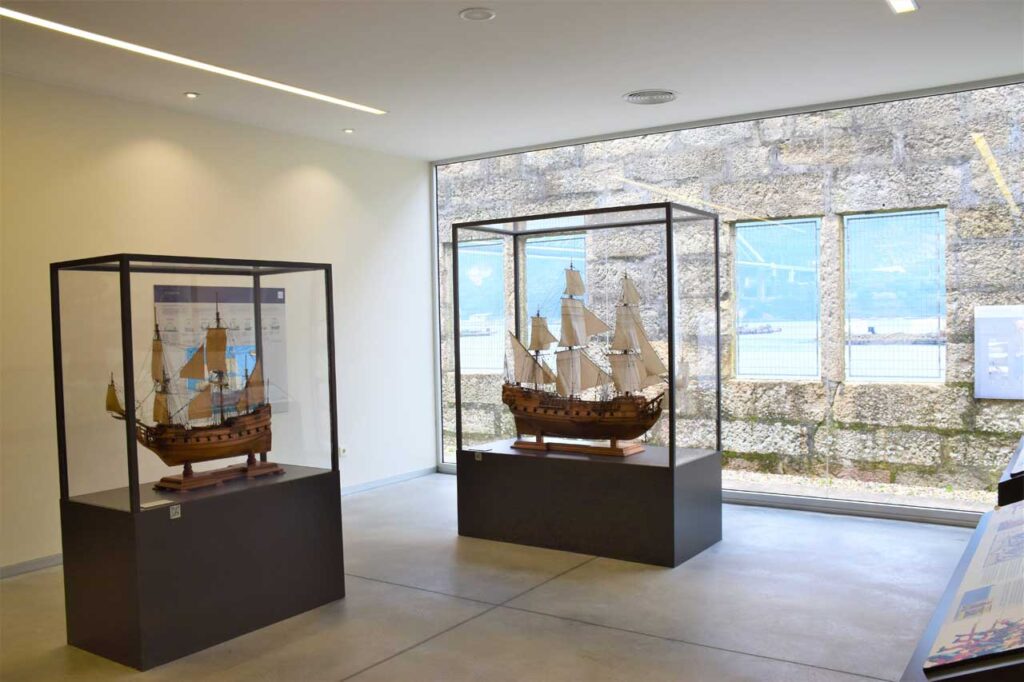
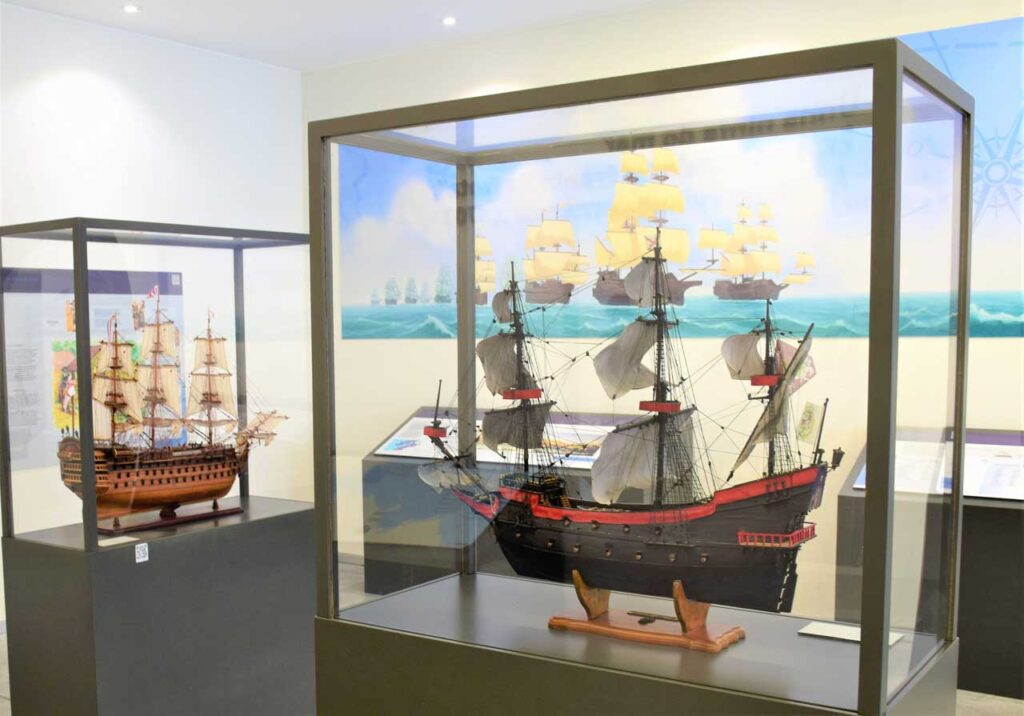
One of the most commented historical episodes of San Simón´s cove is the famous Battle of Rande which was fought on October 23rd 1702 between the Anglo-Dutch and Spanish-French alliances, during the War of the Spanish Succession.
For almost three years, Admiral Manuel Velasco Tejada had been gathering in his anchored galleons in Veracruz´s port, gold, silver, furs, leathers, plants, exotic animals, pieces of precious metals, jewellery, and an endless number of valuable items plundered from the indigenous peoples who paid tribute to the King of Spain through his tax collector.
50 billion at current rates, not taking into account that accounting officers only inventoried 30% of the cargo. The Spanish galleons carried the greatest treasure that ever crossed the Atlantic.
As expected, this colossal cargo was the object of pirate attacks and lootings, as of the 17 galleons only three were actual warships, and they had to escort that fortune to the Old World. In addition, he had released ballast, leaving the ships, in some cases, with less than half their guns. That's why Velasco received a French squadron of 17 ships, led by Chateau-Renault, who would be in charge of clearing the way.
Before their arrival in Vigo, in the Azores, a warning informed the Spanish-French fleet that the combined Anglo-Dutch squadron, commanded by Sir George Rooke, intended to attack Cadiz. A Portuguese fishing sloop based in Lisbon informed that a large British fleet was anchored off the city of Ferrol with orders to intercept any vessel trying to leave or arrive at that port. So, after several discussions, Vigo´s estuary was chosen to disembark.
On September 22nd, the galleons and the war fleet enter the estuary. It was decided to ask the Crown for an accountant with authorization to inspect the merchandise and collect the so-called “royal fifth”, which amounted to more than 20 million pesos in coins, ingots and precious objects. The situation required it, since the only ports authorized by the crown to trade with overseas and receive their goods were Cadiz or Seville.
Soldiers, sailors and civilians collaborated in the unloading of the 14 galleons. They confiscated 1,000 cow carts from the mob to bring them to court and transported them to Santiago de Compostela, Lugo, Toledo, Valladolid and Madrid. The royal fifth arrived at Madrid court on October 30th, transported in 300 overflowing carriages that stopped in front of the “Casón del Buen Retiro”. During the journey they used more than 700 cattle, which were replaced as they were dying from starvation.
Meanwhile, in the estuary, they were trying to form a defence, but the scarce time made bad-equipped militias. The forts of Rande and Corbeiro are restored with cannons from the ships and trenches are dug. In the strait, where the Rande Bridge is currently located, a barrier is formed with chains, masts and rods.
Prince Barbazon, general captain of Galicia, deployed his ground troops in the bay´s batteries. In total, there were 800 men in the Rande bastion. Almost 1,000 soldiers barricaded themselves in Vigo: one half were located in the district of El Castro and the other half reinforced San Sebastián´s fort, where the current city council of Vigo is located.
On October 22, 1702, when the fog lifted, the enormous fleet of Shovell and Rooke was seen, consisting of 189 ships and a landing force of 14,000 men, anchored in front of the town of Cangas, right at the entrance to the estuary. In the early morning of the 23rd the enemy soldiers landed on both sides of the estuary and by mid-morning 2,500 had camped on Teis beach and many others on the opposite side without too much difficulty.
Because of the size of the bay, the enemy´s navy could not get all the ships in, so they were divided up, leaving a fleet waiting outside the estuary in case the French-Spanish navy managed to escape. Rooke, after having failed in Cadiz, expected a great victory and a colossal treasure.
The Duke of Ormond landed with 4,000 Marines, who in little more than an hour swept away all the defenders. The militias run away and prisoners are held.
Taking advantage of a strong gust of wind, Captain Hopsonn's Torbay breaks the chain. After him, the rest of the ships enter and an intense combat begins, with cannon shots without the possibility of manoeuvring, at the bottom of the estuary.
Some fought hand-to-hand, while shrapnel swept the decks. Others could only thought of running away, by swimming or by boat.
Chateau-Renault had agreed with Manuel Velasco to burn his ships and galleons as a lesser evil to prevent them from carrying the remaining cargo and to prevent the passage through the generated debris. So they did not hesitate to give the order when the English Monmouth, Grafton and Kent, all armed with 70 cannons, were dangerously approaching the galleons Santo Cristo de Maracaibo, San Diego de San Francisco Javier and Our Lady of the Rosary which still had part of their cargo.
Flammable material was spread on the decks and rigging and Rear Admiral José Chacón himself set fire to the main sail of his ship, the “Bufona”. When he saw the enemy's intentions, Rooke was quick to point out that they should stop shooting definitively and try to put out the fire, mainly from the last galleons on the line: Santo Cristo de Maracaibo, San Diego de San Francisco Javier and Nuestra Señora del Rosario.
The battle was lost, both admirals were captured along with members of their navy, others run away, perished or drowned in the bay. The greed for not losing the galleons´ treasures caused many sailors to drown themselves clinging to chests and precious stones.
Finally, the Anglo-Dutch navy was able to capture these galleons, but only two of them would reach English lands because the Santo Cristo de Maracaibo ran aground on the Cíes Islands off the southern coast of San Martiño Island.
To learn more
The battle of Rande was fought within the conflict of succession of Charles II where three nations declared war on the French Bourbons. The cargo carried by the Spanish galleons was of utmost importance, since it would finance the subsequent wars.
Upon seeing Shovell and Rooke's huge fleet, most of the Spanish troops in Chateau-Renault's fleet run away in boats to nearby towns before they entered the estuary. Practically all the casualties of the silver fleet side were French, mainly those engaged in the defence of Rande and Corbeiro castles, as the Spaniards, most of them untrained volunteers, disappeared among the orchards and pine forests as soon as they heard the whistle of the first Anglican missile. In total, eight hundred people perished in the battle.
The Anglo-Dutch army was able to capture the galleons of Santo Cristo de Maracaibo, San Diego de San Francisco Javier and Nuestra Señora del Rosario, but only two of them would reach English lands.
From the first, the English amassed a sum of 15,000 pounds and from the second, a little less than a half, both of which, once they had given their share of the booty to the crews, served the English crown to mint a series of coins commemorating the battle.
The third galleon, the Santo Cristo de Maracaibo, was being towed by the Monmouth, but at the height of the Cíes Islands it hit a rocky outcrop on the south coast of the island of San Martiño. With the high tide on the coast, the two ships were out of control and Jennings went ahead to send more troops in order to secure the booty. After several shakes, the two cables connecting the ships broke and the Monmouth and the galleon were separated.
They went to get the merchandise, all the boats were lowered and almost 100 men arrived in the vicinity of the galleon and climbed its ladders. They rushed to unload and threw as much as they could into the sea. Santo Cristo de Maracaibo broke in two and made water everywhere. Soldiers, Marines, officers, and subordinates would save everything they could gathered of the bows and boxes until it finally sank. Rooke collected coins and jewellery from his men totalling £20,000. The rest of the shipment, which some historians estimate to be a million pesos, still lies on the seabed.
The English also took the Modere, Prompte and Triton as no other French-Spanish warship or galleon was left afloat after the skirmish.
The Battle of Rande took 1,200 Anglo-Dutch army fighters with it, and in their quest to save the treasures, nearly 400 men from the invading fleet perished after the battle. The Santo Cristo de Maracaibo itself took 190 lives on his journey to the sea bed. In the part of the action that Jennings wrote to Rooke, the captain explains how there still were 70 labourers inside at the time the Spanish galleon went down, the rest succumbed to the waves and greed, sucked in by the gigantic whirlpool caused by the galleon on its journey to the depths.
To know it better
Redondela is a municipality in the province of Pontevedra that has been inhabited since ancient times, as different remains of dolmens, petroglyphs and rock engravings have been found in Penide mountain or Mirallo and Ventosela mountain to prove it.
Near Redondela, there is the Rande bridge that links the municipalities of Redondela and Moaña. In this area, the so-called Battle of Rande took place many years ago.
This was an important naval battle that took place on October 23rd 1702 in the Rande Strait. The scenario was as follows, the Spanish galleons returned from America to Vigo´s estuary loaded with gold, silver and jewels. The legend says that the ship was attacked with all those treasures inside, but there is another legend that says that the treasures had already been disembarked.
Thanks to this story, Jules Verne turned Captain Nemo into the first treasure hunter of Vigo´s estuary. Since then, hundreds of dives have been made in the Vigo estuary´s waters looking for the treasures.
Gallery
Location
- Town
- Rande
- Municipality
- Redondela
- Province
- Pontevedra
- Country
- Spain
The asset
- Type
- Historical event
- Eco-destination
- Ría de Vigo
- Environment
- Rural
- Relevance
- International
How to get there
- Access
- By sea By land
- Distance
- 6,000 km
The visit
- Accessible
- No
- Parking
- No
- Website
- redondela.gal/es/rande
Coordinates
- Latitud
- 42.29467600
- Longitud
- -8.64752500