


Bueu. Massó Museum
About this heritage
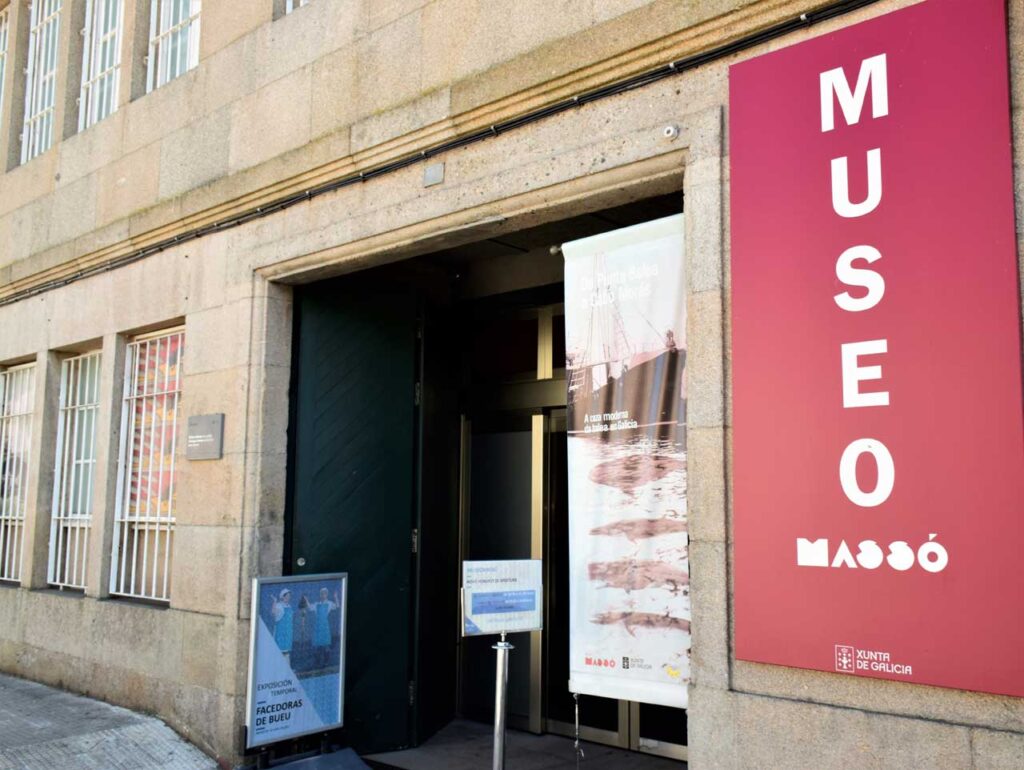
The Massó Museum is located in the center of Bueu, very close to the port, housed in the industrial warehouses of the former Massó Hermanos cannery. Guillermo Marconi, during his visit to the factory in 1928, suggested the idea of creating a museum as he was amazed by the collection of navigation instruments, documents and ancient books, curious objects, and models of historic ships. The Massó brothers took his advice and built an additional floor over the oldest building. In 1932, the Massó Museum was born. In 1994, after the factory closed, the museum was acquired by the Xunta de Galicia and is currently open to the public. It also houses a valuable library specialized in maritime and naval topics, highlighting 20 incunabula, books printed in the early years of the printing press (1453-1500).
The museum is divided into four parts. The first is a large room on the first floor, where the exhibition revolves around the idea of the conquest of the sea. It is dedicated to navigation and the disciplines, such as astronomy, geography, and shipbuilding, that made its development and maritime trade possible. The room preserves the original museography from the 1930s. A second room is located on the ground floor and is dedicated to the exploitation of sea resources. Archaeological materials from the Roman-era (2nd-4th century) salting factory and amphora workshop of the Roman site of Pescadoira are exhibited. The narrative focuses on the industrial activity of the Massó family: their salting and canning factories and whale hunting, showcasing a unique collection in Spain.
The third room deals with traditional boats, exhibiting three of the most representative from the Ría de Pontevedra: the dorna, the "polbeiro" boat, and the large wreck of the last "xeiteira" launch.
The last room is dedicated to the old salting factory where eighteen vats from an early 19th-century salting facility, acquired by the Massó family in 1900 to be used as an anchovy warehouse, were recovered.
To learn more
Located in a dock of the port, in addition to modern boats, traditional vessels can be observed. Thanks to the Os Galos association, today it is possible to enjoy some of these boats, which they themselves restore and even build new ones. Docked there is the polbeiro boat, also known as the Bueu boat. It is a unique and exclusive vessel of this municipality, with only three examples remaining: this one, the one in the Massó Museum, and the one in the Maritime Museum in Barcelona. Its main characteristic is that the bow and stern are indistinguishable (it has two bows), pointed at both ends, and its beam is half its length, giving it a rounded appearance, similar to an open walnut shell.
This shape provides great stability. Additionally, its structure is made of oak wood, making it much more resistant and ideal for octopus fishing from the rocks. Due to its size, only one or two crew members operated this boat, which was used for octopus fishing.
The propulsion method, like other boats, was by oar or sail, depending on the winds.
In the 1960s, it ceased to be used because it could not be fitted with an outboard motor and its slowness made it no longer viable.
The xeiteiro boat is similar to the polbeiro boat, although it is longer, larger, and more streamlined. It is dedicated to sardine fishing using the gear known as xeito, hence its name. As a vessel, it was larger, carried more crew members (3-5), and they usually went fishing for 2 or 3 consecutive days; for this reason, there was a stone inside the boat to grill sardines.
There is also the Dorna xeiteira, a boat with origins in the Middle Ages, sharing its clinker-built construction system with the Viking drakkar. It is dedicated to sardine fishing. It remains in use today because it could be fitted with an outboard motor.
The Dorna is a very streamlined, stable, and fast vessel that can be handled by a single person. Oak or cork wood is used for the keel. Besides octopus, it is used to catch sardines, anchovies (xouba), and pouting fish (piobardo). A variant is the Dorna polbeira, which is smaller and used for octopus fishing.
For sardine fishing, the need for larger boats to increase catches led to the import of a traditional vessel from the Basque Country, the Trainera. Its name derives from the word "traíña": a very dense mesh net used for anchovy and sardine fishing. It is a light, fast, and large boat that can carry 10 crew members. Today, it is used in sports practices and Trainera regattas. These competitions originated from Basque fishermen racing to be the first to reach the port to sell their fish at a better price.
To know it better
In the port of Bueu, in the industrial buildings of the former Massó Hermanos canning factory, we can visit the Massó Museum. The idea for its creation arose during one of the visits to Guillermo Marconi's cannery. He himself was surprised by the number of instruments, documents, and old books preserved in the place. It was precisely then that the idea of launching this project was put on the table. The Massó brothers listened to Marconi and in 1932 created the museum which, a few years later, in 1994, passed into the hands of the Xunta de Galicia. Today, it has become a must-visit place within this municipality located in the province of Pontevedra. The Massó Museum has two rooms with quite distinguished elements. In the first, we can find traditional boats, explanations about the canning industry, and about the fish salting technique, documented with photographs of the old factory. The second room focuses on the Catalan Massó family, as well as a collection of nautical elements and models. Additionally, in this same space, we can learn about carpentry, as the different tools used to build traditional boats are displayed.
Gallery
Location
- Town
- Bueu
- Municipality
- Bueu
- Province
- Pontevedra
- Country
- Spain
The asset
- Type
- Museum
- Eco-destination
- Ría de Pontevedra
- Environment
- Regional
- Relevance
- Regional
How to get there
- Access
- By sea By land
- Distance
- 200 metros
The visit
- Schedule
- Opening hours from: Tuesday to SaturdayOpening hours from 10:00 to 20:00
- Visitable
- Free EntryEstimated visit duration: 1 hour Reservations accepted tel.: 886 151 101
- Interpretation
- There are informative panels
- Accessible
- No
- Parking
- No
Coordinates
- Latitud
- 42.32680900
- Longitud
- -8.78503600