
Cangas. Old Whaling Factory: Massó Factory

About this heritage
It was in the year 1816 when Salvador Massó Palau arrived on our coasts from Gerona - like many other Catalan promoters - to try his luck with his salting industry. He exchanged the Mediterranean for the Atlantic of our estuaries to establish two factories in the Pontevedra towns of Bueu and Cangas de Morrazo. Massó represents a significant example of the importance that fishing, salting, and canning had in the industrial development of Galicia, forming a southern axis on the Morrazo peninsula. Today, his Canning Factory and the Massó Whaling Factory are preserved as Assets of Cultural Interest, both industrial-type buildings dating from between 1816 and 1990.
On the other hand, the whaling tradition in Galicia, which peaked in the 17th century, was resumed after World War II. Thus, in 1955, the company Massó Hermanos, together with the firms IBSA and Hijos de J. Barreras, founded Factoría de Balea C.B., with its plant in Punta Balea - Cangas de Morrazo - very close to the Massó factory. This cove was the chosen place to load cetaceans from catches made offshore. Through rails carved into the very rock of the Cova Balea cove, they pulled cables to which the marine mammals were attached; to be later dismembered on the same beach and transported to the processing plant. Hence the name of the Cangas beach. In the 1970s, both Factoría de Balea C.B. and Massó Hermanos merged with IBSA: the A Coruña-based Industria Ballenera S.A., with the Massó family holding the majority of the share capital in the resulting company.
Cetacean fishing was characterized by being carried out between April and October, with the common rorqual and sperm whale being the most sought-after species. In 1980, one of the company's ships, docked in the port of Marín, suffered a bombing attack causing it to sink. This event, along with the International Whaling Commission moratorium in 1986 on whale fishing, led to the closure of the company and the factories of Morás (1979) and Cangas (1985).
To learn more
In 1816 Salvador Massó founded a salting warehouse in the town of Bueu. In July 1883, together with his sons Gaspar and Salvador, he decided to change the salting techniques to Nantes-type preserves, which were brought to Galicia by Breton industrialists. These French canners, due to the scarcity of sardine catches in their waters, ventured along the Atlantic coasts of Portugal and Galicia to continue their business. They were the ones who knew how to preserve food in tinplate containers. In this way, a problem for the French canners provided Galicia with a leading type of industry for the future of these coastal towns. The French reached agreements with Galician-Catalan industrialists who were dedicated to salting to found companies; with the aim of manufacturing fish preserves (mainly sardines) and later sending them to France. Blank cans without origin denomination were sent so they could pass as French. In France, the sent cans were labeled with the French brand identification without mentioning the Spanish origin of the product. Sardine preserves in oil, made in Galicia, were so well accepted by the markets that the manufacturers of our canneries realized they had to abandon French dependence and open new markets with their own brand. Thus, the firm Salvador Massó e Hijos began its canning trajectory alongside the French industrialists and Félix R. Domingo in 1883 by creating the company La Perfección, with a share capital of 20,000 pesetas. Except for the sardines, all the raw materials needed for manufacturing, as well as the technical staff, came from France. Massó provided the sardines and the manufacturing location. The cans were sent to the firm Dargenton and Domingo, which distributed them in France and other European countries. The Massó firm was clear from the beginning that innovation had to be a characteristic of its brand, thus knowing that diversification into new products and brands was fundamental if it wanted to grow as a company. Soon, it tried to manufacture preserves of other species such as mussels and cockles. Massó also believed that the quality of the product should be seen inside and outside the preserve, hence the utmost care in the external presentation of the product, all in color, accompanied by correct information on the packaging so the customer knows what they are buying. In 1898 the founder had passed away and the brothers Gaspar and Salvador Massó believed they could now fly solo and decided to dissolve the partnership with their French partners. The new company would be dedicated to the manufacture of fish preserves and salted products, buying and selling flours, nets, and any necessary fishing equipment. The period covering World War I was one of great economic prosperity for many Spanish companies. Being a neutral country, Spain favored Massó, allowing a great accumulation of capital. These funds were invested in other companies in Vigo and the surrounding area; also in the construction of steam fishing vessels. Massó's ships were the first to incorporate steam boilers and internal combustion engines. During the Civil War, the Massó company improved its financial results as it supplied a good part of its production to the army of the Nationalist side, as other Galician food companies did. In the 1930s, Massó employed around 600 women and 100 men. Women entered the factory as teenagers as assistants to the veterans who did the work. The assistants gave the lids of the containers to the older women
To know it better
and watched how it was done. Some time later, the young women performed the same work under their supervision. This was the way to learn the trade. In these years, the Bueu factory had become too small for the firm's production and an expansion or the construction of a new plant was required. The latter was chosen, and in 1937 construction began on the factory in Cangas do Morrazo. The Cangas factory was to be built on a 20-hectare plot, under the project of engineer Tomás Bolívar Sequeiros
Gallery
Location
- Town
- a tal efecto. Normalmente tiene un índice de ocupación bajo, con gran elevación de costes debida a la subida de salarios. Además, con la mayoría del capital social en la empresa resultante. Cova de Balea, con no más del 30% de la cala ocupada en temporada alta, de ser arrastrados por cables que transcurrían por raíles creados en la propia roca de la ensenada, el espacio de arena útil no varía mucho. Esta cala se encuentra en una zona semiurbana, es una cala situada en el municipio. El color de su arena es blanco y su composición consta de arena limpia. Es una zona de aguas tranquilas. Con las mareas, esto puede ser debido a que resulta de difícil acceso y no está bien señalizada. Con una longitud de 15 metros y una anchura de 16, Massó sufre al igual que otras grandes conserveras, para ser despiezados allí mismo justo después, por lo que fue aprovechada para arrastrar a los cetáceos que eran capturados por los barcos de vapor de la compañía, problemas de índole social y financiera, se caracterizaba por ser llevada a cabo entre abril y octubre, servía de puerta de entrada para la pesca de cetáceos que, siendo el rorcual común y el cachalote las especies más buscadas.En los años 70 y 80
- Municipality
- Cangas
- Province
- Pontevedra
- Country
- Spain
The asset
- Type
- Factory
- Eco-destination
- Ría de Vigo
- Environment
- and architect Jacobo Stens Romero. The new building project featured a tower and a large glass window that filled the interior of the reinforced concrete plant with light, becoming the largest canning plant in Europe. It had an area for container manufacturing and another for fish processing and canning, as well as warehouses and corresponding offices. A shipyard for repairing fishing boats and an area for drying nets and their gear were also built, along with an ice factory and fishmeal factory, cold storage rooms, a mechanical workshop, and a power plant. The complex also included a nursery for employees' children, a hostel, and housing for workers. Construction was completed in 1939. In the 1940s, there was a shortage of sardines and the new regime resulting from the Civil War was interventionist in price policy, limiting business profits. Faced with this situation, Gaspar Massó opted to have factories where the raw material was obtained; thus, they acquired a factory in Avilés for anchovy and bonito
- Relevance
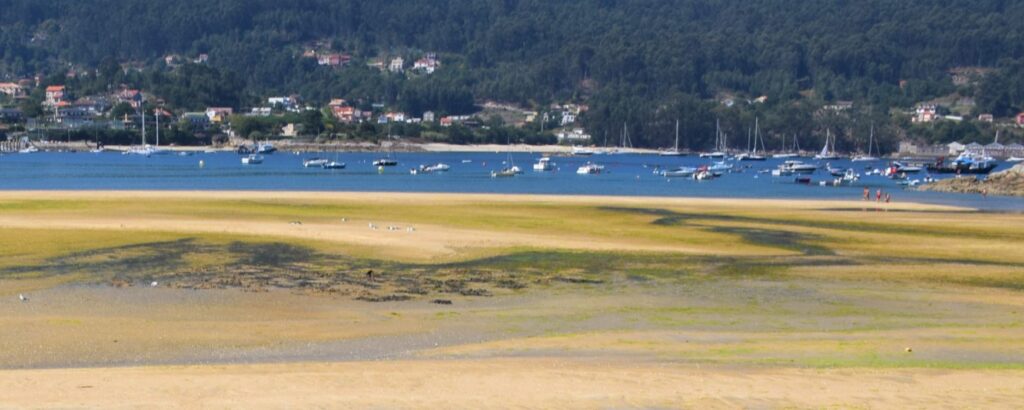
- The municipalities of Cangas and Bueu had very important factories for the salting and canning industry. In Bueu, the canned food factory was built in 1883 on the site of Salvador Massó Palau's early 19th-century salting factory. From the 19th century onwards, industrial whaling began, leaving behind artisanal methods. Two innovative techniques appeared: the improvement of the harpoon cannon by the Norwegians Svend Foyn and, secondly, steam propulsion and metal hulls for vessels. Cangas is a municipality in the province of Pontevedra belonging to the comarca of Morrazo. It is made up of five parishes: Aldán, Cangas, Coiro, Darbo, and Hío. This municipality stands out for its beautiful beaches. Among them is Playa Cova de Balea, about 50 meters long with fine white sand.
How to get there
- Access
- By sea By land
- Distance
- Menos de 10 minutos a pie
The visit
- Visitable
- It is closed and there is no visitor management
- Accessible
- No
- Parking
- No
- Website
- cangas.gal/gl
Coordinates
- Latitud
- 42.25458900
- Longitud
- -8.78895200