
Condes de Albarei Winery
About this heritage
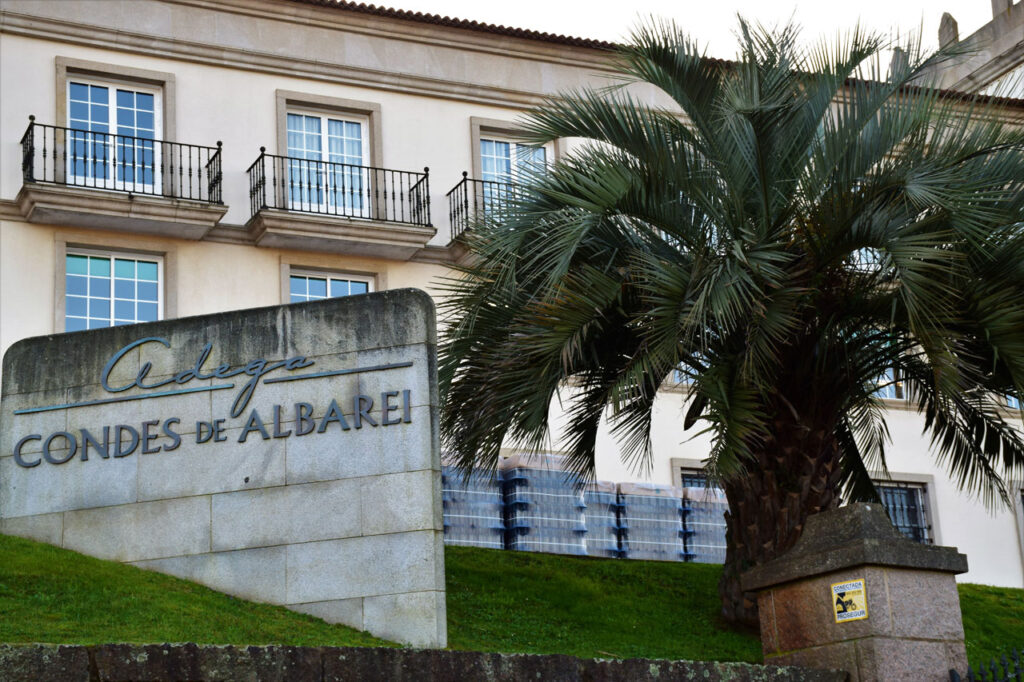
To talk about Albariño wine is to speak of the Counts of Albarei. It is a success story because since its foundation and until today, the evolution of this winery has been constant, achieving deserved successes like the one with its Albariño wine Condes de Albarei, which was awarded with the gold medal Challenge du Vin de Bordeaux, surely, one of the most important recognitions in this sector, being the first Spanish white wine to obtain such distinction.
The Condes de Albarei winery was created at the end of the 1990s by a group of winegrowers from the Salnés region with the aim of producing and marketing their wines.
The growth of the winery Condes de Albarei since its creation and until today has had a progressive evolution, not in vain and thanks to its 400 cooperative members and its 300 hectares of vineyards, it has a production capacity of 3 million litres, which has made it one of the largest wineries in the Rias Baixas area.
Almost at the same time as the winery was founded (only 3 years later), the Rías Baixas Denomination of Origin was created, an organisation that has overseen the quality and promotion of Albariño wine up to the present day. The D.O. Rías Baixas has multiplied by 10 its hectares of vineyards and the number of wine growers it has.
To learn more
Since its foundation, the Condes de Albarei winery has been an obligatory reference in the Rías Baixas Denomination of Origin. In 1991 and as a result of the already mentioned international award Challenge du Vin de Bordeaux, it began to be commercialized in important markets around the world like England, Mexico, United States or Japan.
Condes de Albarei acquired the Pazo Baión winery, undertaking an important wine and wine tourism project, in 2008. Pazo de Baión is a singular estate located in the heart of the Salnés Valley. A property whose origins date back to the 15th century and which is characterized by having one of the most spectacular vineyards in Europe.
The history of the Albariño wine takes us to the monks of Cluny, since one of the theories indicates that they were the ones who introduced the variety from the Monastery of Armenteira in the XII century. Today this hypothesis is considered a legend since it is well known that the Albariño is a native variety from the south of Galicia. There are other theories that associate it with Germanic peoples and their migrations.
Salnés region is located in the Rías Baixas and is made up of nine municipalities. It is characterized by the kindness of its climate and landscapes, not in vain, it offers us a world of contrasts since we will be able to choose or even better to combine the coast represented by the beauty of the Rias Baixas or to enter the mountain populations. The region of Salnés is formed by: Cambados, A Illa de Arousa, O Grove, Meaño, Meis, Ribadumia, Sanxenxo, Vilagarcía de Arousa and Vilanova de Arousa.
To know it better
The municipality of Cambados, in the province of Pontevedra, is known nationally for its wines good quality. It is in this town where we find the Condes de Albarei Winery, which started in 1988 thanks to a wine grower who worked in the Salnés Valley idea, as he was interested in marketing the wine produced in the area.
The wine, made from the Albariño grape variety, improved over the years and became one of the best quality Albariños in the Rías Baixas. With this, in 1991, the Condes de Albarei winery obtained the gold medal in the "Challenge International du Vin de Bordeaux", which meant that their wine would be marketed internationally; in other words, a dream come true.
On the other hand, in Cambados the archaeological remains of the Castro culture stand out, such as the castros (traditional military fortress) of A Pastora, Castrelo, Sete Pías and Monte Rei. The remains of the castro Castrelo, reflect the past of a Celtic village, typical of the end of the Bronze Age and the Iron Age, where they lived together in circular or elliptical stone houses.
Gallery
Location
- Locality
- Si
- Municipality
- Cambados
- Province
- Pontevedra
- Country
- Spain
The asset
- Type
- Cellar
- Eco-destination
- Ría de Arousa
- Environment
- Rural
- Relevance
- Internacional
How to get there
- Access
- By land
- Distance
- 4.500km
The visit
- Visitable
- Yes
- Accessible
- Sí
- Parking
- Sí
- Signposted
- Yes
Coordinates
- Latitud
- 42.49006500
- Longitud
- -8.80522900