


Infrastructure. Sardine and small fish fishing gear
About this heritage
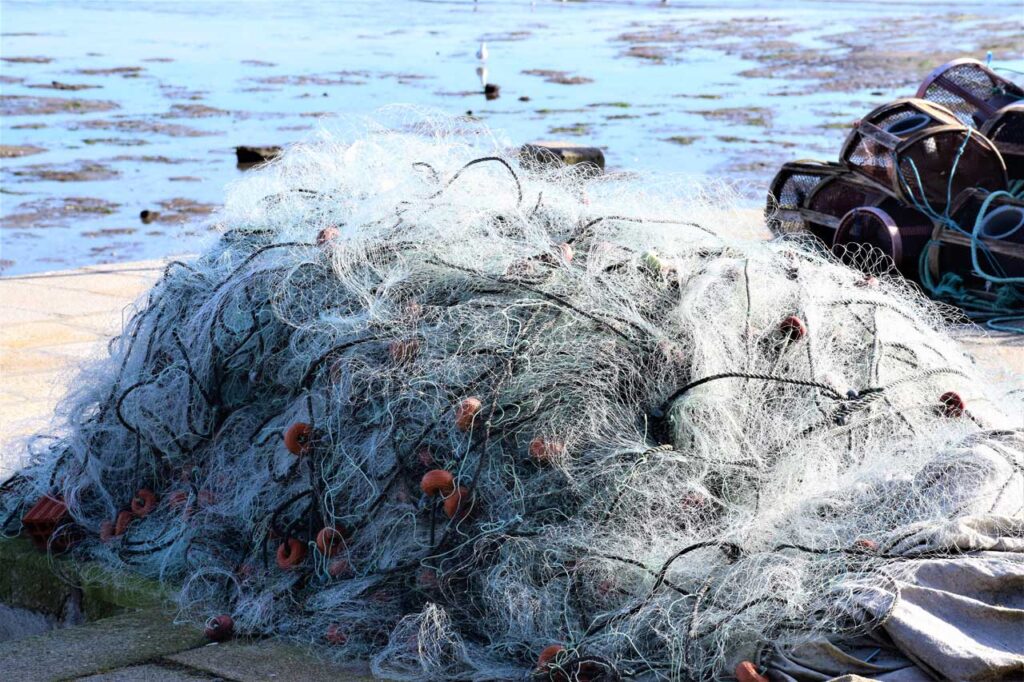
The art of drift gill used in Galician coastal areas, called "xeito," is, unquestionably, the oldest and primordial sardine fishing gear. It consists of an artisanal and sustainable gear that has been used by Galician fishermen for centuries to capture sardines at the entrance of the estuaries.
The "xeito" (gillnet) is a rectangular cloth extended between two ropes (tralla), the upper one, which consists of a buoyancy system allowing the cloth to float at a variable depth, and the lower one ballasted with weights allowing the cloth to sink into the water.
The cloth remains attached to the boat by a rope (tralla o relinga) of variable length, which allows the “xeito” through the boat. The cloth remains attached to the boat by a rope of variable length, which allows the “xeito” through the boat. The great advantage of this gillnet fishing gear is that it allows the selective capture of sardines, which are stuck to the cloth and have to be removed from it manually. This one by one task helps to avoid capturing another type of fish of different weight, which does not stick to cloth, and therefore, the small one is returned to the sea in this manual selection process.
Although the sardine is sold throughout the year, it is in summer when there are catches increase, and also, when it acquires a higher fat content, and thus, more flavor.
In Galicia, Portosín town (A Coruña) holds the largest volume of sardine auctions, followed in importance by Ribeira and, with less fame, Vigo. However, at Vigo's fish market, many ships arrive from other Galician ports.
To learn more
Inshore fishing, as well as deep-sea fishing, is a fundamental pillar of the Galician economy and the main source of income for many families.
It is carried out close to the coast; hence, its name "inshore," with small boats and artisan methods called minor arts. Normally, they fish during a period of no more than one day; therefore, anglers return to port every day. They customarily leave at dawn, at the first light of day, and then the catches are auctioned in the market of the port each day.
Each rig has a technique adapted to the type of fish to catch, so there are more than 40 rigs or gears authorized. They can be divided into a hook, gillnet, trawl, ring netting, traps, shellfish on foot or afloat, and diving.
Trawls are usually used to a greater extent in deep-sea fishing, but there are trawling gears that are typical of minor and inshore fishing, such as the beam trawler (bou de vara) and the basket rake (rastro). They are rigs towed from a boat, which are dragged in contact with the seabed to catch scallops, clams, and other similar mollusks.
The fishing fleet based in the port of Baiona consists of about 70 vessels, including an auxiliary (data from the Register of Fishing Vessels of Galicia 2019) with lengths ranging from 3.85 meters for the smallest artisanal boats to more than 14.30 meters for the largest. Moreover, shellfishing on foot workers are part of the group of fishermen since they are also users of the port.
Most of the fleet is made up of small tonnage boats for the Minor Arts, gillnets, fishhook gear, and artisanal fishing creels. To a lesser extent, there is an auxiliary service vessel intended exclusively for the auxiliary service of the main recreational vessel it serves; and one dedicated to longline gear in international fisheries.
To know it better
The sardine or European pilchard is a saltwater bluefish that belongs to the family Clupeidae, being this its only species. The body of this animal is elongated with small teeth, and the back stands out for its dark gray, blue, and silver colors. Its belly is white with silvery tones, and the fins are colorless.
La sardina asada es muy famosa en la cocina gallega. Su campaña comienza el 31 de mayo, y son muy solicitados el 24 de junio, día de San Juan (San Juan o San Xoán), ya que en Baiona y otras comarcas costeras, la sardina asada es el plato principal para celebrar esta festividad.
In Baiona, two fishing methods are used to catch sardines: bottom trawling and ring netting. The first, as its name implies, consists of dragging a large net along the seabed so that the sardines are trapped in the net. Nowadays, this technique is rarely employed due to the irreversible damage to other seabed organisms, such as corals. The second technique is ring netting, which involves encircling a shoal of sardines within a large net and then closing it to trap them.
Gallery
Location
- Town
- Baiona
- Municipality
- Baiona
- Province
- Pontevedra
- Country
- Spain
The asset
- Type
- Fishing gear
- Eco-destination
- Ría de Vigo
- Environment
- Natural
- Relevance
- Regional
How to get there
- Access
- By sea By land
- Distance
- 0 km
The visit
- Accessible
- No
- Parking
- No
Coordinates
- Latitud
- 42.11921400
- Longitud
- -8.84714600