


Infrastructure. Shellfishing afloat
About this heritage
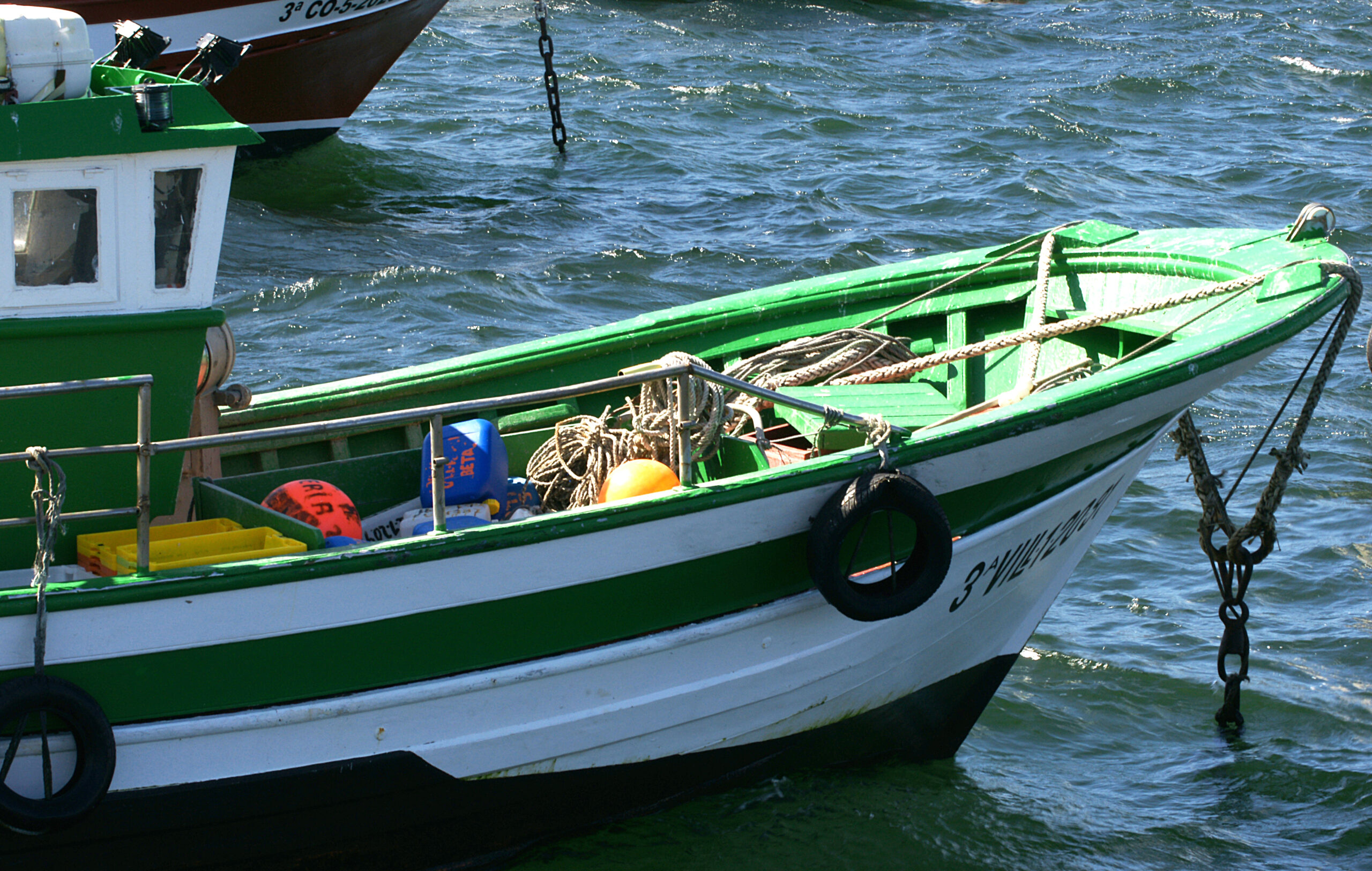
There are different shellfishing arts, and shellfishing afloat is one of them. It is carried out from a boat with manual or mechanical traction tools. The first ones are exclusively hand-operated utensils employed in shallow waters to catch mainly cockles, clams, or related bivalves while the latter ones are used in deep waters towed by the boat to catch King scallops or Saint James escallops (Vieiras), variegated scallops (zamburiñas), queen scallops (volandeiras), and oyster.
The manual traction tools are the rake or clam-rake (angazo), which has an eight to nine meters long handle and requires considerable effort. The shellfisherman throws it into the water, and then drags it along the seabed to catch cockles or clams, among other bivalves. The basket rake (Raño or gancha) is used as the clam rake; however, it is lighter and does not require much effort. Its basket is made of metal rods to capture different types of clams, among others, palourde clam (almeja) or venus clam (chirlas).
In shellfishing afloat with mechanical traction, they used the scallop rake tool, designed to capture different scallops, among others, king, variegated, queen scallops, as well as and oysters. The tool is towed by the boat dragging it along the seabed while this one removes the sand with its teeth and retains the prey at the top. Every so often, the fishermen bring the gear on board, remove the catches, and repeated the operation.
To learn more
In Galicia, shellfishing is organized through exploitation plans drawn up by the shellfish sector itself using the Fishermen's Associations or Shellfisherwomen's Groups. These plans are presented to the administration to be validated and included in the General Seafood Exploitation Plan that is approved annually.
Shellfishing is carried out along the entire Galician coast, and it has its higher importance and economic impact in the Arousa and Muros- Noia estuaries. Primarily, in these areas, the cockle catch represents 72% of the total in Galicia.
It is an aged sector, and the lack of generational relay is evident since 51% of the total of shellfish workers are over 50 years old, and only 4% are under 30.
The Baiona Fishermen's Association called "La Anunciada" (The Announced) is a public law, non-profit corporation, which acts as an advisory and collaborative body with the Administration to promote the fishing sector and represent the economic and corporate interests of all its professionals.
Its territorial scope extends from Abra Beach (Patos) to the Orelludas Islands, including the Estelas and Farallóns Islands.
The first sale of the catches is made in the Lonja by auction. It is in this first sale when the exit price of the product is established and labeled for the first time. The label must specify the catch area, contact details, the common and scientific names of the species, weight, production method, presentation - specifying whether the product is wild or aquaculture - details of the vessel, fishing gear, date of catch and dispatch, Fisheries mark, and traceability code.
To know it better
In Galicia, there are different ways to get fish and seafood. Shellfishing is the activity by which different species of shellfish are extracted and obtained. This activity has been developed for many years, and sometimes, it becomes particularly dangerous since female and male shellfish workers face strong swell when standing extremely close to the rocks.
They used two techniques to catch mollusks, one is shellfishing afloat, and the other is shellfishing on foot.
Shellfishing afloat is carried out from a vessel, that is, from the fishing boat or ship. Within this modality, there are two ways to perform it. On the one hand, the manual way, which forbids the use of mechanical devices for dragging. For this reason, utensils such as the rake are used to catch cockles or clams; the basket rake (Raño or gancha), which is lighter requires less effort, and finally, the mechanical way. The latter is authorized in Galicia for scallops, razor clams, clams, and shrimps trawling. This art is used in deeper waters, and supposedly, the boat tows the utensils, giving rise to a mechanical art.
Gallery
Location
- Town
- Baiona
- Municipality
- Baiona
- Province
- Pontevedra
- Country
- Spain
The asset
- Type
- Fishing gear
- Eco-destination
- Ría de Vigo
- Environment
- Natural
- Relevance
- Regional
How to get there
- Access
- By sea By land
- Distance
- 0 km
The visit
- Accessible
- No
- Parking
- No
Coordinates
- Latitud
- 42.11921400
- Longitud
- -8.84714600