
Mussel Infrastructure. Mussel Rafts
About this heritage
Curiously, the origins of mussel growing in Spain occurred in Catalonia in 1901, when Catalans began the cultivation of these mollusks on rafts or floating nurseries in Tarragona; however, soon decreased production due to lack of seed and low efficiency. In the '40s, in Galicia, they began to experiment with this type of cultivation with exceptional results, achieving the same growth in eight months as they did in two years in Barcelona.
At first, mussels growing was not of scientific interest because the subsector of aquaculture was not highly developed. Consequently, the spat collectors had to use their intuition, experience, and ingenuity to develop everything related to mussel breeding.
They built the first rafts by recycling existing vessels, such as boat hulls or catamarans, to get buoyancy. These ones were covered with cement to protect the wood and to fix the structure of the ropes to the rafts' deck.
Afterward, they refined and improved the designs, giving birth to the first raft with a central float. The floater was a wooden box covered with cement. Its use was widespread.
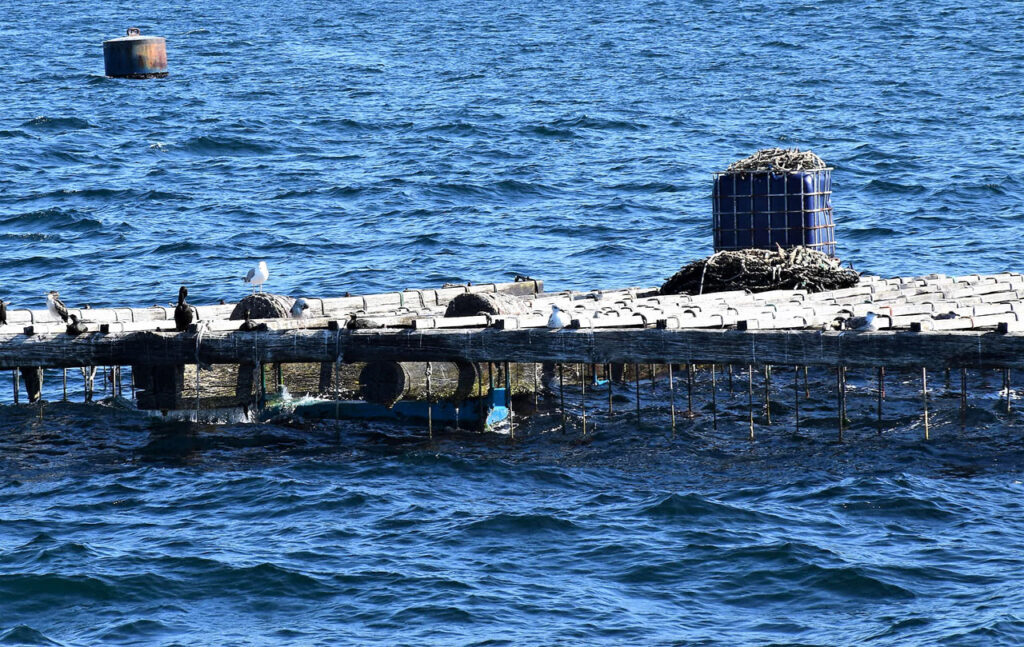
In general, a mussel raft is a floating body consisting of bow, stern, and sides, where the bow is the part intended for mooring. This floating part of the raft has a grating like structure, usually made of wood, from which the ropes hang, and also has fastening and culture systems.
They experimented with different models of rafts, such as those with a floating rectangular section, where the boxes were made of wood covered with cement. Another type with cylindrical iron floaters, originally covered with cement, but currently made of fiberglass, and other floating devices made of four or six polyester horizontal tube-shaped fixed from side to side.
They made all these modifications to solve problems with buoyancy, corrosion, and weight. They tried various materials to know which gave better consistency and flexibility since adverse weather conditions caused the ropes to "lash," thus, generating a loss of production.
The commonly used materials are eucalyptus to make the grating part and iron for the floats, the latter ones usually covered by fiberglass. An attempt was made to build an iron grating structure, but it turned out to be too rigid. They also used polyethylene, which is more durable; however, it had and has little success due to its price and rigidity.
Other complementary structures were used, such as a rigging employed in old hull rafts as well as the single float rafts when necessary to support the grating device. They used to build a hut on the deck of the raft when needed to perform the tasks. However, nowadays, the entire work is carried out onboard the mussel's auxiliary ship; thus, the hut is not necessary anymore.
To learn more
Since the Bronze Age, settlers took advantage of the low tide to collect mussels, limpets, and other mollusks found in coastal rocks. The Romans were the first mussel farmworkers, collecting them from the environment and transporting them to artificial nurseries. A Roman gourmet from the 1st century A.D., Apicio, invented a recipe that consisted of cooking the mussels in a sauce made with garum (fermented fish sauce), chopped leek, cumin, straw wine (raisin), savory, wine, and water.
The mussel’s culture, as it is known today, did not develop until the first decades of the twentieth century. In Galicia, an attempt was made to grow them in fences or stakes, but the origins of the mussel culture date back to 1901 in Catalonia. The Catalans began mussel culture on floating nurseries in Tarragona and later in Barcelona. The system quickly spread to other ports on the Mediterranean coast, and in the 1920s, there were around 156 rafts. This decade's production reached 2,700 tons a year. This system presented difficulties obtaining seeds, and due to the enlargement of the port facilities, the mussel farmers had to place their structures in other enclaves, reducing productivity.
During the 1940s in Galicia, specifically in the Vilagarcía port within the Arousa estuary, Mr. Alfonso Ozores Saavedra began experimenting with a different way of mussel breeding. He had been trying for some time to raise mussels on stakes and decided to change the method and move to a suspended culture.
A year later, Molins, following the advice of the biologist Oliver, who worked at the Spanish Institute of Oceanography (IEO), anchored the first rafts in the Vigo estuary. He got exceptional results, reaching identical development in eight months than in Barcelona in two years.
By 1945, the first mussel rafts were anchored in the Arousa estuary. These were a single floater of wooden cube-shaped, from which they hang the raw esparto ropes.
Onward, mussel culture in Galicia had a vertiginous development extending to Cambados, O Grove, Bueu, Redondela, and Pobra do Caramiñal.
In 1956, they installed 400 mussel rafts, and in 1967, the number rose to 2537. A decade later, it reached a density between 3100 and 3300 rafts. Moreover, from 1959-60 to 1975-76, the production rose from 51,000-61,500 Tm to 173500-192,000 Tm, making Spain the leading producer of mussels in the world.
In Spain, over the last few lustra, their harvest has remained between 170,000 and 240,000 tons. Production was stable, and inter-annual differences were due to incidents of red tides that prevented regular harvesting of mollusks. In Spain by 2018, the harvest was estimated at 273,600 tons, which became a record figure in the history of mussel production with a total first-sale value of 133.2 million euros.
There are five Spanish autonomous communities where mussels are cultured, Catalonia, Andalusia, Valencia, the Balearic Islands, and Galicia. It is precisely in Galicia, where production represents 97% of the total national mussels. Spanish aquaculture is a reference on a European and world level for the quantity and quality of its shellfish breeding.
To know it better
The mussel is a bivalve mollusk that lives in large rocky areas, where it attaches using parts of its foot. The mussels live at low depths in tidal zones; thus, the rafts or mussel platforms are used for their collection. These are structures placed neatly and accurately in the estuaries; in the Arousa estuary case, thick ropes called "maromas" hang from these constructions, where these renowned bivalves are cultivated of the Galician gastronomy.
The town hall of Vilanova de Arousa in the Pontevedra province within the O Salnés region is a place with antiquity, and thus, history. Since the 16th century, this municipality has always stood out as a fishing port, for supplying fish to the entire region of Castile. Moreover, the arrival of the Catalans set up salting and preserving factories. Nowadays, fishing and shellfishing activities are one of the most important of this area.
Galería
Location
- Locality
- Vilanova de Arousa
- Municipality
- Vilanova de Arousa
- Province
- Pontevedra
- Country
- Spain
The asset
- Type
- Rafts
- Eco-destination
- Ría de Arousa
- Environment
- Maritime
- Relevance
- National
How to get there
- Access
- By sea
- Distance
- 0 km
The visit
- Accessible
- No
- Parking
- No
Coordinates
- Latitud
- 42.56356800
- Longitud
- -8.83019900