
Octopus
About this heritage
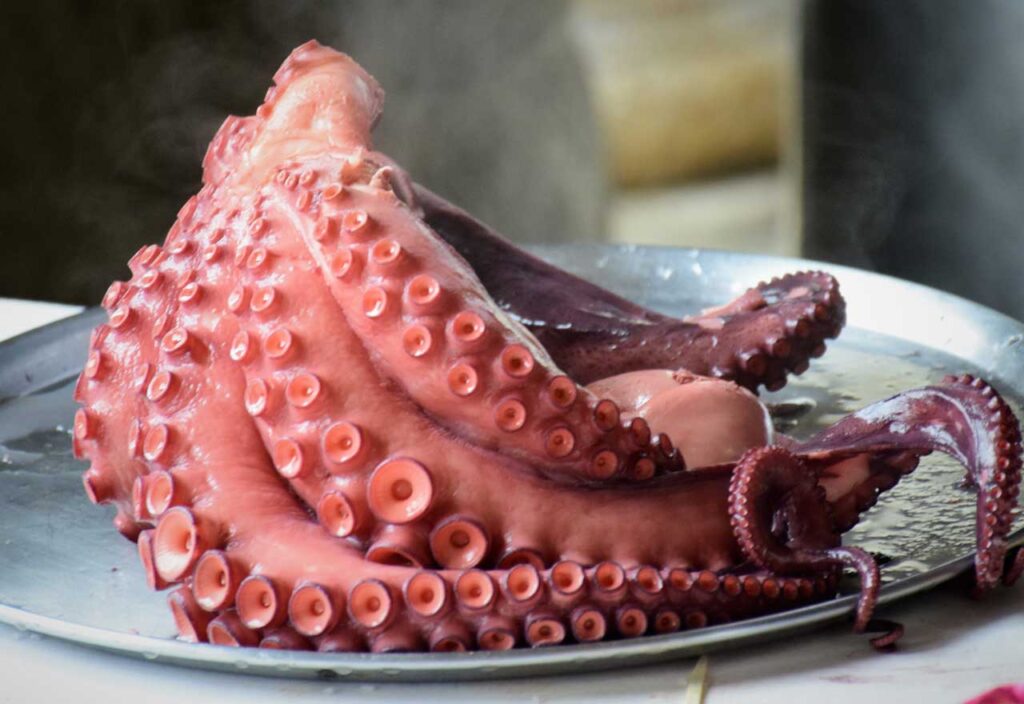
The common octopus (Octopus vulgaris; Cuvier, 1798) is a cephalopod mollusk with eight arms and a large head, under which it hides a mouth in the shape of a double beak (a parrot beak). It has two rows of suction cups or suckers on its inner side, unlike the curled octopus (Eledone cirrhosa; Lamarck, 1798), which has only one. It lives on rocky seabed in coastal areas, among rocks and stones, and sometimes in dens. It lives at depths of less than 200 m.
It feeds mainly on small crustaceans, such as crabs, as well as bivalves, fish, and carrion.
The octopus is an animal, which mimics its environment, making it difficult to see, even wrinkles its skin to make itself look like a rock with algae. Its coloration is very variable - orange, brown, yellow - that it changes at will. It has a muscular and flexible body and can hide in spaces ten times smaller than its size.
It can measure up to 40 centimeters in mantle length and 1.6 meters in total length.
The minimum legal catch size for octopus is 1000 grams.
In Galicia, the octopus forms part of the gastronomic culture. "A Feira" - literally meaning "fair-style octopus" - is the typical dish of Galicia par excellence: boiled carefully to not overcook it; hence, for forty or fifty minutes depending on the size, and without uncovering the pot, so to keep the same temperature and constant cooking. Before starting to boil it; it is recommended to scald it by introducing it three times in boiling water, once cooked and chopped, and before it gets cold, add a jet of virgin olive oil, salt, and sweet and hot paprika to one's taste. It is also suitable to serve it to the vinaigrette, cooked with onions (encebollado), or in caldeirada (Galician stew) according to the recipe of the Ons Islands. It is also delicious in empanada (pie-like), in rice and potatoes stew, or with a rustrido (onion sauce) to the Mugardesa (stew typical of Mugardos area in Ferrol).
To learn more
There are more than 800 species of cephalopods, which are distributed at different depths in oceans worldwide.
The word cephalopod comes from the Greek kephale (head) and podos (feet). They are invertebrate organisms, so they have no bones in their bodies. They have rows of suckers along their limbs.
They have small spots in their skin, called chromatophores, which are pigmented cells that help them camouflage by changing color.
Octopus belong to the class Cephalopods, which includes nautilus, cuttlefish, squid, as well as fossil nautiloids. The genus octopus is characterized by their benthic habits. Their body is globular and sac-shaped, and they have no fins. Although they can swim, they normally crawl over the rocks among which they live. They use their arms, which are equipped with adhesive suction cups, as locomotive organs.
They can also propel themselves with its eight appendages and use the siphon for both breathing and locomotion by expelling a jet of water.
They have a complex nervous system, excellent eyesight, and are among the most intelligent and behavioral diverse invertebrates. They live in galleries located inside cracks or holes. These animals make excursions in search of food or hunt stalking near the entrance of their refuge. They live in galleries located inside cracks or holes. These animals make excursions in search of food or hunt lurking next to the entrance to their refuge. Clams, snails, and crustaceans are their typical prey. Some of these are ingested during the fishing outings while others are taken to the burrow and then devoured. Therefore, octopods usually have a dumpsite near the opening of their refuge.
During breeding, the male uses a specially adapted arm to deliver a bundle of sperm right into the female's mantle cavity, after which he becomes senescent and dies. The female deposits fertilized eggs in a cave and cares for them, oxygenates them, and protects them until they hatch. During this period, the female does not feed or leave the cave and can even eat part of her arms.
In Galicia, the life cycle of the octopus is approximately two years. The main reproductive period occurs in spring, and consequently, the recruitment period (individuals up to 300 grams in weight) is spring-summer of the following year. The fleet working with artisanal fishing creels, basically, exploits a single annual cohort.
Since 1992 and in most years, the octopus fishing in Galicia set the closing season in the months of May and June, as a technical measure to protect the reproduction of the species and contribute to more sustainable exploitation. Therefore, and to adjust fisheries management to the species life-cycle, they considered reasonable to start the fishing season after the closure and end it right at the beginning of the following closure period.
For professional fishermen in Baiona, the most conventional method to catch octopus is by using "nasas," which are artisanal fishing creels. This trap-creel is a type of passive fishing gear, consisting of a rigid frame cover with a net, and a narrow opening or mouth. This access in the creel allows the cephalopod - lured by the bait set inside - to enter easily but make its exit nearly impossible.
The average catch in the last five years of the octopus (Octopus vulgaris) was about 44,316.60 kg/year, which represents 24.82 % of the total annual catch in the Baiona fish market. This generated, for the same period, an average income of 276,584.27 euros per year.
To know it better
One of the most typical dishes in Galicia is the Galician-style octopus ("A Feira"). This animal known as octopod – a Greek word meaning "eight feet" – is one of the most intelligent invertebrate animals and is part of the mollusks. Its body is soft without shell and has eight arms to move, take objects, and defend against specific attacks.
It is striking that the octopus has three hearts: two of them, the branchial hearts, are responsible for moving blood to each of the two gills while the third, the systemic heart, circulates blood around the body. Moreover, in its body, it holds the siphon used both for respiration and for locomotion, by expelling a jet of water.
For professional fishermen in Baiona, the most conventional method to catch octopus is by using "nasas," which are artisanal fishing creels. This trap-creel is a type of passive fishing gear, consisting of a rigid frame cover with a net, and a narrow opening or mouth. This access in the creel allows the cephalopod - lured by the bait set inside - to enter easily but make its exit nearly impossible.
Gallery
Location
- Municipality
- Baiona
- Province
- Pontevedra
- Country
- Spain
The asset
- Type
- Fish product
- Eco-destination
- Ría de Vigo
- Environment
- Urban
- Relevance
- Regional
How to get there
- Access
- By sea By land
- Distance
- 0 km
The visit
- Accessible
- No
- Parking
- No
Coordinates
- Latitud
- 42.11921400
- Longitud
- -8.84714600