


Roman Salt Deposits

About this heritage
The salt deposits of A Guarda are part of the largest salt exploitation complex documented of the Roman Empire, which covers other areas of the peninsular northwest such as Vigo, Cangas, Oia, Viana do Castelo and Matosiños.
The salt has always had a great importance since ancient times, its history is closely linked to the economic transactions of the history of humanity, an activity that has left names such as salary. It is an indispensable raw material for the salting industry. So the discovery of the salt ponds indicates the value and relevance of this area for the production of salt in Roman times.
In their most rudimentary form, the basins were cut out by pecking large rocks about two centimetres deep, resulting in a sinking where a small amount of brine could remain stagnant to evaporate evenly and harvest the salt contained in it.
Salinae are called those formed by a serial of quadrangular-shaped pits, delimited by shale or granite slabs, which are systematically arranged together, and which are lined by a floor of impermeable clay, sometimes compacted with gravel, and arranged on a levelling preparation that may be formed by slabs.
Seawater entered directly into the ponds with the force of the tides; it then flowed from one pond to another, evaporating progressively by the action of the sun, until its final crystallization.
The salt deposits can be found following route PRG-160 in the area of O Seixal, Camposancos I in A Armona and Camposancos II in O Puntal.
To learn more
The salt deposits of A Guarda are part of the largest salt exploitation complex documented of the Roman Empire, which covers other areas of the peninsular northwest such as Vigo, Cangas, Oia, Viana do Castelo and Matosiños.
In their most rudimentary form, the basins were cut out by pecking large rocks about two centimetres deep, resulting in a sinking where a small amount of brine could remain stagnant to evaporate evenly and harvest the salt contained in it.
Salinae are those formed by a series of quadrangular-shaped pits, delimited by shale or granite slabs, which are systematically arranged together, and which are lined by a floor of impermeable clay, sometimes compacted with gravel, and arranged on a levelling preparation that may be formed by slabs.
Seawater entered directly into the ponds with the force of the tides; it then flowed from one pond to another, evaporating progressively by the action of the sun, until its final crystallization.
The salt deposits are found in different areas such as:
- O Seixal-Fonte Quentes is located in the coastline, between the towns of A Guarda and Camposancos, in an area of small cliffs, sedimentary sands and beaches of pebbles and rocks, located at the foot of the strong slope that creates the western slope of the granite elevation of Mount Santa Tegra.
- In Armona the Camposancos II there is an interesting group of salt ponds slightly distant from the coast, located about 300 metres in a straight line with the current sea level. It is made up of 20 or 30 individual salt flats, arranged in several groups.
- Or Puntal, where the Camposancos II salt ponds are located to the north of the Miño river, here there are more than 50 individual salt ponds that are frequently found forming groups.
The excavation led by Brais Currás, researcher at the University of Coimbra, of the CSIC's EST-AP research group within the project "A Guarda, Mar de Sal"(A Guarda, Sea of Salt) and Mar Cortegoso, director of excavations, advanced in the research on the salt deposits of O Seixal and Camposancos.
To know it better
The City Council of A Guarda, in the province of Pontevedra, has been developing since 2015 a complete project for the recovery of the O Seixal salt deposits. In this place different excavations have been carried out to find out more about the past of this municipality.
Thanks to the research derived from the project A Guarda, Mar de Sal and the students of the universities of Coimbra, Vigo and Santiago de Compostela, some old salt ponds of the Roman era have been discovered in this place. Salt water from the sea was allowed to evaporate to seize its salt, dry it and market it.
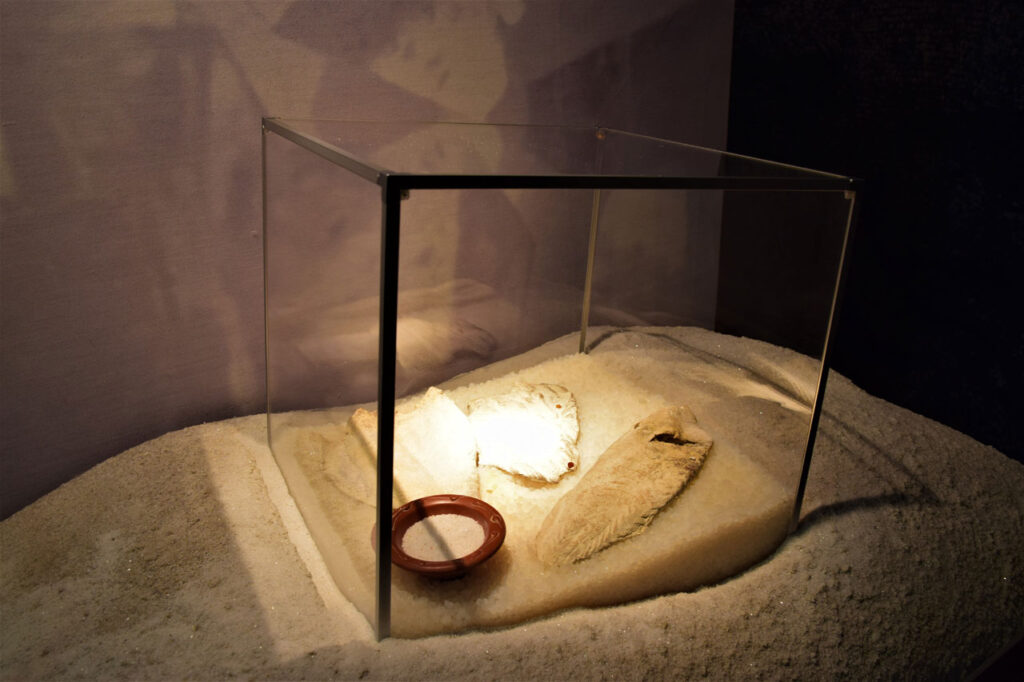
The salt deposits of A Guarda were an important trading point throughout the Roman Empire. The salt extracted from the coastline of ancient Galicia was used mainly to produce fish salting, which is so important on the north-western coast of the Iberian Peninsula.
Salting is possibly one of the oldest gastronomic specialities in our country. It is a method designed to preserve food, so that it is available for consumption for a longer time. The effect of salting is the partial dehydration of food, the reinforcement of flavour and inhibition of some bacteria. Its origin goes back to the Bronze Age, when it was necessary to keep fish in an optimal way during transport and trade, which at that time could last several days.
Although in most cases this method is used for salting fish, this method of preservation is also suitable for meat, fruit and vegetables.
Gallery
Location
- Town
- Vigo
- Municipality
- Vigo
- Province
- Pontevedra
- Country
- Spain
The asset
- Type
- Salt flats
- Eco-destination
- Ría de Vigo
- Environment
- Natural
- Relevance
- International
How to get there
- Access
- By land
- Distance
- 2,9 km / 5 minutos en coche
The visit
- Visitable
- Only outside
- Interpretation
- No. There is only one information panel in each of the salt flats
- Accessible
- Sí
- Parking
- Sí
- Signposted
- Yes
- Website
- turismodevigo.org/es/salinae
Coordinates
- Latitud
- 42.23814300
- Longitud
- -8.71735900