


SEAFARING DISTRICT. Boats afloat. The Gamela
About this heritage
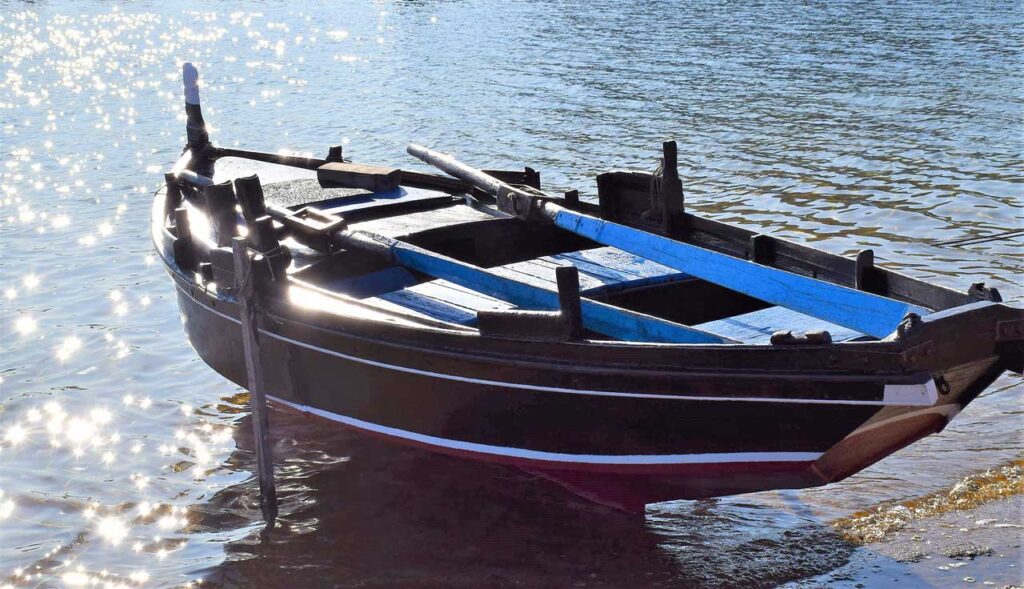
The Gamela is a traditional sailing or fishing Galician boat of simple construction and made with remarkably wide boards. The one from A Guarda seems to be the oldest traditional boats known in the South Estuaries (Rías Baixas).
They were built entirely of pinewood, with just five boards, and a characteristic rectangular shape, although slightly curved at the bow.
It is a small wood boat of about 5 meters long. It has a flattened bow and stern and a flat bottom that navigates by rowing or sailing. Currently, the stern area has been modified to adapt an outboard engine.
It takes its name from a container, derived from the Latin "camella," which means, "drinking glass", although it was later called "artesa" or "maseira", a large container for kneading bread. Therefore,in Portuguese coastal areas, this traditional boat is called "masseira."
The term "gamela" spreads along, practically, the entire coast of Galicia referring to any flat-bottomed boat, including the different types of barges.
In the Val Miñor area, the "gamela" was par excellence the most used boat; it is said that the Baiona's one was such a characteristic that the sailors could distinguish it from the Panxón's one by listening to the sound of their oars.
The first weekend in August brings to Baiona, the traditional festival of "La Anunciada." Among the festivities, the “gamela” regatta is one of the key events, a competition in which the resistance of those who dare to grip these long oars is put to the test.
To learn more
Other types of “gamelas” often have small differences to adapt to the peculiarities and fishing habits of each estuary. Therefore, A Guarda’s gamela has a smaller length-width ratio than the Coruxo’s one (coruxeira), making it wider and more curved at its bottom, which is required in those coasts with stronger swells. The carpenters of Coruxo riverside in Vigo built the “coruxeira,” originally, as an evolution of A Guarda’s model. This typology - also known as “bacía” - includes the gamelas of Cangas, Oia, and Baiona.
It is smaller than the other variants, it is more stylized and narrower, with a flatter and more curved bottom, which makes it easier to beach on the seashore while working in rocky areas near the coast. Usually, it has corridors, bow and stern decks, and benches. When using sails, they are lugsails with a considerable boltrope.
There is also the Redes' gamela from the Redes port in the Ares Estuary, which differs by an almost uniform width, curved ends, and the overall elongated rectangular stern.
The neighboring Portuguese's gamela is similar to the "coruxeira." However, in Vila Praia de Âncora in Viana do Castelo and other nearby ports are called "Masseria," a traditional boat whose origin resides in the A Guarda's gamela (guardesa).
The Cambados' gamela, like a dorna (traditional Galician fishing boat), has at a panel and foresheet (the inner part of the bows of a boat) at its bow, and side corridors on its deck.
It can reach considerable sizes; it has a large helm and can sail with oars or with lateen-sails and was dedicated to both trawling and shellfishing afloat.
Typical of the village of Albariño was the "loro" (parrot), a gamela designed to row and not sail. Therefore, its stern is narrower and its bottom has a greater curvature. Moreover, its scarce draft allowed it to work easily in the shellfish banks even with little water.
The Cabo de Cruz' Gamela combines the dorna's richness structure and the gamela's simplicity. A mixture that gathers the virtues of both to adapt it to trammel fishing and shellfishing within the Arousa Estuary.
One of the typical traditional boats in the South Estuaries (Rías Baixas) area is the Dorna, made of wood forming a clinker-built structure (tingladillo) and characterized by its navigability both rowing and sailing. It is believed to have a Viking origin due to its resemblance to the "Drakkar" boat used by the Scandinavians. The remains of these vessels - abandoned during the invasions that attempted to besiege the coast - served as a pattern for the naval carpenters to create the new boat of that period.
Another of the traditional vessels is the Galician Galleon or the Estuaries Galleon, which, due to its large size, was used for transporting goods and fishing between the main ports of Galicia. Built with oak and pine wood, they were used approximately until the '60s, and many of them were later used as mussel rafts in some of the Galician Estuaries.
The "trainera", originally from the Cantabrian coast, arrived in Galicia around 1900, coinciding with the rise of the salting industry. In the beginning, they were used mainly for sardine and horse mackerel fishing. It had between six and eight benches, driven rowing or sailing, and characterized by its easy adaptability and lightness. Competitions of "traineras" are as frequent in Cantabria as in Galicia or in the Basque Country.
To know it better
In Baiona's historic center, we can find the House of Navigation, also known as the Carvajal House. Where it is revealed, the crucial role played by this Galician port in the history of Atlantic navigation, since this was the first port in Europe to receive news of the discovery of America. Moreover, in 1493, Captain Martín Alonso Pinzón docked, in its Galician waters, the Pinta caravel.
In the early 15th century, Portugal and Spain used caravels vessels. They differed from the "naos" - a large old sailboat with bow storage room - as they were smaller and lighter. Even so, the Gamela is a traditional fishing boat commonly used in Galicia, especially in the Vigo Estuary. It is characterized by its pinewood construction and, although most of them are currently motorized, they were previously sailed vessels.
Baiona is a county in the province of Pontevedra, located to the south of the South Estuaries (Rías Baixas) and stands out for being a seafaring district for many years.
Gallery
Location
- Town
- Baiona
- Municipality
- Baiona
- Province
- Pontevedra
- Country
- Spain
The asset
- Type
- Fishing neighborhood
- Eco-destination
- Ría de Vigo
- Environment
- Natural
- Relevance
- Regional
How to get there
- Access
- By sea By land
- Distance
- 0 km
The visit
- Accessible
- No
- Parking
- No
Coordinates
- Latitud
- 42.11921400
- Longitud
- -8.84714600