
Bueu. Historical centre and seafaring district
About this heritage
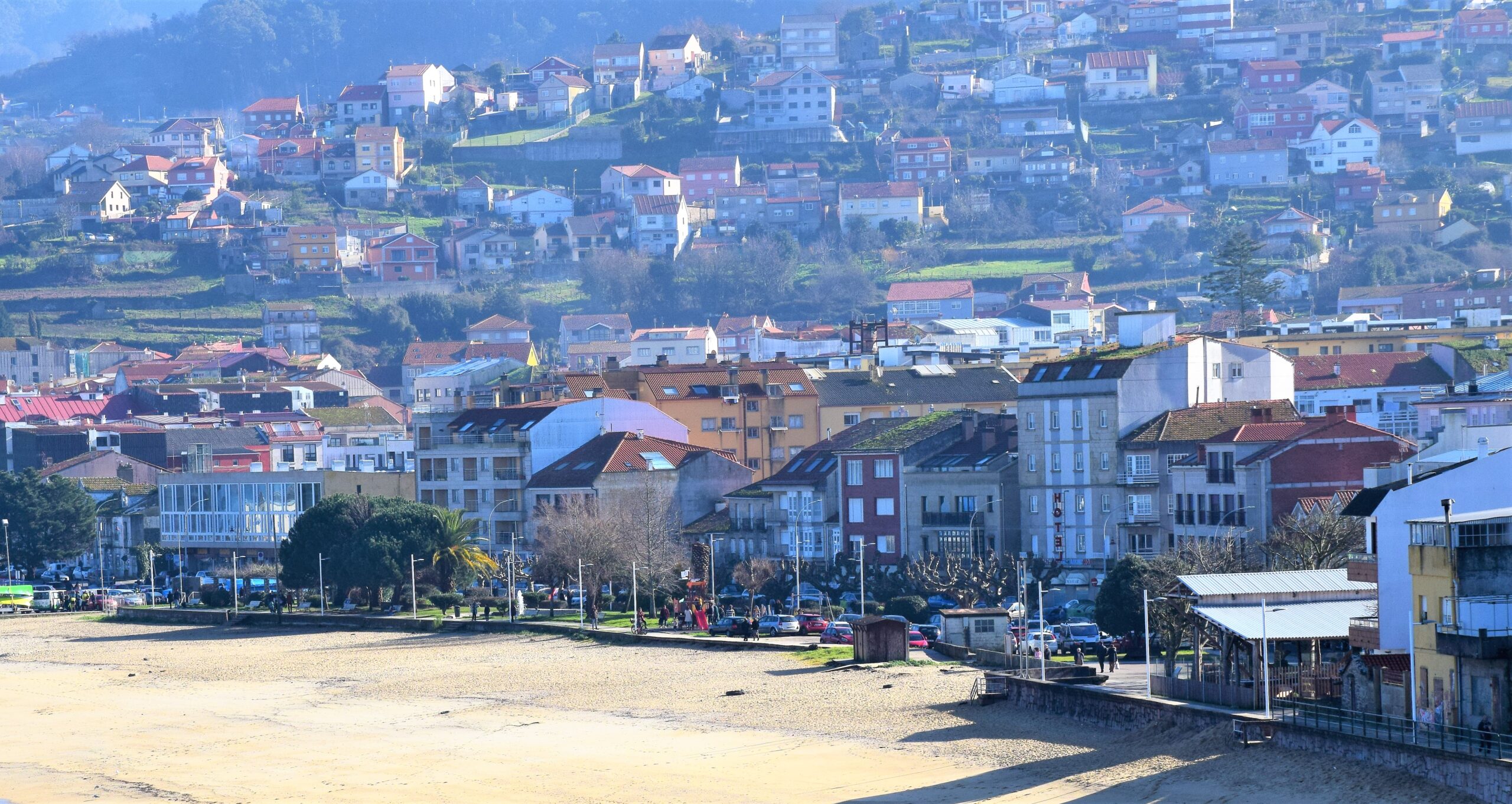
Bueu is located in Pontevedra´s province, in the Rías Baixas region. The fact that is situated in a natural valley means that is sheltered within the estuary; it has an oceanic climate with mild temperatures all year round.
The name of “Bueu” comes from “Buhedo” which means swamp terrain. It is a seafaring town divided into three parishes: Bueu, Cela and Beluso, and which has about 13.000 inhabitants and a sea-based economy.
These lands have been inhabited since prehistoric times, as it can be seen from the burial mounds, petroglyphs, and Roman remains that can be found in Bueu.
In addition, Bueu has the archipelago of Ons and Onza, which are part of the Maritime-Terrestrial National Park of the Atlantic Islands of Galicia, it also has the natural area of Cabo Udra which is a “Special Protection Area” (ZEC) of the Natura Network 2000, with numerous white sand beaches and other natural sites.
Bueu is famous for its salting factories. At the end of the 19th century, the so-called “Fomentadores Catalanes” (Catalan promoters) arrived here and, seeing the potential production of the estuary, they settled down to set up numerous preserving factories of this type. Along the municipality´s coast there were about thirty factories in operation.
But its beginnings go back to the Roman period and within the city of Bueu interesting remains of this historical stage were found.
In the urban beach of A Pescadoira, there is a site from the Roman period consisting of the remains of a Roman village, a salting factory and also the discovery of ovens for making amphorae. It is curious that, in the same location where this elements were found, the Alonso canning factory (currently located elsewhere) would have been installed later.
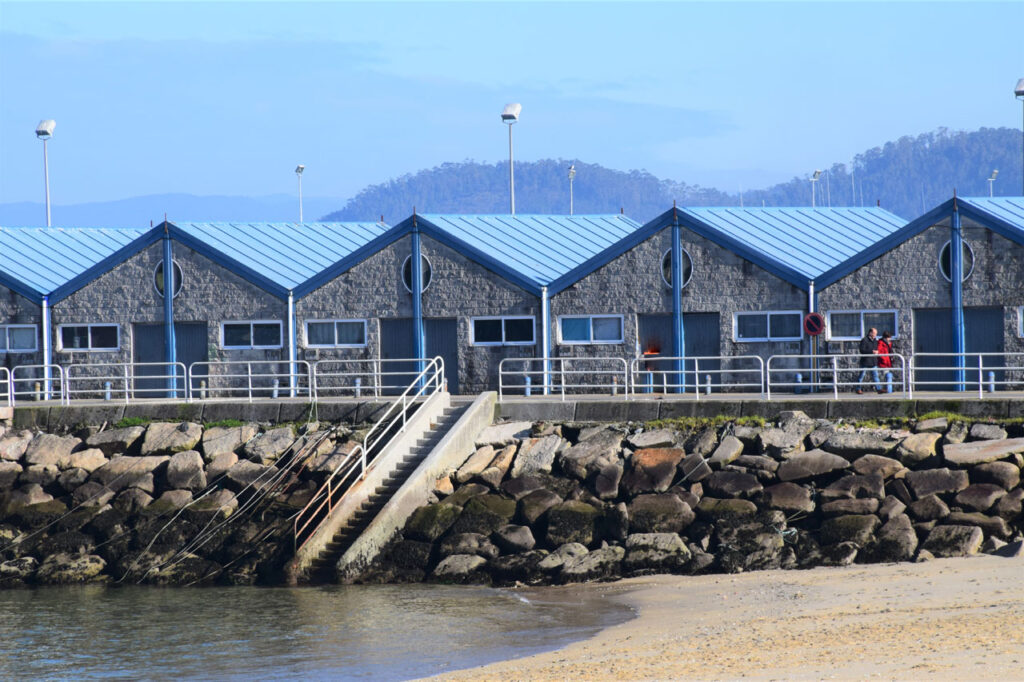
Bueu´s urban beaches are old ports, the pier is relatively recent, from the 60s. The Romans would stop their boats on the beach or use small wooden docks for unloading fish, with stakes placed on the beach as the Massó factory did.
The Massó canning factory had a great repercussion in Bueu, practically the whole town was related to this canning industry. Men used the traditional boats for fishing such as the dorna or the “Xeiteiro” boat (Galician boats), but they also imported others from the Basque country such as the trawlers that were faster. When the men used to return back from the sea -to fish for sardines-, a siren sounded in Bueu, and all the women who worked for Massó left their chores and went to the factory to clean the sardines.
Catalan businessmen innovated “salting” in three concepts, trawling nets, new sailing techniques based on pressed salt, and new work systems with the privatization of equipment and salaried work.
So in Bueu, there are still remains of this industry as in the Massó square that preserves the factory chimney, so that one can get an idea of the dimension. It also has the Massó Museum, where many of the factory´s gadgets, fishing equipment and boats remains are collected. Apart from the family´s collection who donated it to the village.
With the advent of the canning methods this factory was modernized and adapted to the new modality. Another subsidiary was also built in Cangas, which at the time was the largest canning factory in Europe.
Bueu is characterized for being a seafaring town where you can find houses that look to the urban beaches, also elements like the rest of the Purro´s shipyard, place where it was made Ribeira carpentry and built the boats needed for sardine fishing. It is located in an area called “Banda do Río”, near a small stream that they used to “treat” the wood.
In Bueu´s port, there is a lot of fishing activity and its most important catches are octopus, barnacle and razor. The fish market auction this sea-products at different times, and the supply square, located nearby, sells them in the morning and afternoon to ensure the freshness of their catch.
To learn more
Bueu is a municipality open to tourism, but it maintains its fishing heritage. It has a busy port and a star product in the estuary, the octopus.
The “San Martiño” guild of Bueu created the collective brand of octopus from the artisanal fishing “Polbo das rías” (Octopus from the estuaries). This brand allows the consumer to differentiate and guarantee the quality and origin of the octopus they catch.
The octopus festival is celebrated at the beginning of August, where this cephalopod can be tasted in different ways.
Another jewel that can be seen in Bueu, is located in the village´s centre. It is the “Estaleiro de Purro”, where Ribeira´s carpentry was developed. This place, is included in the “General Inventory of Cultural Heritage of Galicia”, since 2011.
It has a very unique structure, the original carpentry was the part with tiles, everything else was added later, which was done according to the volume of work, and to the need.
Founded in 1920 by the carpenter José del Río Casal, its enclave is on a sheltered beach in the place called A Banda do Río. In this Bispo river, the wood was treated by burying it for months and then moulding it.
“Gamelas”, “Chalanas”, “Xeiteiras”, “Polbeiros” boats (Traditional Galician boats for different kinds of fishing and shell-fishing) and even trawlers were built in this shipyard. Larger vessels were also built. It is even said that one of them was so long that it reached the balconies of the houses.
With the implantation of the shellfish-beds (known as “Bateas” in Spanish) in the Rías Baixas, a new market was opened in the last year of this shipyards operations. Currently the association “Os Galos” uses it to repair traditional boats and even to build new ones.
To know it better
Bueu is a coastal and seafaring municipality located in the province of Pontevedra. It belongs to the O Morrazo region, together with the municipalities of Marín, Cangas do Morrazo and Moaña. Bueu is considered as a Town Council since 1836 and its main economy source has always been fishing and all the activity related to the sea sector.
Furthermore, it has always stood out for its history, as different archaeological constructions belonging to the Palaeolithic period have been found, as well as later Roman settlements such as the Pescadoira salting plant from the 2nd century. This last one, is considered to be one of the most important of the Roman era, along the Atlantic coast. The salting technique is one of the oldest, it was used to make the fish last longer in a good condition. This consisted of dehydrating food, that is, salting, washing, and drying it.
On the other hand, and thanks to different excavations carried out in this territory, a 2000 year old oven has been found in Pescadoira itself. At present, the Town Council is planning to carry out a project for the conditioning of these remains for their better conservation.
Gallery
Location
- Locality
- Bueu
- Municipality
- Bueu
- Province
- Pontevedra
- Country
- Spain
The asset
- Type
- Old town
- Eco-destination
- Ría de Pontevedra
- Environment
- Urban
- Relevance
- National
How to get there
- Access
- By sea By land
- Distance
- 200 metros
The visit
- Accessible
- No
- Parking
- No
Coordinates
- Latitud
- 42.32693000
- Longitud
- -8.78424000