
Sálvora Island. Con De Lapegar.
About this heritage
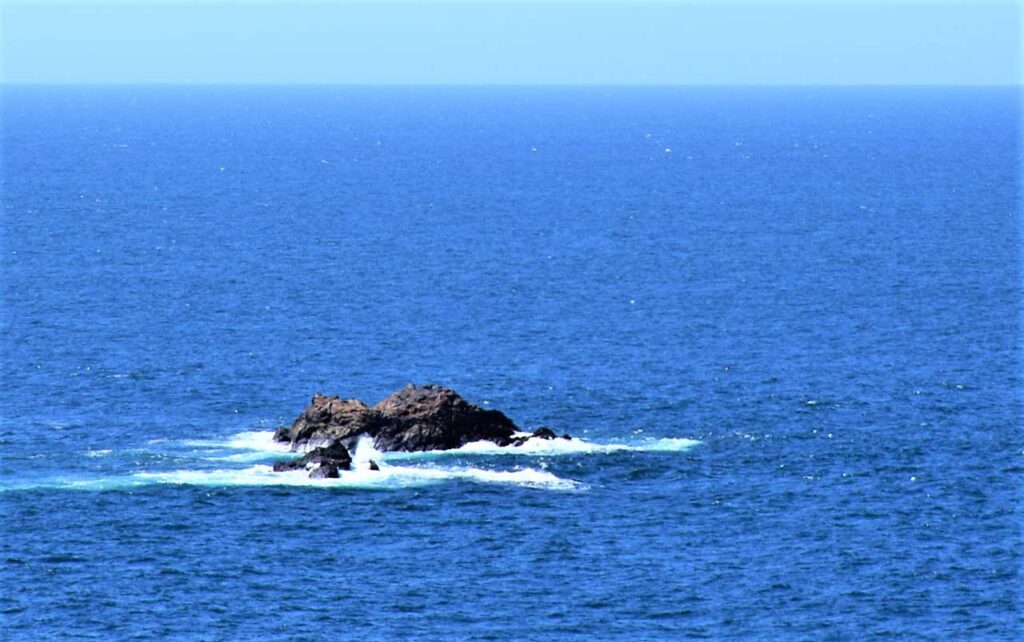
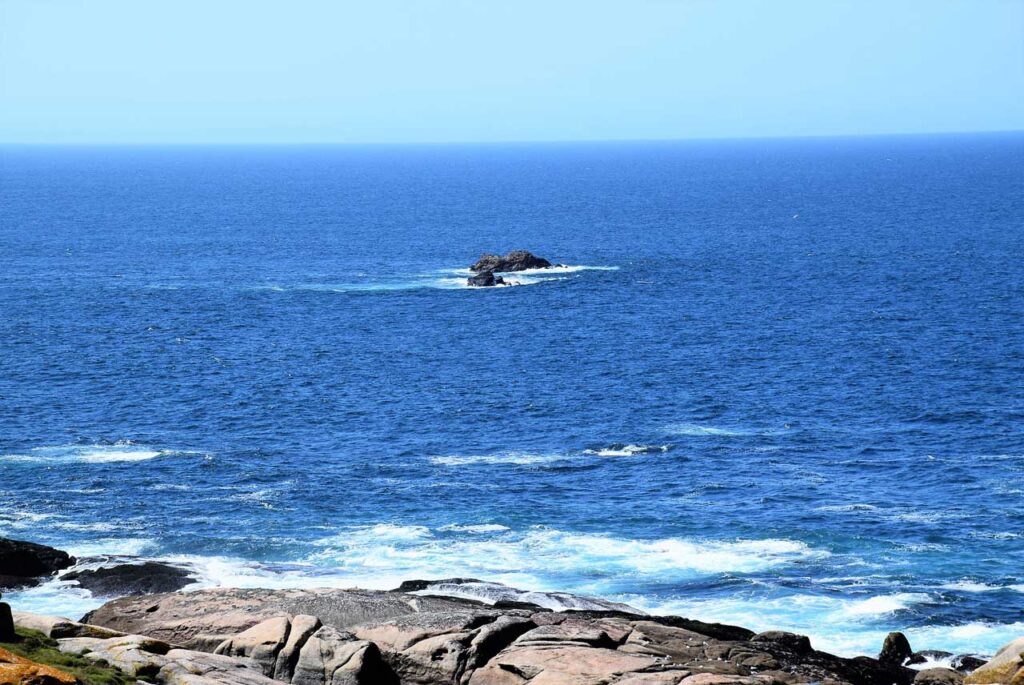
The Con de Lapegar is a large rock located to the right of the Sálvora's lighthouse, getting a little towards the sea. This rock has an oval and elongated shape, and the beating of sea waves can be observed when the tide is low. When the tide rises, it is nearly submerged and can only be intuited.
The fact that it is large and extremely close to the surface poses a great danger to ships that on stormy nights, can encounter misfortune off the Sálvora’s coast.
Such was the case of the "Santa Isabel" on January 2, 1921, in the middle of a storm, in front of the old lighthouse; a great roar was heard on the black night of the island. The frightened lighthouse keeper came out and could guess that a shipwreck had occurred from the screams heard near the beating of the ocean waves.
The "Santa Isabel" was a steam mail ship that had departed on January 1, 1921 from the A Coruña port. It had come from Bilbao, Santander, and A Coruña full of illusions and hopes of prosperity towards a new life since, at that time, emigration to the Americas was the answer to poverty and stagnation situation. This ship would have to stop in Vilagarcía and continue to Vigo and then Cadiz to transfer to the transatlantic "Queen Victoria."
The tragic accident took the illusions of 213 people who collided irretrievably with their rocks when trying to swim to the shores of Sálvora.
About 56 people, 29 of whom were crew members, were saved by the rescue action of the women of Sálvora. Specifically, there were four of them – today, known as Sálvora's heroines – who bravely took a traditional boat called “dorna” and went out into that raging sea and set out to aid the castaways.
To learn more
The shipwreck of the "Santa Isabel" occurred during a terrible storm in the early morning of January 2, 1921. At that time on the island of 60 inhabitants, only 25 people remained in it: mostly women, children, and the elderly since its men and some families had gone to the mainland to sell seafood and spend the beginning of the year. Because of the storm, they had not yet returned, as on other occasions.
The "Santa Isabel" was a steam mail ship that had departed on January 1, 1921, from A Coruña's port. It came from Bilbao, Santander, and A Coruña full of illusions and hopes of prosperity towards a new life since, at that time, emigration to the Americas was the answer to poverty and stagnation situation. This ship would have to stop in Vilagarcía and continue to Vigo and then Cadiz to transfer to the transatlantic "Queen Victoria."
The first to notice was the lighthouse keeper, who heard a terrible uproar and the cries of the ship's passengers, and he ran out to the village to call for help.
Three small boats rushed into the dangerous sea trying to save some lives. One of the boats went to Ribeira to inform about the shipwreck since for lack of electricity, the ship had not been able to issue any distress message, except a telegraphed one that read: "We are Salv...," which was understood as "We are saved."
In another boat, three sailors from the island navigated, and in the third one, three women – almost girls – set sail into the sea: Cipriana Oujo Maneiro (25 years), Josefa Parada (16 years old), and María Fernández Oujo (14 years). Another one, Cipriana Crujeiras, added her grain of sand by alerting about the shipwreck so that a rescue could be launch, and the rescued could be treated at the shore.
The children also played a key role as they took all the village sails and placed them on the rocks, in safe areas where the shipwrecks could arrive at a seating.
Of the 213 people on the ship, 56 people – 29 of whom were crew members – were saved by the rescue action of the women of Sálvora.
Luis de Cebreiro, the "Santa Isabel" ship's second officer, was also a hero, who would go down in history. Cebreiro decided, with great courage, not to climb into the lifeboat to avoid tipped the boat over. He was a burly man two meters high, who chose to swim shore. He was the driving force behind maritime studies and the sea rescue service and was the most decorated marine merchant of the last century for his heroics.
To know it better
The island of Sálvora was a haven for pirates and buccaneers until the 19th century. Currently, it has a magnificent landscape, with beaches and dunes surrounded by marine flora and fauna.
In 1921, there was a shipwreck and the sinking of the Santa Isabel vessel due to adverse weather conditions. The ship carried 266 people on board, counting the crew and passengers, of whom only 56 survived thanks to the help of countless villagers.
Ribeira is a county in the province of A Coruña that has one of the most significant fishing ports in Galicia. It belongs to the region of North Arousa and is divided into the following parishes: Aguiño, Artes, Carreira, Castiñeiras, Corrubedo, Oleiros, Olveira, Palmeira and Ribeira.
In front of the Arousa estuary`s opening, right at the town hall of Ribeira, we find the Island of Sálvora. This island is included in the Nacional Park of the Atlantic Islands and is the only one belonging to the province of A Coruña.
Gallery
Location
- Locality
- Ribeira
- Municipality
- Ribeira
- Province
- A Coruña
- Country
- Spain
The asset
- Type
- Island
- Eco-destination
- Ría de Arousa
- Environment
- Natural
- Relevance
- International
How to get there
- Access
- By sea By land
- Distance
- 1,200 km
The visit
- Visitable
- Yes
- Interpretation
- Information panels and signage: The National Park has a welcome information panel in Sálvora at the end of the port. It contains a specific map of the archipelago, with points of interest and authorized itineraries, as well as a general map with the situa
- Accessible
- No
- Parking
- No
Coordinates
- Latitud
- 42.45923200
- Longitud
- -9.01958000